Pages

Showing posts with label Sport. Show all posts

Thursday, 23 March 2017

Formula 2017

This Sunday sees the opening race of the 2017 FIA Formula 1 World Championship season. On Monday night, with this in mind, a peculiar thing happened to me: the wife said that she was getting more interested by the F1 races. This is presumably due to her continued hazardously toxic exposure to me, but whatever the reason, she said it and there are no take-backs. As a result, I plan to spend this season trying to indoctrinate her to my own poisonous ends: i.e. watching motor racing all the time.

To this end I thought I should begin with a pre-season primer, a broad sweep looking at the coming Grand Prix year and pointing out some potential areas of interest. Maybe it will work on her. Maybe it won't, but it will work on you. I hope so. Formula 1 motor racing, even when it is at its most soporiphic and tedious (which is anything up to 85% of the time), is GREAT and I love it.

THE FORMULA

Formula 1 is called "Formula" 1 because the cars are designed to a formula: that is, regulations which stipulate everything about the dimensions of the car, the specifications of the tyres it is allowed to run and the size and type of engine. If you didn't know that, I have just BLOWN YOUR MIND.

This year, the Formula has changed. Cars are now wider than they were last year, with bigger tyres which offer more grip and more downforce - 35% more downforce, in some cases - coming from the increased allowances in the size of the aerodynamics. The effect of all this is increased performance, a much needed change since the previous formula, which began in 2014, had seen the drivers forced to drive their cars below their full limitation in order to finish races in the shortest possible time. A 2017-spec Formula 1 car will probably begin the season lapping 4 to 4.5 seconds faster than its 2016 counterpart, with potential increases of up to 5 to 6 seconds per lap by the time the circus reaches Abu Dhabi in November.

The likely result of this: more spectacular cars, more physical and mental challenge for the drivers and more flat-out driving on Sunday afternoons due to more the durable redesigned Pirelli tyres. The racing cars actually being able to race each other on the circuit may prove more difficult to due increases in aerodynamic turbulence and shorter braking distances. However, the passing we do see should be purer - less based on strategic factors - than it has been in recent years.

The rules have also been tweaked. Instead of lengthy safety car periods, red flag stoppages are making a welcome return to Formula 1. Rather than countless neutralised laps behind the pace car, eating away at the total distance, races will now be stopped and the remaining competitors subject to a standing restart on the grid. It should add a little extra spice to proceedings.

Pirelli continue as the sole supplier of Formula 1 rubber. There are five compounds of dry tyre available: Ultrasoft, Supersoft, Soft, Medium and Hard. Three of these compounds will be available at each race, with drivers able to choose their own allocation of each. Drivers need to run at least two different types of tyre in each race, meaning that there will be at least one pit stop each.

Finally, over the winter there was a major change behind the scenes, as Bernie Ecclestone finally relinquished control of the sport he has dominated since the 1970s to the American company Liberty Media. Expect a brief period of harmony followed by inevitable, relentless, politics.

An racing car driver, yesterday


THE COMPETITORS

AMG MERCEDES-BENZ

Mercedes have dominated Formula 1 since the sport switched to 1.6 litre turbocharged hybrid power units for the 2014 season. Of the 59 Grands Prix of the hybrid era so far, Mercedes have won 51. Last season they won a record-breaking 19 races from the 21 events, with Nico Rosberg winning nine to snatch his first World Championship. It was a Herculean effort from Rosberg, who promptly decided that he was spent and retired from Formula 1 in the following week.

Car 44: LEWIS HAMILTON (GB)
Born: 7th January 1985, Stevenage. Age: 32
First GP: Australia 2007
Statistics: 188 races; 53 wins; 61 pole positions; 31 fastest laps; 2247 points. 2008, 2014 and 2015 World Champion.

Car 77: VALTTERI BOTTAS (SF)
Born: 28th August 1989, Nastola. Age: 27
First GP: Australia 2013
Statistics: 77 races; 2 second places; 1 fastest lap; 411 points. Best Championship: 4th (2014).

Hamilton is now driving his fourth season at Mercedes, an association which has brought him 32 Grand Prix wins in 78 starts. If the new car is on the leading pace, Lewis Hamilton is the most likely World Champion of 2017 because he is the most complete driver on the grid. This is the Lewis Hamilton-era of Grand Prix racing, whether people like it or not. Bottas moves across from Williams to replace Rosberg. 2017 will most likely prove to be the Finn's first season in a front-running car and so he has it all yet to prove. I would expect him to win his first race this year, but beating his teammate consistently will almost certainly be beyond his capabilities.

FERRARI

Ferrari have endured a fallow period since the departure of Michael Schumacher at the end of 2006. Their last championship title came in 2007 and, since the hybrid era began in 2014, the sport's most historically successful team have won just three races, all the victories coming in 2015. Pre-season testing suggests that this year's car is much improved, however and Ferrari go into this year's Championship chasing the title.

Car 5: SEBASTIAN VETTEL (D)
Born: 3rd July 1987, Heppenheim. Age: 29
First GP: United States 2007
Statistics: 178 races; 42 wins; 46 pole positions; 28 fastest laps; 2108 points. 2010, 2011, 2012 and 2013 World Champion.

Car 7: KIMI RAIKKONEN (SF)
Born: 17th October 1979, Espoo. Age: 37
First GP: Australia 2001
Statistics: 252 races; 20 wins; 16 pole positions; 43 fastest laps; 1360 points. 2007 World Champion.

Vettel has won more world titles than any other active Grand Prix driver but the Hamilton domination of the hybrid era has seen rather slim pickings for the German. He failed to win a race in 2016, the second season in the last four where he came up empty handed. However, if the Ferrari is quick enough to get Vettel pole positions in 2017, expect him to win a lot of races: there is no better front-runner in the field and he could easily win a fifth world title this year. Raikkonen, the oldest driver on the grid, hasn't won a race since the Australian GP in 2013 but is one of the most consistent, reliable and canny drivers in Formula 1. Quick enough to beat Vettel over a season? Probably not, but he only just missed out last year.

RED BULL RACING-TAG HEUER

Red Bull consistently produce the most admired chassis in the field but the hybrid era has seen them hamstrung by a weak engine. Don't be fooled by the name: Red Bull are powered by a factory team-specification Renault unit. There are signs that Renault have started to make significant strides towards equalising their performance with the Mercedes and Ferrari powertrains and if they have, a tantalisingly competitive season could be in prospect.

Car 3: DANIEL RICCIARDO (AUS)
Born: 1st July 1989, Perth. Age: 27
First GP: Britain 2011
Statistics: 109 races; 4 wins; 1 pole position; 8 fastest laps; 616 points. Best Championship: 3rd (2014 and 2016)

Car 33: MAX VERSTAPPEN (NL)
Born: 30th September 1997, Hasselt (Belgium). Age: 19.
First GP: Australia 2015
Statistics: 40 races; 1 win; 1 fastest lap; 253 points. Best Championship: 5th (2016).

Red Bull boast what is perhaps the strongest driver line-up in the field. Max Verstappen arrived from the junior Toro Rosso team mid-way through last season and promptly won his first race, the youngest driver ever to win a Grand Prix. His explosive, aggressive talent makes him the hottest prospect in Formula 1. Daniel Ricciardo was the moral victor of last year's Monaco Grand Prix, his brilliant weekend's work spoilt by a tactical mistake by his team in the pits. He is the sport's most bold, daring and exciting racing driver and well capable of putting a Championship tilt together in the right car. The most likely one to wear the "future World Champion" crown? Probably Verstappen, but only on account of his age.

FORCE INDIA-MERCEDES

Force India had their best ever season in F1 last term. Aided by the superiority of their Mercedes engine and their wise decision to live within their financial means by not maintaining their own wind tunnel or building their own gearbox sees them focus their attention on the things that really matter. All of this is moot, of course, since they painted their new car pink and that became the only thing anyone noticed. But make no mistake, Force India are now a team who are capable of winning a race if things go their way.

Car 11: SERGIO PEREZ (MX)
Born: 26th January 1990, Guadalajara. Age: 27
First GP: Australia 2011
Statistics: 114 races; 2 second places; 3 fastest laps; 367 points. Best Championship: 7th (2016)

Car 31: ESTEBAN OCON (F)
Born: 17th September 1996, Evreux. Age: 21
First GP: Belgium 2016
Statistics: 9 races, no points.

Sergio Perez spent 2016 showing distinct signs of a hitherto unseen maturity. Previously, his Grand Prix performances had been lacking in consistency and alarmingly prone to wild and woolly on-track behaviour. Last season, though, he delivered two third place finishes and scored points on 16 occasions from 21 races, including in the last ten consecutive events: Perez looks like a driver coming into his prime. His new teammate, Ocon, spent half of last season racing for Manor but is a protege of Mercedes-Benz. 2017 is his first real chance to show what he can do, but the signs are very promising. His speed is allied to significant consistency: Ocon has so far finished every Grand Prix he has started.

WILLIAMS-MERCEDES

Williams are marking their 40th year as a Formula 1 constructor in 2017. They are the sport's third most successful team and the one that most neutrals root for. Their association with Mercedes-Benz has seen them pull themselves out of the doldrums to a certain degree, although last season was a little more disappointing than the two that had gone before it. Williams last won a race in 2012 and, like Force India, they will need things to go their way for that to change this year.

Car 18: LANCE STROLL (CDN)
Born: 29th October 1998, Montreal. Age: 18
New to Formula 1 this season

Car 19: FELIPE MASSA (BR)
Born: 25th April 1983, Sao Paulo. Age: 33
First GP: Australia 2002
Statistics: 250 races; 11 wins; 16 pole positions; 15 fastest laps; 1124 points. Best Championship: 2nd (2008)

Williams' driver line-up is perhaps the weakest on the grid, on paper at least. Lance Stroll, the son of a Canadian billionaire, is the field's only rookie at the start of 2017. He dominated last season's European Formula 3 championship, but there remain big question marks regarding his age, his experience, his consistency, his racecraft and his fitness for driving this new generation of more aggressive cars. Time will tell. His teammate is Felipe Massa, who was World Champion for 30 seconds in 2008 but hasn't won a race since he fractured his skull in a freak accident at the 2009 Hungarian Grand Prix. Massa's time as a top line Grand Prix driver is past, a fact of which he is sufficiently aware to have retired at the end of last season. However, Williams' main sponsor, Martini, contractually oblige the team to have one driver who is over 25 years of age (for the purposes of advertising hooch) and Massa found himself unretired again. He's a good driver, who at one point looked as though he was coming to be great, but Massa's likely benefit to Williams this season is his experience.

McLAREN-HONDA

McLaren are now presided over by American advertising guru Zac Brown, long-time president Ron Dennis - the divisive and controversial figure who had made McLaren into the second-most successful team in F1 history - having been acrimoniously deposed last year. They have also returned to running orange cars, a welcome return for the team's traditional colour after years in silver and grey. However, that is pretty much the only piece of positive news coming out of Woking, because the car is a shambles. This will be their third year with Honda engines and both companies are openly dreaming of divorce, following a disastrous pre-season where McLaren didn't manage to run a car for more than eleven consecutive laps because of reliability issues. Will Honda get there? All recent signs suggest that they probably won't. A desperate season looks to be in prospect for McLaren unless these problems can be resolved and they may even be trying to avoid the ignimony of finishing last.

Car 2: STOFFEL VANDOORNE (B)
Born: 26th March 1992, Kortrijk. Age: 24
Only GP: Bahrain 2016
Statistics: 1 race; 1 10th place; 1 point. Best Championship: 18th (2016)

Car 14: FERNANDO ALONSO (E)
Born: 29th July 1981, Oviedo. Age: 35
First GP: Australia 2001
Statistics: 273 races; 32 wins; 22 pole positions; 22 fastest laps; 1832 points. 2005 and 2006 World Champion.

One area where McLaren don't need to worry is in their driving strength. Fernando Alonso is one of the greatest Formula 1 drivers in the history of the sport but his luck (and judgement) are famously atrocious. Since his back-to-back titles with Renault and his fractious season as Lewis Hamilton's teammate in 2007, Alonso has managed to be in the wrong place at the wrong time with alarming consistency. He is not as adept at the politics of the sport as he perhaps thinks he is, which is a terrible pity because as a driver he is probably Hamilton's nearest rival. Since the retirement of Jenson Button, Alonso is the sport's most experienced active driver and he is starting to look royally fed up with McLaren and Honda's inability to give him what he wants, a third world title. His new teammate is the Belgian Stoffel Vandoorne. Vandoorne is highly rated thanks to a stellar and highly decorated career in the lower formulae, but more impressive yet was his drive in Bahrain last season, where sitting in for an injured Alonso he delivered a points finish in his debut Grand Prix. Paddock whispers are that Vandoorne is a potential future World Champion. But probably not in this car.

TORO ROSSO-RENAULT

Toro Rosso are Red Bull's junior team, operated out of Italy by what used to be the Minardi team. This will be their eleventh year in the sport and they have already brought through drivers like Sebastian Vettel and Max Verstappen. They have firmly established themselves as midfield runners now and are usually a good bet for picking up a lot of small points during the year. Whether or not they boast the resources or ambition to push on to challenge for podiums is open to question: often they start the season well then slide backwards as their better-funded opposition catch up. This year's neat car is also, finally, painted sufficiently differently to the Red Bull that colourblind people will be able to spot it at a glance.

Car 26: DANIIL KVYAT (RU)
Born: 26th April 1994, Ufa. Age: 22
First GP: Australia 2014
Statistics: 57 races; 1 second place; 1 fastest lap; 128 points. Best Championship: 7th (2015).

Car 55: CARLOS SAINZ JR (E)
Born: 1st September 1994, Madrid. Age: 22
First GP: Australia 2015
Statistics: 40 races; 3 sixth places; 64 points. Best Championship: 12th (2016)

Toro Rosso's brief is to provide a home for young drivers in the Red Bull program, with a view to establishing them in Formula 1. As such, it is a peculiarly brutal place, where young talents are cast aside with alarming regularity. Daniil Kvyat can count himself fairly lucky, then, to still have a seat: he was promoted to a Red Bull seat for 2015 but lost it to Max Verstappen early in 2016 after a series of high-profile accidents with Sebastian Vettel's Ferrari. It's sometimes not easy to remember that Kvyat is not yet 23 years of age, because he is fighting for his Formula 1 life. His teammate, similiarly, has a lot to prove. This will be Carlos Sainz Jr's (he is the son of the two-time World Rally Champion, Carlos Sainz) third season at Toro Rosso and that usually means: reckoning. Sainz has shown himself to be a thoroughly reliable pair of hands but there are questions about his ultimate speed. A Red Bull drive may await him if he can prove himself, though.

HAAS-FERRARI

Haas are now in their second season. They are the sport's only American team, although it is hard to guess that from the outside. Indeed, much of their powertrain is built by Ferrari and their chassis is built by Italian racing car manufacturer Dallara, so there's a peculiarly European feel. This is a pity, as Formula 1 could do with some of that Stateside glitz, glamour and showmanship. They had a decent first year, scoring a remarkable 5th place at their debut race, but after that their development curve flattened out and they were comfortably overtaken by their rivals. Second seasons are notoriously difficult for new Formula 1 teams, so we will wait and see. Testing was not particularly promising, with the car suffering from brake problems that its lead driver considered to be insurmountable until Haas finds a new supplier.

Car 8: ROMAIN GROSJEAN (F)
Born: 17th April 1986, Geneva (Switzerland). Age: 30
First GP: Europe 2009
Statistics: 103 races; 2 second places; 1 fastest lap; 316 points. Best Championship: 7th (2013)

Car 20: KEVIN MAGNUSSEN (DK)
Born: 5th October 1992, Roskilde. Age: 24
First GP: Australia 2014
Statistics: 40 races; 1 second place; 62 points. Best Championship: 11th (2014)

Haas has two pilots whose "highly-rated young driver" mantle is starting to go curly and crisp at the edges. Grosjean was fast and wild in his early years in the sport but he has matured into a fine, if not necessarily ultimately competitive, Grand Prix racing driver. Whatever the Haas car is capable of, Grosjean will deliver. Kevin Magnussen's Formula 1 career so far has been a stop-start affair: he finished 2nd in his first ever race in a McLaren that spent the remainder of the season getting slower by the race. He found refuge at Renault last year, but the car wasn't competitive enough to showcase what he can do. What can he do? We don't really know yet. Magnussen is the son of former Grand Prix driver Jan Magnussen and is one of three drivers in the field who can make a similar boast, alongside Max Verstappen (Jos) and Jolyon Palmer (Jonathan).

RENAULT

Renault's love affair with Formula 1 blows hot and cold, but when they are determined to stick around they usually win things. Last season saw fresh investment and impetus being given to the current project and the team are starting to grow again. Renault are operated by an outfit at Enstone, Oxfordshire who originally competed as Toleman and then as Benetton before Renault bought them in 2001. In their various guises, they have won three constructors and four drivers world titles. Renault seem to be on an upward trajectory again, which will be a blessed relief after a difficult 2016 which saw the team finish in the points just twice.

Car 27: NICO HULKENBERG (D)
Born: 19th August 1987, Emmerich. Age: 29
First GP: Bahrain 2010
Statistics: 115 races; 3 fourth places; 1 pole position; 2 fastest laps; 362 points. Best Championship: 9th (2014 and 2016)

Car 30: JOLYON PALMER (GB)
Born: 20th January 1991, Horsham. Age: 26
First GP: Australia 2016
Statistics: 20 races; 1 tenth place; 1 point. Best Championship: 18th (2016)

Nico Hulkenberg joins Renault this year from Force India, the first time that Hulkenberg will drive for a team with full factory support. Hulkenberg is an enormously well-respected driver who has been continually passed over by bigger teams because of concerns over his height and weight. There are few drivers in the field who are quite so reliable, however, and if Renault can give him a good car he will give the team good results. Maybe even his first ever Formula 1 podium: Hulkenberg is just 14 races shy of holding the unwanted record for the longest Formula 1 career without one. His teammate, Jolyon Palmer, was retained by Renault for a second season despite a difficult first year. This may be a smart piece of business by the team, as Palmer has consistently proved that he gets better with time. A better car this year could offer us an insight into what his potential might be.

SAUBER-FERRARI

Sauber have been in Grand Prix racing for 24 years now and are yet to shake off the suspicion that they are making up the numbers. Normally, such suggestions are greeted by an impressive season of point scoring, but Sauber now look as though they might now be in terminal decline. A 9th place at last season's chaotic Brazilian Grand Prix was their only return in a harrowing 2016 season, where they were often the slowest car in the field. However, their facilities at Hinwil, Switzerland are some of the finest in the world and last year saw fresh investment in the team, who have built a neat-looking car for 2017. Beating McLaren is not an unreasonable target, although Renault and Toro Rosso will probably prove too far ahead.

Car 9: MARCUS ERICSSON (S)
Born: 2nd September 1990, Kumla. Age: 26
First GP: Australia 2014
Statistics: 56 races; 1 eighth place; 9 points. Best Championship: 18th (2015)

Car 94: PASCAL WEHRLEIN (D)
Born: 18th October 1994, Sigmaringen. Age: 22
First GP: Australia 2016
Statistics: 21 races; 1 tenth place; 1 point. Best Championship: 18th (2016)

Pascal Wehrlein is a Mercedes-Benz development driver who was impressive in an uncompetive Manor last season. His age and lack of experience cost him, however, as Bottas got the nod ahead of him when the seat at the works team became available. He was also publically sore about Force India choosing his teammate Esteban Ocon as their second driver instead of him. Still, Sauber represent a step up for Wehrlein, who needs to discover that the only way to really make your mark in Formula 1 is by delivering results and lap times. He certainly seems to have the ability to do so. His teammate, Marcus Ericsson, really IS making up the numbers. He has much to prove and, I fear, lacks the talent to do it.

THE RULES

Grand Prix meetings are three day affairs: on Friday (or Thursday, in Monaco) there are two 90-minute free practice sessions. On Saturday morning there is an additional 90 minute free practice, before an hour-long qualifying session at lunchtime. The cars are then put away and cannot be worked on by the teams until the race on Sunday afternoon. Each driver is allocated 13 sets of dry weather tyres and 4 sets of wet weather tyres for the race meeting, no more and no less, so teams have to limit their running to ensure they have enough serviceable rubber to be competitive on Sunday.

QUALIFICATION

On Saturday afternoon, there is a one hour long session to decide the order of the grid for Sunday's race. Within the the first 18 minutes - called Q1 - all twenty cars must set a time, after which the drivers who have set the five slowest lap times will be eliminated and will line up in 16th-20th positions on Sunday. After a short break, the remaining fifteen cars must set a time during the 15-minute Q2, where the 11th-15th placed starters will be decided. The fastest 10 cars then compete in the 12-minute Q3, after which the driver who has posted the fastest time celebrates wildly because they will start the race from pole position.

Drivers who make it to the Q3 top ten shootout receive an additional set of tyres that they can use for that session only. However, there is a trade-off: those drivers must start the race on the set of tyres they used to set their fastest time in Q2. The drivers who qualify in 11th-20th positions may choose which set of tyres they start the race on. The only alteration to this is if a wet race is declared, when all drivers must change to either intermediate or full wet treaded tyres.

Any driver whose fastest time is 7% slower than the pole position time is deemed to be too slow and does not qualify for the race. However, this very infrequently happens and when it does, there are usually extenuating circumstances and the affected car will be allowed to start.

RACE DAY

Each Grand Prix race takes place over a distance of 200 miles (300 km) or two hours, depending on which occurs first (usually the former). Drivers who finish in the top 10 are awarded points and the driver with the most points at the end of the season is the World Champion. The points are awarded as follows:

Winner: 25 points; 2nd place: 18; 3rd: 15; 4th: 12; 5th: 10; 6th: 8; 7th: 6; 8th: 4; 9th: 2; 10th: 1.

The only changes to this come if the race is stopped before 75% of the distance is completed and cannot be restarted. In this scenario, half-points are awarded: 12.5 for the winner, 9 for second, 7.5 for third, and so on. Drivers must also complete at least 90% of the race winner's distance to be eligible to score points.

FLAGS

You will see flags and lights displayed all over the place during the time that the cars are on the circuit. The meanings of the flags are as follows:

Green: Nothing to see here, get on with racing.

Yellow: Caution - reduce your speed. (Waved yellows mean dramatically reduce your speed, double waved yellows mean be prepared to stop).

Yellow and red striped: Slippery surface ahead.

Blue: There is a faster car behind you. In a race, you must get out of its way within three marshalling posts or else you will receive a time penalty for blocking.

Red: The race has been stopped, return slowly to the pit area.

White and black chequer: The race is over. Well done, you finished.

Black and white diagonal: A warning for unsportsmanlike behaviour.

Black and orange: Your car is in a dangerous condition, return to the pits to have it fixed.

Black: You have been disqualified, return to the pits and stop.

There will be times during the races that the safety car will be called out to neutralise the race: cars line up behind it until the problem has been solved. There are also Virtual Safety Car periods, where drivers must drive at a pre-prescribed pace until the problem has been solved, but do not have to line up and circulate behind a pace car on the circuit. For 2017, laps behind the safety car will not count towards the full distance and races will be restarted from a standstill on the starting grid. This is all very complex and boring on paper but makes more sense when you see it taking place.

THE CALENDAR

There are twenty races in 2017, down from 21 in 2016 after the loss of the German GP.

26th March: Australian GP (Albert Park, Melbourne)
9th April: Chinese GP (Shanghai International Circuit)
16th April: Bahrain GP (Bahrain International Circuit, Sakhir)
30th April: Russian GP (Sochi Autodrom)
14th May: Spanish GP (Circuit de Catalunya, Barcelona)
28th May: Monaco GP (Monte Carlo)
11th June: Canadian GP (Circuit Gilles Villeneuve, Montreal)
25th June: European GP (Baku City Circuit, Azerbaijan)
9th July: Austrian GP (Red Bull Ring, Spielberg)
16th July: British GP (Silverstone, Northants)
30th July: Hungarian GP (Hungaroring, Budapest)
27th August: Belgian GP (Spa-Francorchamps)
3rd September: Italian GP (Monza)
17th September: Singapore GP (Marina Bay Street Circuit)
1st October: Malaysian GP (Sepang Circuit, Kuala Lumpur)
8th October: Japanese GP (Suzuka)
22nd October: United States GP (Circuit of the Americas, Austin, TX)
29th October: Mexican GP (Autodromo Hermanos Rodriguez, Mexico City)
12th November: Brazilian GP (Interlagos, Sao Paulo)
26th November: Abu Dhabi GP (Yas Marina)

I hope you enjoy it.

Wednesday, 22 March 2017

England fan fiction

As one of the voices on the venerable white horse of internet football broadcasting that is the Twohundredpercent Podcast, I have had to do some unusual things. A while ago, when we were thinking of ideas for our subscriber special podcast, we wondered about doing some football fan fiction. That would be a stupid idea, we thought. Well, it most certainly was: so stupid, in fact, that we hastily abandoned the concept and retired to our den to smoke our pipes and suck a thoughtful tooth.

But with today being the day of Gareth Southgate's first game since he was officially installed as the England team's full-time manager - and with that very eventuality being the subject of the fan fiction that I had written - I rashly promised that I would put the piece up on my website. Here it is.

The team coach crackled its way up the hotel's circular gravel driveway, dodging peacocks and Polish gardeners. This was not the usual salubrious countryside retreat where the England team would convene before a Wembley fixture, but the more modest confines of the Hertford Ramada Jarvis. It was the choice of the squad's new permanent manager, Gareth Southgate, keen to stamp his own identity on proceedings. "What's this place, gaffer?", asked a concerned Theo Walcott. "Is this where we're staying? Do they have archery?". "Yes, do they have archery?" chimed Daniel Sturridge, nervously fingering the carbon fibre carry case of his bow.

"There's no archery, there's no pool table, there isn't even a golf course," came Southgate's terse reply. "But they do have excellent conference facilities and there's a love tester machine in the corner of the bar". "Can we use the love tester machine, boss?", Joe Hart asked. "No you may not. No you may not." came Southgate's reply.

Southgate had been both the most outstanding and indeed only candidate for the position of England manager after the hurried dismissal of Sam Allardyce, whose downfall had been so swift that there remained a slice of gala pie and a jar of pickled onions the drawer of the desk in the manager's office at Lancaster Gate. Southgate had established his credentials with his even-handed and successful stewardship of the England Under-21 team, as well as with his willingness to do his own typing. No England manager had ever been so thoroughly proficient with Microsoft Office.

"We're beginning a new era, so we're in a new place," explained Southgate as the team gathered in the hotel lobby. "We're here to concentrate, to work and deliver for the country and I want you to bear in mind that all of my decisions have been taken towards that end". The players shuffled about nervously, some even going as far to remove their headphones so that they could better listen to their new manager. Southgate reached into his briefcase and pulled out a single sheet of immaculately typed A4 paper, which he placed on the table.

"Here are your new room assignments. Many of you will find that you have been given a new international roommate but do not be alarmed. In time, I want you to get to know one another as closely as you do your clubmates, this is my hope and my expectation". The players lurched forward as one, curious to examine the list and pair off into their new units. Many of the players were now grouped by their position, an attempt to help foster a greater understanding both on and off the field."Right, you have your rooms. You've got an hour of free time before hot yoga, so get yourselves settled in," Southgate announced. "And no sloping off to Kyle Walker's room. We all know what goes on in there". Kyle Walker put down the joint he was skinning and made a face.

The team's captain, Wayne Rooney, stepped forward. "I'm not on the list, gaffer. Where do I go?". "I was wondering when you'd ask that, Wayne. You'll be with me", said Southgate. The receptionist, who had been carefully pretending not to listen to any of this, suddenly let out a loud fart with shock.

Three hours later, the players were all back in their rooms. Gareth helped Wayne to peel back his sweaty leotard. "Blimey", said Rooney, "if I'd known that yoga was going to be quite that strenuous I wouldn't have eaten that third Turducken!". The two men chuckled good-naturedly until Gareth Southgate's face froze. "Wait, you've eaten three Turduckens? Today?". "Only a joke, gaffer, only a joke," said Wayne reassuringly, hurriedly kicking a wishbone underneath the Welsh dresser. The two men were now in their white hotel bathrobes and a lengthy silence developed. A minute or two passed before Wayne was the first to speak. "Why did you want me to room with you, gaffer? I've been in football a long time and I've never heard of a player being roommates with the manager". "Wayne, I needed to try and get inside of you," Southgate explained. "Get inside your mind, try and understand what makes you tick. You're still a young man with a lot to offer this team. I need to try and understand why it isn't happening for you on the pitch at the moment. Are you happy at home?"

Wayne Rooney exhaled deeply. "It's been tough, gaffer. My wife has got nipples like walnuts. The actual kernels of walnuts. The nut meats. Its hard to put it out of my mind. Increasingly, I find that during the course of games my mind has started to wander. All I can see are table after tressle table of coffee cakes at a Women's Institute summer fair". Southgate put an arm around Rooney's now bare shoulder. "Wayne, I'm going to tell you something that I have never told anyone outside of my family before. In the autumn of 1996, my marriage nearly ended. My wife couldn't get past the fact that it turns out my cumface is exactly the same as the face I pulled when I missed that penalty in the shootout at Euro 96."

Both men were now in tears. "Football exposes the rawest of emotions, Wayne. It is the root of its success as a sport, but it is also why it puts such a strain on the people who play it. Do you know that Denis Law is only 35 years old?" "That explains why he's got so many Ocean Colour Scene albums in his CD rack," sniffed Rooney. "I had wondered".

"Ultimately Wayne, you can't get through this crazy life inside professional football without the outlet of family. So if your wife has got walnut tits and you make three hundred grand a week, there's an obvious solution. But you need to communicate". Southgate now, too, was completely naked.

Rooney studied the pattern on the carpet intently for a minute or more before he looked up again. "I've seen things you people wouldn't believe. Shell suits spontaneously combusting in the skips outside Deepdale. I watched shadow stripes glitter in the floodlights at Ashton Gate. I've done a shit in the dressing room toilet at Goodison Park that they still can't get to go down. All those moments will be lost in time, like tears in rain. It's time to play."

"I've cum on the floor", said Southgate, pulling the exact face he made when he missed that penalty in the shootout at Euro 96.

Don't @ me.

Saturday, 4 June 2016

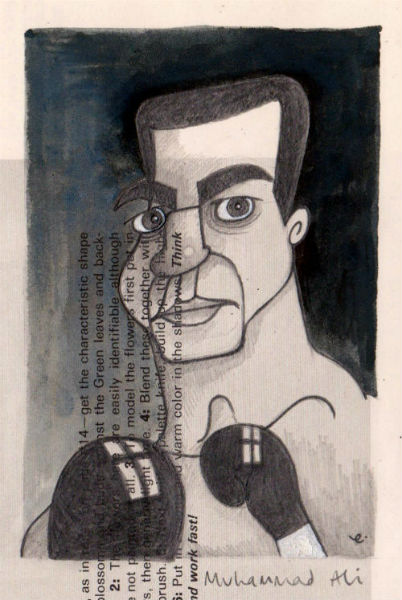
Muhammad Ali, 1942-2016

Muhammad Ali left us today, in as far as he ever can.

Cassius Marcellus Clay Jr. was just a boxer. A boxer in the same way, perhaps, that Pelé was just a footballer, but just a boxer all the same. Muhammad Ali, however, was a politician, a poet, a wit, a diplomat, a contrarian, a storyteller, a peace campaigner, a husband, a father, a religious advocate, a motivational speaker, a pillar of the civil rights movement, a television personality, a social theorist, a comedian, a villain, a hero, a martyr.

He was also twice the heavyweight boxing champion of the world. Having been stripped of the title for his social and political ideals in the turbulence of 1960s America, he regained it - aged 32 - against George Foreman in Zaire with such a breathtakingly audacious combination of brawn and brains that it walked the unseen line that divides life and death. Just under a year later, he retained the belt fighting Joe Frazier in the Philippines. Flirting with that line again,  The Thrilla In Manila was a contest of such punishing circumstances that everyone involved was pushed to the outer limits of the known human capacity for endurance: physical, emotional, spiritual.

Muhammad Ali

In the end, Muhammad Ali was a leader. Never before or since has a sporting figure so supervened their station and entered the wider public consciousness with such vitality or luminous brilliance. Ali is a hero to more than just those who follow boxing or saw him fight. Some, I'm sure, don't even know he was a fighter. After a time, it became incidental anyway. Muhammad Ali went beyond labels, beyond time and place.

Muhammad Ali gave people hopes and dreams; his foibles, mistakes and indiscretions serving only to make us feel better about those of our own. To come across Ali's story is to be moved, thrilled, excited. It is energising in a way that speaks to the human spirit at a most fundamental level.

His story will be discussed for as long as human beings are. The words "The Greatest" will never be far away, drawn magnetically towards one another. It was Clay - the boxer - who first immodestly bestowed himself with the moniker. In later years, Ali would admit he had done so without even realising yet that he was. Nevertheless, it was prescient in the extreme: Ali's life continued along a path of transcendence as if, at times, guided by an unseen hand.

Those of us today, living on in his wake, are blessed and cursed. Cursed because we are too close to properly appreciate Muhammad Ali with anything like the true perspective that his life, his achievements, his personality, his essence, will ultimately demand. It may take tens, or hundreds, of years for that to be possible. But we are blessed, too: no-one else in human history will be able to boast that they had shared a planet with him, had the opportunity to see their lives directly impacted or influenced by his in real time.

Muhammad Ali was bigger than boxing, bigger than sport. His was the ineffable spark of humanity. This was as good as it gets. He is the greatest.

Friday, 6 May 2016

Sport by Numbers: Number 15

Today's notable sporting integer is 15. Fifteen is the first number, counting from one, which is not immediately associated with handfuls of notable sporting heroes. Why should this be? I have absolutely no idea, as it seems to me to be a perfectly serviceable number . Anyone wearing it would no doubt look very handsome and make their grandmother enormously proud.

It is the number that is always worn by the full back in rugby union however, so there is no shortage of competition for our purposes: even if they haven't strictly chosen it for themselves. I like to think that if they could have, they would.

As such, I have picked one of the most notable rugby full backs ever to play the game, a legend of the sport in the British Isles: former Scotland captain and six-time British and Irish Lion, Gavin Hastings. Hastings also played 61 tests for Scotland and, with a combined 733 points, he is the all-time British rugby union top scorer.

Gavin Hastings

Friday, 29 April 2016

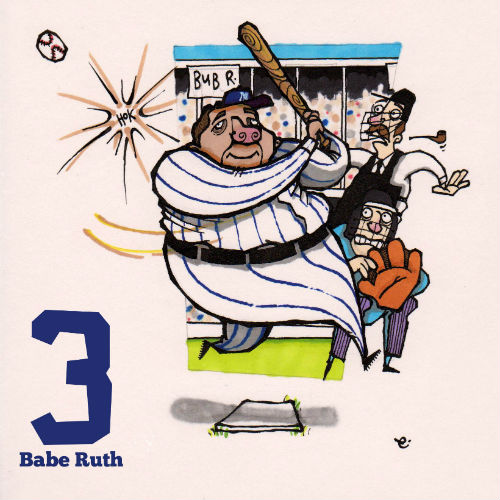
Sport by Numbers: Number 3

Today's sporting number comes from the hotly contested series from one to fifteen. These are the numbers that cover the action for all but the most lunatic of sporting occasions and, as a result, have come to be associated with all kinds of different personalities and disciplines. Number 3 is the number that AC Milan retired in honour of their stalwart defender Paolo Maldini; it is also the number carried by the legendary Dale Earnhardt throughout his career in stock car racing.

However, it would have been remiss of me to not award my number 3 to the Sultan of Swat. The 20th Century saw the invention of many things that we now accept as facts of life without really thinking about them and one of these was international sporting superstars. George Herman "Babe" Ruth was one of the first and, over a century on from his Major League Baseball debut, he remains one of the biggest. If he hadn't been born, someone would have had to invent him.

George Herman "Babe" Ruth 1895-1948

Friday, 22 April 2016

Sport by Numbers: Number 33

Today begins a new series of pictures combining sport and the iconic numbers associated with some of its greatest practitioners. I'll be trying to add a new one every Friday morning, but you know what I'm like. Flaky.

Keen-eyed viewers will also notice that I am not doing them in any kind of order, least of all numerical order. This is a deliberate strategem on my part to make the project seem like more fun and less like a self-imposed prison. Where, of course, the gaoler is me and the terms are fairly lenient. Flaky, you see.

Anyway, the first entrant is probably best known to British people as the co-pilot in the 1980 disaster comedy film Airplane! but the majority of Americans recognise him instead as perhaps the greatest basketball player of all time, Kareem Abdul-Jabbar. Virtually every other rival he has for that title is also on my list awaiting being drawn by the way, so don't panic too much.

He is also an excellent reminder that US sporting greats can appear in motion pictures and not subsequently murder their wife.

Number 33: Kareem Abdul-Jabbar

Wednesday, 30 March 2016

The Five Greatest Sports Stars of the 20th Century

Last year I made five drawings of the five people who I consider to be the greatest sports stars of the 20th Century and with typical efficiency I am only now doing anything with them. I love sport more than anything else, I think. Like great music or art, it transcends human experience with a potency far outreaching its remit. But, unlike music or art, it retains a crucial element of total objectivity. There are winners and losers in sport; for all the discussion and for all the postulation there will always come a time when all the bullshit must, through absolute necessity, stop. It is this which appeals to me on such a fundamental level. Elemental, even. I need it.

Choosing five outstanding people from the sporting field is foolhardy in the extreme and invariably shot through with bias, blind spots and flaws. Complaints to the usual place, perhaps. Or, even better, how about making your own list? Creative solutions to internet-based disagreement is surely the way forward. For my choices, I tried to pick five people whose greatness went beyond their particular field of endeavour. They are people who made a wider social impact, through their values, their example or their personality.

I consider them to be five of the most inspirational people the Twentieth Century produced.

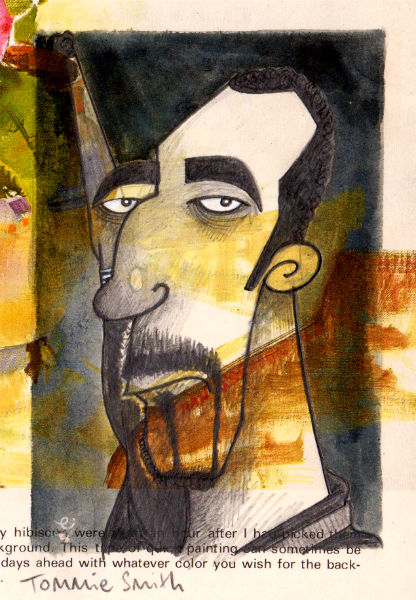
5. Tommie Smith (1944-) - Athletics

Tommie Smith

Tommie Smith crystallised an entire movement in one single perfect moment. On 16th October 1968 at the Mexico City Olympics, he won the 200 metres sprint in 19.83 seconds. It was an heroic enough performance as it stood: he had been nursing a hamstring injury through the heats and his display in the final was astonishing, the first time that 200 metres had been officially run in under twenty seconds in human history.

Quite rightly, however, Smith is better remembered for what he did on the podium. 1968 had been a year of tumult. In his homeland, it had seen the assassination of Martin Luther King and Robert Kennedy and the worsening of the conflict in Vietnam. The Civil Rights struggle was far too deeply ingrained to be solved simply by recourse to legislature and racial tension remained a tinderbox across the United States. As for the rest of the world, similar life-and-death struggles for recognition, for freedom and for human rights also raged: Northern Ireland, Warsaw, The Prague Spring, student uprisings in France and West Germany; the continuing stain of Apartheid in South Africa, as well as continuing tension in Israel and Palestine.

Tommie Smith's black gloved raised fist salute was seen as being a symbol of black power and association with the nascent Black Panther movement. In truth, it represented support for everything that is good and just in a year that had, at times, looked set to spiral out of control. Even if in the moment he, silver medallist Peter Norman of Australia and Smith's American teammate John Carlos may have not realised what an epochal gesture they had made, nearly 50 years on it remains the single most staggeringly eloquent reminder of sport's social potency.

Of course, Smith's reward was to be canned. Both he and Carlos were immediately sent home from the Olympics and made pariah by a significant proportion of American society. The following year, Smith moved into American Football, playing two games for the Cincinnati Bengals before becoming both a sociology teacher and an athletics coach at Oberlin College, Ohio.

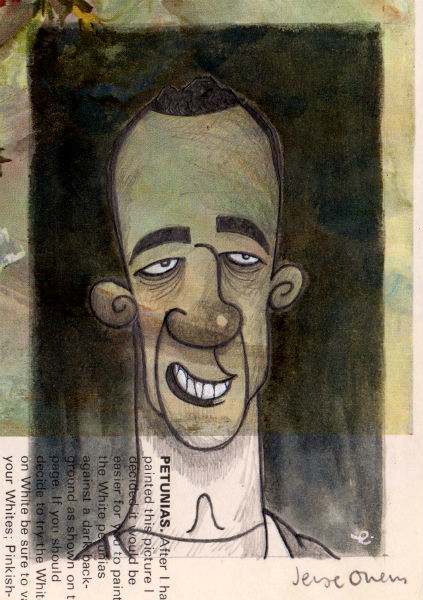
4. Jesse Owens (1913-1980) - Athletics

Jesse Owens

Jesse Owens was one of the greatest track athletes in history. During the 1935 Big Ten athletics meeting at Ann Arbor, Michigan, he broke three world records within 45 minutes. The following year, he won four gold medals in the 100 metre sprint, 200 metre sprint, 4x100 metre sprint relay and long jump at the Berlin Olympics.

Owens never set out to be a hero or a warrior for social justice. Both things just sort of caught up with him, even when nothing else could. He remains the ultimate fly in the ointment, the most celebrated up yours to the most insidious and evil political regime of modern human history. Adolf Hitler had, of course, designed the Berlin Olympics to be as carefully choreographed a love letter to the innate superiority of his Aryan supermen as any sporting event could be. But he had not reckoned on the basic truth of the forces at work in the sporting arena. 1936 was Owens' time and he would not be - could not have been - denied.

Much has been made of the Fuhrer's avoidance of Owens following his Olympic success. Debate still continues as to whether or not this was the result of prior engagements, a desire to not be caught out in an impending rainstorm or his virulent racism. The possibility even remains that the Nazi leader did seek out and congratulate Owens but that it was subsequently hushed up. The fact remains that Owens' feats were all featured in Leni Reifenstahl's state-funded 1938 film of the event, Olympia, whilst at home he remained a second-class citizen. It is this frequently ignored story which speaks with the greatest volume about the legacy of Jesse Owens, a campaigner for civil rights and social justice. He always maintained that it was not Hitler who snubbed him but his own President. "[He] didn't even send a telegram".

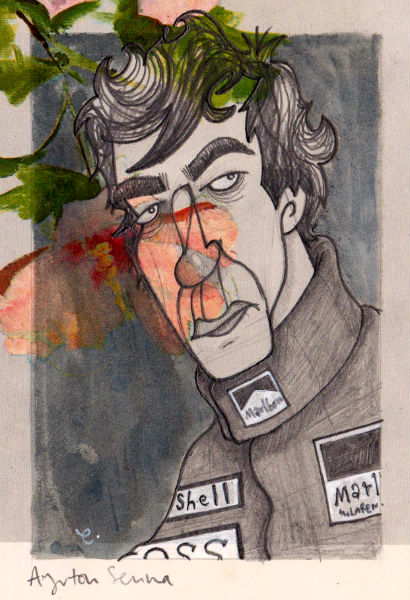
3. Ayrton Senna (1960-1994) - Motor racing

Ayrton Senna

Ayrton Senna was the fastest racing driver who has ever lived. He drove like the devil was after him and he was trying to get away. And as fanciful a narrative as that sounds, the man himself would leave you in some doubt as to whether or not it was what was at stake. There are few people possessed of the kind of single-minded dedication, control and ability to achieve all that Senna did in his brief life, fewer still able to articulate it in quite the same mesmerising way that he did: all the more remarkable if you consider that he was often doing so in a second language.

The winner of 41 Grands Prix, three Formula 1 World Championships and 65 pole positions - the latter a record that it took even Michael Schumacher nearly a hundred additional career races to overhaul - Senna's numbers remain impressive but, as is the nature of many statistics, are slowly being subsumed by history. What will not go away is the story. Senna's electrifying presence transfixed the motor racing world; Formula 1 was Ayrton Senna and to set out to conquer it meant beating him. What will never go away is the footage. Some of it shows him doing things which are devious, questionable or downright reprehensible, all reminders of the fundamental flaws that reside within human beings. These were foes to overcome all as real as Alain Prost, Nelson Piquet, Nigel Mansell or Michael Schumacher. What will never go away is the sight of a man propelling a racing car along at a speed at which his rivals were either unable or unwilling to match.

Senna was a remarkable man. Born of considerable privilege and wealth, he nevertheless remains nothing less than a hero to millions of his disenfranchised and poverty stricken Brazilian countrymen. Clearly flawed and prone to behaviour on track so nefarious it could probably have been tried in a court of law, he remains a hero to every journalist and motorsport fan, one whose legacy grows with each passing year. Had he survived the crash in the 1994 San Marino Grand Prix which claimed him, he could well have been the President of Brazil by now. Or of the United Nations. He may even have been able to swing Pope. To assume anything less of Ayrton Senna always was to be confounded by him.

2. Billie Jean King (1943-) - Tennis

Billie Jean King

So much of the story of Twentieth Century sport, as with its history, is entangled with the story of race that it is easy to forget that the battle for equality was never just confined to the colour of a person's skin. Women's rights and LGBT rights were - are - just as defining and active a social battleground. Billie Jean King was a pioneer, a leader and a spokeswoman; a brilliant competitor who could have made all her most telling points on the court but chose to speak out off it as well. Moreover, she still is and still does all of these things.

Much is made of her participation in the famous Battle Of The Sexes tennis match, an event between the top female player of the day and Bobby Riggs, the 1939 Wimbledon singles champion who, at 55-years old believed he was still the match of any modern female player. King disabused him of this notion, defeating him comfortably 6-4, 6-3, 6-3. But in reality this was just a spectacle for the television and a silly old fool getting his comeuppance. Billie Jean King is better remembered for the way she lived her life day to day, a fact summed up by her belief that her most famous match's key virtue was getting people interested and enthused about the sport of tennis.

As a player she was an indefatigable competitor. Combined with a longevity rare in such a high impact sport - her career spanned four decades and lasted 24 years - it makes the case for her inclusion on any list of sporting greats on a statistical basis alone. What truly sets King apart for me is her bravery. It takes considerable courage to choose to continually put your head above the parapet because it is the right thing to do, especially when you are successfully operating in an arena which would make anyone quite able to happily and quietly feather their nest ready for a peaceful retirement. King refused to stand down; on the issue of professionalism in tennis, on the issue of equality for women, or on the issue of the acceptance of homosexuals into society. To this day, if Billie Jean speaks openly on any subject, we had better all be listening.

1. Muhammad Ali (1942-) - Boxing

Muhammad Ali

Muhammad Ali is the greatest. We have no excuse for this coming as a surprise as he has been telling us all for decades. It is perhaps to his greatest credit that the scale of his achievement - as a sportsman and as a human being - was such that it was nevertheless still surprising.

No other sporting figure has ever blurred so many social boundaries. He was both of our time and for all time; initially just a boxer, his extraordinary personality made him a star at a time in America where black people were supposed to know their place. Ali stood up and was counted. When this, as it inevitably would, made him enemies he stood louder and prouder. When they took away what was rightfully his he won it back in such impossibly heroic circumstances that it would be dismissed out of hand as a film treatment as simply too unbelievable.

Ali is a continual reminder to me that the search for a higher power is best attempted by looking around you. A glimpse into the eyes of Ali, even now as a frail man broken by disease and dulled by age, leaves me in no doubt as to his other-worldly power to inspire greatness in those around him. There will never be another sportsman who so unifies as many disparate sections of human society as Muhammad Ali. The greatest tribute of all is that, principle among the reasons for this is that Ali existed in the first place.

The five pictures that illustrate this piece are available to buy for £25 each, or £125 for the full set (including Pelé, who didn't make the cut). If you are interested, drop me a message on Facebook or send me an email.

Tuesday, 23 February 2016

Pictures for sale

It's that time again, when Spring is starting to spring and I look around my cave of bewilderment and pencil shavings and see artistic output strewn everywhere. Maybe you or someone you know might be able to give any of these pictures a home?

ADELAIDE TERRACE, HOVE. 28 x 38cm, acrylic on 300gsm watercolour paper. WAS £120, now £80.

CHIN UP, LOVE - IT'S THE PRESIDENTIAL INAUGURATION. 9.5 x 28cm, acrylic on 300gsm watercolour paper.
WAS £50, now £30.

NIKI LAUDA. 21 x 27cm, acrylic on textured white card. WAS £70, now £40.

STREET FIGHTER 2: REUNION EDITION. 38 x 28cm; pen, ink and watercolour on 300gsm watercolour paper.
WAS £120, now £80.

SWAN RUGBY. 10 x 15cm; pen, ink and marker on 220gsm cartridge paper. WAS £25, now £10.

WESTERN. 21 x 30cm; pen, ink, watercolour and pencil on white card. WAS £35, now £20.

ZINEDINE ZIDANE. 21 x 29cm; acrylic on reclaimed book page. WAS £70, now £40.

If any of the above have caught your attention, you can email me or contact me via Twitter or Facebook. Alternatively, you can do the whole thing via Paypal, although do remember to leave a note stating which picture or pictures you would like.

Sunday, 8 November 2015

Sixty Greats of European football

For larger, click here
Every so often a picture escapes from my dingy artist's hovel and the above is one such example. It has proved very popular too, a fact that I attribute to the following broader social observation: a lot of people like football.

FAQ


How did you choose the players for the picture?
Every single winner of the Ballon d'Or, otherwise known as the European Footballer of the Year award, who has also represented a UEFA-affiliated nation at international level is included. This left a dozen or so spaces, which I filled with players who I deemed to be significant enough to sit in this company. So, as far as they are concerned, complaints to the usual place.

Where is Lionel Messi? Where is Diego Maradona?
Both Lionel Messi and Diego Maradona are from a country called Argentina, which is not in Europe. I made a rod for my own back here, including players such as Alfredo Di Stefano and Omar Sivori, who were also from Argentina. However, Di Stefano also represented Spain in internationals and Sivori was capped by Italy, therefore making them eligible for inclusion. Messi and Maradona did their finest work playing in Europe but, of course, all their international hoofing was for the land of their birth.

Where is Eric Cantona?
Complaints, as ever, to the usual place.

Where is [someone else]? If I pay you, will you draw him for me?
Almost certainly. For all commission requests, you can email me or send me a message via Twitter or Facebook.

Why is this picture so rubbish? None of these people look like who they are supposed to!
OK, it's probably best that you don't avail yourself of the following:

I like this picture, can I buy one?
I am very glad you asked. Yes, you can. I am producing a limited edition print run of 100. They are A3-sized on 160 gsm photographic paper and will each be hand signed and numbered by me. The price: £20 each, inclusive of postage and packing (within the UK only, or £30 each for places that are not in the UK. If you're not sure if where you live is in the UK, I don't know what to tell you.)

To order, just send the appropriate amount of money to my Paypal account (for outside the UK, click here) Don't forget to include a suitable delivery address and an email address where I can contact you to keep you updated as to the progress of your order. Each print should be with the recipient within 7-14 days, although this may take a little longer during the festive period.

Don't have a Paypal account but still want to buy a print? Not a problem... simply contact me via the emailTwitter or Facebook links in this post instead and we can sort out an alternative method of payment.

The original is also for sale: price £200. If you would like to buy that, please don't send money to my Paypal account - I can't be sure that when you do the picture will not have already been sold. Instead, send me an email. That way whilst I can't absolutely guarantee that the picture will not have already been snapped up, at least we won't have had to send £200 back and forth between one another.

Tuesday, 22 April 2014

World Cup Red Card Cards


If I'm honest, I think I only watch the World Cup for the dismissals. International football's biggest tournament has a way of elevating everything it touches. There have been countless better goals than Diego Maradona's second against England, but the combination of place, time and significance means that it looks set to remain as THE goal. Likewise, there's no indisipline quite like World Cup indiscipline. People rightly argue that it is a shame that George Best or Ryan Giggs never got the opportunity to grace the World Cup stage, but I feel just as much of a sense of loss for Pat Van den Hauwe or Vinny Jones. Paul Scholes played at two World Cups, but I always got the impression that he never meant to be that bad at tackling. He was never a true artist in the same way as Julian Dicks or Vinny Samways.

To celebrate this finest of the fine football arts, in association with Twohundredpercent I have designed a range of 25 collectible World Cup Red Card Cards, available as greetings cards or postcards. Now other fans of ill-discipline can assemble their very own treasury of the most notable World Cup moments and relive their very favourite wild fouls and outrageous pieces of referee-deceiving fakery. It's sure to bring football into disrepute and the first batch off the shelf will be no doubt heading to FIFA headquarters and the office of Mr. J. Blatter.

FIFA, of course, are continually trying to clamp down on such foul play, potty mouth and various other monkeyshines. However, for the committed fan of the red card, these efforts are nothing but good news. Their chosen method to bring transgressors back into line is to encourage the referees to pop the cards out until they learn, as though they are misbehaving dogs. The only worry red card connoisseurs have is that one day they might, along similar lines, try to reverse the trend and instead reward players who toe the line. Referees taking to the field with a string of sausages or a pocket full of Haribo instead of a notebook and pencil remains my worst nightmare.


159 players have been dismissed in the nineteen World Cup Finals tournaments so far, to 157 different miscreants. Cameroon's Rigobert Song and France's kung-fu master Zinedine Zidane are the only repeat offenders, while Argentina's Leandro Cufré is the only player to be given his marching orders without having set foot on the field of play. 159 in 772 matches equates to a rather meek-looking 0.21 dismissals per match. However, it is a rather misleading statistic, because it is becoming far more prevalent. In the first nine World Cups, just 22 players were invited to leave the field early. In both 1950 and 1970, no-one was sent off at all. The latter of those tournaments was significant as it was also the first World Cup since yellow and red cards were introduced to international football and although the red card didn't make an appearance until four years later, it has since been shown 137 times.

This equates to a rate of 0.25 red cards per World Cup match, or one every four games. In the last three tournaments, this has risen to one every three. Since three games is the minimum number that any team who qualifies for the Finals can play, you are now statistically more likely to have a player sent off than not. If you go further than the group stage and still don't have any players dismissed, you're simply not trying. Days like 18th June 1998, where five players were sent off in a single round of group matches (Denmark v. South Africa and France v. Saudi Arabia) or 25th June 2006, the day of the second round match between the Netherlands and Portugal in which 16 players were booked and 4 sent off are starting to look less like aberrations and more like the norm.

All of which is great news for me, until you remember that whilst dismissals are trending unrelentingly upward, goals-per-game are falling fast. Just as fast as dismissals are rising, in fact, or moreso. At the current rate, by the 2142 World Cup at the very latest we can expect more red cards than goals in each and every World Cup game. I drew a graph and everything, so this is definitely going to happen.


I mentioned my rigorous researches on Twitter and Terry Duffelen, Fußball correspondent on Twohundredpercent and eminent football podcaster, remarked, "red card coefficients are the future of football", a thought which was the perfect combination of funny and bottom-clenchingly terrifying. Because if red cards are to become the game's new currency, we can expect teams going through elaborate simulation in order to prevent their opponents getting sent for an early bath. And while their own tackling would reach new heights of ferocious overkill, the players on the receiving end would react with such Gandhi-like equanimity and calmness that the referee won't know what to think. No-one would get sent off at all. Combine that with there being no goals either and every World Cup game would essentially be like watching Brighton and Hove Albion: you're slightly drunk, it's raining, nothing is happening on the pitch and you don't know where you're supposed to sit.

The only way to prevent this ludicrous situation from occurring is to send everybody off before the game has even started. This is something I'm sure we can all get behind.

It's not just Red Card Cards that are available via my Redbubble, there are loads of other cards, prints and items of clothing to be had. Or you can just go and look at the silly pictures: dotmund on Redbubble

Friday, 3 January 2014

Michael Schumacher

Michael Schumacher, seven-times World Motor Racing champion, is 45 years old today. However, this morning he remains in a medically-induced coma after a skiing accident in France.

Schumacher's standing as statistically the greatest Formula 1 driver of all time has been endlessly dealt with elsewhere. In fact, many of these records owe themselves to the seasons where, in an utterly dominant Ferrari car, he won as he pleased. 2001 saw him win 9 times and in the following year he added eleven more victories, never finishing lower than third place. A tighter championship in 2003 (a season where the powers-that-be had amended the World Championship scoring system to try and slow his progress) still yielded six wins on the way to a record-breaking sixth world title. The 2004 World Championship, meanwhile, was his zenith, winning 13 times from 18 Grands Prix with eight pole positions and ten fastest laps. Out of a possible 180 points, he scored 148.

However, unlike the current situation with Sebastian Vettel -where naysayers continually ask how much of his success is down solely to the brilliance of his car - no-one casts aspersions about the value of Schumacher's numbers. If they seem unrelentingly high then it is only because they were deservedly so; Ferrari were a team in disarray when Schumacher joined them in 1996. The fact that he spent the early part of the 21st Century monotonously chalking up successes is solely a result of his own work building a team who were able to deliver them and who were continually inspired to want more. This much said, Schumacher's genius was never better displayed than in the four years between joining the Scuderia and his first World Championship with them - and third overall - in 2000.

There was the dancing, balletic win in the streaming wet 1996 Spanish Grand Prix where he made everyone else look like they were driving Formula 3000 cars, in spite of his own vehicle having the majority of the handling attributes of a truck. Or his win the same year at Spa-Francorchamps in the Belgian Grand Prix where, having qualified over a second slower than Jacques Villeneuve's dominant Williams in the damp, he doggedly prevailed in the dry on race day. How about Monaco in 1997, where he was leading by 6 seconds after the first waterlogged 2 mile lap? Or Belgium, streaking through the field in the wet? Or his electrifying win in Hungary in 1998 where he overcame the faster McLaren cars of Mika Hakkinen and David Coulthard by being able to deliver the performance required of Ross Brawn's impossible tactical gamble?

There were questions - questions that very often unsatisfactory or even disturbing conclusions - about his standards of on-track sportsmanship and racing ethics. Off the circuit, there was also little doubt that he lacked the charisma of the driver he succeeded as the leader of the F1 pack, Ayrton Senna. It was the latter's death at the 1994 San Marino Grand Prix that thrust Michael Schumacher to the top of the pile. His first World Championship, that same year, was a bit of a hodge-podge of an affair. Suspensions, suspicions, accusations of illegality that dogged his Benetton team and the final race collision with his title rival Damon Hill all gave a strong impression that the right man had won but in the wrong way.

A dominant 1995 season, however, confirmed what most of us already knew - rather than just being the best of the rest, Schumacher was coming to hold his place in the sport's pantheon in his own right. By the time he won the first of his 72 wins for Ferrari (bear in mind that the highest career total of victories after Schumacher is Alain Prost's 51) at the following year's streaming wet Spanish Grand Prix, it was clear that there was very little to choose in raw talent between Schumacher and the brilliant Brazilian whose shoes he'd had to step up to fill. Whilst I would hesitate in calling Michael Schumacher one of the all-time greats, any list of the best racing drivers of all time which does not have Schumacher towards, if not at, the very top isn't worth a brass farthing.

Because like all people who are the very best at what they do, Michael Schumacher took what he did and changed it. In Michael Schumacher's era, to be less fit, or less dedicated, or less tactically astute, or less politically savvy as a racing driver meant that you would at best finish second. To manage to get up to his level was in itself no guarantee, as by that point Schumacher would most likely have tirelessly moved onward and upward to a higher plane. Even after his retirement, the standards he set have remained the norm. The modern-day Grand Prix driver is his legacy.

He was a brilliant racing driver, the best of the best and a man whose achievements have cast a long shadow on a significant part of life thus far. It's hard to accept that his 46th year begins in such a vulnerable position, hovering between life and death, when it was the sheer gravity of his presence in the sporting arena that meant that most of my formative years were consumed with loving, hating, supporting or opposing him in some way.

But admiring. Always admiring. Happy birthday, Michael. Get well soon.

Michael Schumacher by numbers

Grand Prix entries 308
Grand Prix starts 307
Grand Prix wins 91 (record)
Podium finishes 155 (record)
Career points 1566
Pole positions 68 (record)
Fastest laps 77 (record)

Formula 1 World Champion 1994, 1995, 2000, 2001, 2002, 2003, 2004. (record)

Grand Prix wins: 1992 Belgian GP; 1993 Portuguese GP; 1994 Brazilian GP, Pacific GP, San Marino GP, Monaco GP, Canadian GP, French GP, Hungarian GP, European GP; 1995 Brazilian GP, Spanish GP, Monaco GP, French GP, German GP, Belgian GP, European GP, Pacific GP, Japanese GP; 1996 Spanish GP, Belgian GP, Italian GP; 1997 Monaco GP, Canadian GP, French GP, Belgian GP, Japanese GP; 1998 Argentinean GP, Canadian GP, French GP, British GP, Hungarian GP, Italian GP; 1999 San Marino GP, Monaco GP; 2000 Australian GP, Brazilian GP, San Marino GP, EuropeanGP, Canadian GP, Italian GP, United States GP, Japanese GP, Malaysian GP; 2001 Australian GP, Malaysian GP, Spanish GP, Monaco GP, European GP, French GP, Hungarian GP, Belgian GP, Japanese GP; 2002 Australian GP, Brazilian GP, San Marino GP, Spanish GP, Austrian GP, Canadian GP, British GP, French GP, German GP, Belgian GP, Japanese GP; 2003 San Marino GP, Spanish GP, Austrian GP, Canadian GP, Italian GP, United States GP; 2004 Australian GP, Malaysian GP, Bahrain GP, San Marino GP, Spanish GP, European GP, Canadian GP, United States GP, French GP, British GP, Hungarian GP, German GP, Japanese GP; 2005 United States GP; 2006 San Marino GP, European GP, United States GP, French GP, German GP, Italian GP, Chinese GP.

Michael Schumacher's other all-time Formula 1 records:

Most consecutive World Championships 5 (2000-2004)
Most wins in a season 13 (2004, tied with Sebastian Vettel (2013))
Most front row starts 116
Most perfect races (win, pole and fastest lap) 22
Most consecutive podium finishes 19 (2001-2002)
Most wins in a single Grand Prix 8 (French Grand Prix (1994-95, 1997-98, 2001-02, 2004 and 2006)
Most wins for a single team 72 (Ferrari, 1996-2006) (Michael Schumacher is also the only driver in Formula 1 history to have won multiple World Championship titles with two separate Constructors)
Most points in a season (10 points for a win) 148 (2004)
Highest championship winning margin (10 points for a win) 67 points (2002)

Tuesday, 25 June 2013

A moustache for Roger

Roger Federer: cold top lip?
Can Roger Federer do it?

The greatest tennis player of all time is after a record eighth Wimbledon Men's Singles title this year and most learned commentators seem to be of the opinion that if he manages it, it will be his greatest achievement at the All-England Club to date.

This is due to a quirk of the ranking system: Rafael Nadal has spent much of the past 12 months with his knee elevated somewhere on a fishing boat in Mallorca recovering from leg surgery and, as such, is only the number 5 ranked player in the world. This means that, going by seeding alone, to win an OctoWimbledon Federer's path saw him having to beat Nadal in the quarter-final, Andy Murray in the semi and world number 1 Novak Djokovic in the final. An incredible challenge.

Of course, in sport things are wont to change. Yesterday the bookmakers had Federer out at 7-1 to win the tournament. I rather suspect his odds will be somewhat shorter this morning. The headline news was that an out-of-sorts Rafael Nadal fell at the first hurdle to an inspired Steve Darcis in straight sets, but equally noteworthy in my book was the thunderous masterclass delivered by Federer on Centre Court earlier in the day. Up against Victor Hanescu, the Romanian player who is ranked the 48th best tennis player currently on Earth, Federer rolled back the years, playing shots of power, accuracy, grace and invention. His service, meanwhile, peppered the lines of the box, giving his opponent no realistic chance at all. It was a privilege to watch.

But there's still something missing. The answer, nevertheless, is close at hand. Sat in the Royal Box watching, in fact: it was Roger's dad Robert Federer, the silver fox in a smart suit, sporting his trademark moustache. It was a strong look. Roger is definitely a chip off the old block as far as his appearance is concerned - he and his father look very alike. And then it struck me.

The last few percent of any sporting success are always in the mind. That little spark of self-belief and confidence that can carry one competitor over and above another competing at an identical physical level. Roger Federer's path to history remains fraught with huge challenges, but I believe Roger Federer with a moustache would be unflappable and, more significantly, unstoppable.

I have to admit that I would like Andy Murray, the plucky Brit with a heart of gold, to win Wimbledon this year. But I can never begrudge Roger Federer another title at The Championships, he is a magnificent sportsman and my admiration for him grows exponentially. If it came to it, I'd have to cheer on Andy Murray in a Murray-Federer semi-final. But a moustachioed Federer? No contest.

Now, I am a reasonable man. I am, it's true, demanding that Roger Federer grow a moustache, but that is not to say that I will not be giving the great man options. Five options, in fact. Which style he decides to go with is up to him (or, indeed, you - democracy could well win through if you would like to leave a comment with your preference). But nature and reason and all the gods in their heavens have surely spoken: Roger Federer must surely grow a moustache. And then we'll have world peace.

ROGER FEDERER MUST GROW A MOUSTACHE

Option 1: Robert Federer Junior
Simple, classic lines. Will make his father proud all over again.

Option 2: Easy Rider
Is it hot as hell in here, or is it me?

Option 3: Terry-Thomas
I say!

Option 4: Freddie Boswell
Lilo Lil = tart

Option 5: Ron Mael
This just made my soft parts go hard and my hard parts go soft.

Come on Roger, do it for all of us.

(You can follow my campaign in real time on Twitter when I remember, just watch out for the #RogerFedererMoustache hashtag.)

Attention

You have reached the bottom of the internet