All subsequent recommendations will be £12.99 each.
Showing posts with label Music. Show all posts
Tuesday, 14 April 2020
Top 40
Today is my 40th birthday. Happy birthday to me. As a present to you, I have chosen 40 of my favourite albums from my 14,610 day stretch. You have probably heard most of them, because if nothing else I am extremely vanilla. But if you haven't, here are some free recommendations.
All subsequent recommendations will be £12.99 each.
Wednesday, 30 January 2019
Get Back, outside
Speaking personally, I avoid going out wherever possible, but other people do venture forth into the wide blue and when this happens they will no doubt sometimes find themselves in attendance at live music performances. There are countless of these taking place right now all over the world, and save for the occasional unplanned pregnancy or Damascene moment of self-realisation, little or nothing about them will be remembered by history.
Of course, it is not always this way. Nothing that is possessed of the power of music could always slide by unnoticed and as a result there have been some performances so shattering, so profound and so memorable that they have – directly or otherwise – shaped the course of more or less everything that happened next. This is a fact that is particularly on my mind today, for reasons that I will get into shortly. However, I feel it would be germane at this point to first provide some examples of gigs that sent ripples far beyond their own pond, just in case any of you think that I am lying.
Case study 1: Bob Dylan is so Punk it's unbelievable 1965-1966
One of the curious and unexpected effects of the rise of technology that still threatens to end us all was the re-emergence of the folk music scene in America during the 1950s and 1960s. The apex of this movement was the Newport Folk Festival, an annual three-day analogue happening on the picturesque New England coast; THE place for all the insufferable hairshirt-wearing, hempy draft-dodgers to assemble for a coffee clatch, smoke a doobie and listen to Pete Seeger sing a scurrilous eighteen-verse song about King George II as two shirtless men chop wood at the side of the stage.
Dylan's gig there in 1964 had been greeted by the kind of fervent, rapturous response normally reserved for Jesus Christ on Palm Sunday. Perhaps mindful of what happened to the J man subsequently, the following year the prophet of all of the oakiest folkies decided that the time had come to mix things up a little. On Saturday 24th, Dylan played a three-song acoustic set at an afternoon workshop, accompanied only by his guitar, harmonica and (presumably) two blacksmiths casting pewter tankards, before making the spontaneous and momentous decision to play an electric set the following day to showcase his new material accompanied by the Paul Butterfield Blues Band.
This Sunday evening set was completely incendiary. Dylan would again play three songs, but this time his output came courtesy of RAW POWER. He clattered through this truncated set, playing into a wall of discontent and studied outrage, before leaving the stage to a cacophony of jeering and politically appropriate anger. The evening's master of ceremonies Peter Yarrow was left on the verge of tears. Neither in his role as King of the Hippies nor or as Peter from Peter, Paul and Mary had he ever had to deal with such overt and voluble hostility and Yarrow begged Dylan to return to the stage and continue his performance. This he did, unaccompanied once more, cheered to the echo by the same crowd who minutes before had been baying for his blood. An unprepared Dylan didn't have the correct mouth organ and asked the crowd whether or not anyone had an E harmonica. The subsequent volley of metal objects that hurtled towards the stage had been quite unmatched in the area since the Revolutionary War and, now musically replete, Dylan performed two more songs to placate the crowd, whom rock historians by this point may have started to suspect of being a load of reactionary idiots. Dylan wouldn't return to folk music's hallowed spot again until 2002 where, possibly still wary of reprisals from hacky sack-playing beatnik wastrels, he played his set decked out in a wig and false beard.
But it wasn't just American folk fans who had temporarily lost the Zeitgeist: it turned out that British people can be idiots as well, and idiocy without the consoling prospect of the imminent tour of duty in Vietnam is a deadly combination indeed. The following year, during a rambunctiously adversarial European tour, on 17th May 1966 (a Tuesday) Dylan played a concert at the Free Trade Hall, Manchester which would become perhaps the most notorious, bootlegged and discussed non-festival gig ever played in the United Kingdom.
Anyone who believes that trolling is a modern phenomenon that came about with the advent of online communities need only look at the set list from that night in order to see the errors in their thinking. The first half of Dylan's show, solo and accompanied only by himself on acoustic guitar and harmonica, was largely comprised of pared-down versions of his newer material, cribbed from the contentious electric era albums. When he returned for the second half it was in the company of five other musicians, four of whom were on the cusp of finding stardom in their own right as The Band. Here, Dylan played eight more numbers, this time mainly older songs from the folk era but with a thousand volts shoved right up them. The crowd grew increasingly restless, chanting, shouting and slow handclapping their way through the gaps between songs, only for Dylan and his band to beat them back into submission with another wall of noise. The whole affair culminated in the most famous heckle in rock and roll history: “Judas!”, followed by its most famous riposte: a version of Like A Rolling Stone that, as per Dylan's instruction to his group, was played “fucking loud”. Dylan would suffer a serious motorcycle accident two months later and following his recuperation would choose instead to tread a less confrontational path: country rock.
Case study 2: Otis Redding makes black all right for the all whites, 1967
The United States of America's black community had been quietly producing all the music that mattered for generations, only for the rest of the population to ignore it and then have it sold back to them by more "palatable" (i.e. white) British acts for much of the preceding decade. The 1967 Monterrey Pop Festival was when White America finally woke up to this fact and realised they could cut out the middle man and, in turn, help make America great again. The Jimi Hendrix Experience blew a few minds later that weekend (lest we forget that Hendrix himself had needed to leave America and go to the UK in order to gain any recognition as a solo artist, a fact which history has rendered completely absurd), but the standout moment was Otis Redding's set on 17th June 1967, a Saturday. Backed by the Stax Records house band Booker T and the MGs, it culminated in a screaming rendition of Try A Little Tenderness so shattering that it can, even now, still peel the skin from your face. White America, suitably chastened, would never again so wilfully close its ears en masse to the music of their black brethren. This is a considerable legacy for just an hour's work and all suitably marvelled. Unfortunately for Redding, his personal legacy would be cemented by his untimely death in an aeroplane crash just six months later.
Case study 3: James Brown saves Boston
Martin Luther King, one of the great orators and humanitarian figures of the 20th Century was assassinated on April 4th 1968 in Memphis, Tennessee. This was a Thursday and by Friday morning, many of America's inner-cities were already counting the cost of a night of protest, anger and civil disobedience. In Boston, MA, the powers that be had a bright idea: if they could get WBGH-TV to film and broadcast the James Brown show scheduled for the night of April 5th at the Boston Garden, perhaps everyone who might otherwise be keeping themselves occupied by rioting would instead be glued to their television sets.
Brown himself took some convincing: he had already signed a contract with a rival TV station for the exclusive filming of a later show in the same tour and if he allowed the Boston gig to be broadcast he would break its non-compete clause, costing him a cool $60,000. No matter: the Boston city government put their hands in their pockets and paid him the difference, in what turned out to be a particularly savvy move for all concerned. Brown's electrifying eleven song set and legendary stage show had the effect that the city council had desired. Having succumbed to riots and fires on Thursday evening, Boston remained calm that Friday night while many other major American cities continued to burn.
All of this is not to say that the whole event was without a frisson of tension, however. In fact, the whole gig was a tinderbox, but one that would be masterfully handled by the hardest working man in showbusiness. The overall effect is completely electrifying, as well as pregnant with a sense of historical significance. In the most famous point in the show, the stage was invaded by over-enthusiastic fans and Brown had to stop the concert in order to prevent the police and venue security from over-reacting in their attempts to make them stand down. Having re-established control and his authority over the situation, Brown would then turn on his audience, admonishing the crowd: “Wait a minute, wait a minute now WAIT!” Brown yelped. “Step down, now, be a gentleman….Now I asked the police to step back, because I think I can get some respect from my own people!”
Case study 4: Jimi Hendrix breaks the national anthem, 1969
As we have previously discussed, Jimi Hendrix had gone to some lengths to get some respect from his own people and at The Woodstock Festival, New York on 18th August 1969 (it was a Monday), he would crystallise his entire experience of race and of national identity down into a single unforgettable moment. With his new band, Gypsy Sun and Rainbows, Hendrix closed the 20th Century's most legendary countercultural gathering with a middling twelve-song set (beginning at the decidedly un-rock'n'roll time of 9 am) that would become infamous for a wailing three-minute long electric guitar rendition of The Star Spangled Banner. Filled with feedback, distortion and notes bent way out of shape by his Stratocaster's tremolo bar, it was viewed by many as a protest - against prevailing racial politics in the US and against its ongoing war in Vietnam - and it caused quite a stir in the United States at large, already a country notably and visibly fractured along generational lines. Hendrix himself later told talk show host Dick Cavett that he didn't consider his performance unorthodox in the least. "I thought it was beautiful". Perhaps it was. Perhaps his tongue was in his cheek. It is a moment frozen in time, whose power to move and shock and provoke is seemingly captured inside the same amber.
Case study 5: David Bowie kills an alien, 1973
Tuesday 3rd July 1973. As his alter-ego Ziggy Stardust, Bowie - a man who craved fame but who just two years previously couldn't even have gotten himself arrested - sent the entire world's youth population into spasms of uncontrollable grief with a spontaneous announcement that this would be "the last show that we ever do". That night, July 3rd 1973 (a Tuesday) Bowie - backed by Mick Ronson, Woody Woodmansey and Trevor Bolder (with additional help from Jeff Beck) - played an extensive seventeen song set, drawing on all his previous album releases as well as covers of songs by both The Velvet Underground and Jacques Brel. The resulting concert entered legend both for Bowie's dramatic announcement of his retirement (actually, he was just off to return to his home planet) and the fact the whole happening was filmed by feted rockumentarian D.A. Pennebaker.
What the anguished teens who were still reeling from the Ziggy-shaped void that had just been ripped into their souls were not to know is how lucky they had been to be getting any of this at all: earlier that day, a notorious gang of Shepherd's Bush herberts had broken in to the Hammersmith Odeon and nicked thousands of pounds worth of high end public address and recording equipment. They were, however, to put it to good use.
Case study 6: Manchester's Big Bang, 1976
At the Lesser Free Trade Hall, Manchester on 4th June 1976 (a Friday), a then little-known group of London herberts (featuring Shepherd's Bush's very own Steve Jones on lead guitar) called the Sex Pistols played to an estimated crowd of as many as 40 people. Such would prove to be the cultural impact of what happened that night, almost everyone who worked in the music industry alive on Earth at the time has subsequently claimed to have been one of them.
The Pistols wouldn't achieve their national notoriety until the December 1st that year (Wednesday) when Jones dropped the F-bomb on tea time television. Six months prior, on that night in Manchester the band played thirteen songs, five of which were covers, some indication as to how limited their repertoire still was at this point. The crowd sat transfixed by this clattering, antagonistic and utterly indifferent performance and then staggered out into the world with an urgent need to create their own music. Confirmed attendees that night included Mark E. Smith of The Fall; Bernard Sumner, Peter Hook, Steve Morris and Ian Curtis (later Joy Division and three-quarters of New Order); Pete Shelley, Steve Diggle, John Maher and Howard Devoto of The Buzzcocks; Stephen Morrissey (later of The Smiths, Morrissey and other notoriety); TV producer and future record label impressario Anthony H. Wilson and, yes, Simply Red's and sex with ladies' Mick Hucknall. "It was our Big Bang," Hook would tell the BBC years later. "It created our musical universe". It was, and it did. The course of British culture was definitively and permanently diverted as a result, in ways which can still be seen and felt over forty years later. No-one had even so much as thought to record it, one of rock's greatest oversights.
Case study 7: Radio Ga-Ga, 1985
In 1985, Bob (now Sir Bob) Geldof and Midge (he got an OBE in 2005) Ure (with a smattering of help, no doubt, from Harvey Goldsmith) organised the world's biggest ever charity concert, to raise money for the victims of the brutal, pitiless, civil war and famine in Ethiopia. This became known as Live Aid and took place on 13th July 1985 (which was a Saturday) at both Wembley Stadium in London and the John F. Kennedy Stadium in Philadelphia, PA. The London gig had been rattling along nicely for six hours and 41 minutes by the time that Queen - a band who, variously, were largely considered to be at the time either all washed up, rock dinosaurs or (rather more troublingly) mercenary shills of the Apartheid regime in South Africa - took to the stage, introduced by comedians Griff Rhys-Jones and Mel Smith dressed as policemen.
They would play six songs in a set lasting just over twenty minutes, including fragments of classic hits Bohemian Rhapsody, We Will Rock You and We Are The Champions, as well as their current single Hammer To Fall. But it was their unremittingly powerful rendition of Radio Ga-Ga that stole the show, no small boast for a show that an estimated FORTY PERCENT OF THE WORLD'S POPULATION was actively engaged in watching. Freddie Mercury's charismatic pull was astonishing to an extent that it has later drawn parallels with the performance of Adolf Hitler at the Nuremburg Rallies in the 1930s. This was perhaps not what the band were aiming for but then Hitler couldn't possibly compete with their record sales, which went through the roof almost immediately. It guaranteed that it this would be another good year all round for the band. And for the starving Africans, of course.
It was, and is, a mesmeric performance, its power to affect quite undimmed by time, its impact still tangible from watching the recording back on YouTube 34 years removed, which I would heartily advise.
Up on the roof, January 30th 1969
But for all of this: for all of the cultural impact, for all the lives touched and the paths changed, it all pales into insignificance next to an impromptu 42-minute performance in central London fifty years ago today. It is, for me, surely the greatest concert ever played in the history of popular music. The band who gave it played just nine songs. Of these nine, only five were different: one number was repeated on no fewer than three occasions and two others were played twice.
No-one had heard any of these songs before, either: the group eschewed the potential to run through their greatest hits and instead picked all new numbers from a forthcoming LP that wouldn't be released for another 14 months, by which time the band itself had broken up. Two of them were wearing their wife's coat to keep warm in the January air and the gig itself would be curtailed by the intervention of the Metropolitan Police. It was 30th January 1969, a Thursday, on the roof of a terraced office building at number 3 Savile Row, Mayfair. The group in question were The Beatles, accompanied by Billy Preston on an electronic piano. It would be the last time they ever played together in public.
Indeed, this was the first time that The Beatles had performed live ANYWHERE outside of a recording studio for 886 days, since their concert at Candlestick Park, San Francisco on 29th August 1966 (a Monday). For one of their number, it would prove to be the penultimate live performance of a brilliant career: John Lennon would appear before an audience just once more before his untimely death in 1980, once again unbilled, during the encore of an Elton John concert at Madison Square Garden, New York City on 28th November 1974. Which was a Thursday.
The genesis of the idea that led them to the rooftop was a desire to recapture the spirit of live performance after two and a half years of studio-based nurdling, radical experimentation and fierce, circular arguments that had left the group on the brink of dissolution. It stemmed from the death of their manager, Brian Epstein, in the summer of 1967: the group had reinvented the possibilities of popular music but were, from a personal and professional point of view, now completely rudderless. Step forward Paul McCartney, who as the band's new self-appointed leader would spend the remainder of the group's life royally pissing everyone off.
After the backbiting and ill-feeling that had marinaded the recording sessions for The White Album, McCartney had developed the theory that the solution to all of The Beatles problems would be to play live together again just as they had in the olden days, after these lost years of overdubs, tape loops and pissy arguments in windowless rooms. The rest of the band, despite some serious misgivings, went along with this idea if only to shut McCartney up and so the Get Back project was born. McCartney's idea ran as follows: just after the new year in 1969, the band would reconvene at Twickenham film studios to begin rehearsals for their triumphant return to the stage. The songs that they produced would form the basis of this mooted concert at the Royal Albert Hall, as well as being the contents of their next album. In addition, a film crew would accompany the group throughout, making a fly-on-the-wall documentary about how it all came together.
The eventual documentary, Let It Be, was released the following year and portrays four men who had grown apart, going through the motions of being in The Beatles because they didn't yet know any other life. John Lennon spends much of the time huddled in a corner giggling conspiratorially with Yoko Ono and Ringo Starr sits forlornly behind his drum kit, hoping that someone, somewhere, would give him something to do. The sessions were particularly tough on George Harrison, who was the Beatle with the strongest distaste for the return to live performances. Early in the film we watch him get electrocuted twice by a microphone stand, before he receives an equally unwelcome dressing down from the matronly McCartney for his failure to play his guitar parts properly.
Thankfully, what happened next did not make it into the film. On January 10th (a Friday), he and Lennon had a fearsome argument which some reported turned into a physical altercation (although this was later denied by both parties). At issue was Yoko Ono's continued attendance at rehearsals (that old chestnut) and Lennon's strident dismissals of Harrison's new material. At this point, Harrison had flourished as a songwriter – in one scene in the Let It Be film we hear him working his way through the chords for Something – and Lennon and McCartney's continual treatment of his creative output as an afterthought, a mere trifle or good only as album filler was becoming a serious issue. Serious enough, in fact, for Harrison to walk out of Twickenham Studios and announce to the rest of the group he would not be coming back.
Days of mediation followed (although the hard-boiled Lennon's idea was to “just get Eric Clapton in”) and when George agreed to make the Fab Four again it was on the understanding that he would not be a part of any concert, at the Royal Albert Hall or otherwise. George would return to the fold with his friend, keyboard player Billy Preston, in tow. This was a time honoured Harrison trick: bring an outsider with you to recording sessions in the hope it would make the others behave. It worked, too, but McCartney's grand plans seemed to be dead in the water.
Eventually, a compromise solution was agreed where the band would go up onto their office roof and play a set of the material they had been filmed working up, completely unannounced. And so it came to pass that after lunch on January 30th 1969, the Beatles emerged to play in the open air one last time. Many of the staff at Apple Corps would join them to spectate, too, taking a break from their normal day-to-day office activities – chiefly making reverse charge telephone calls to Canberra and smoking ounce after ounce of Moroccan black, according to Ringo Starr's later account of his erstwhile employees' labours.
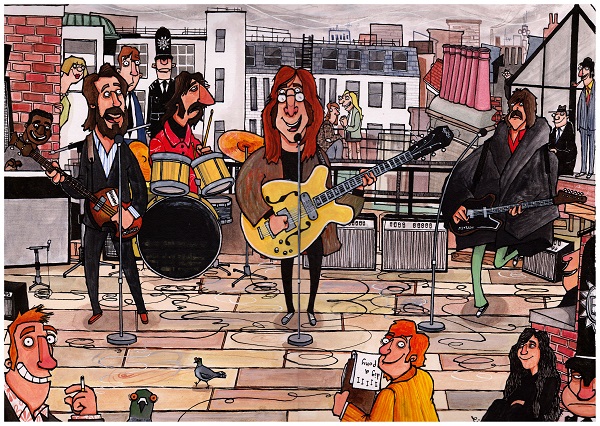
The band began their set with Get Back. Now a song about as familiar to everyone in Britain as the National Anthem (they would play this too, incidentally, while the film crew changed the reels in their cameras), at the time it was so shiny new that it probably took anyone in earshot a minute or so to put together exactly what the hell was going on. They soon realised, however, and a genuine cross-section of British society all began to try as best they could to get a better look. In the film, we see excitable secretaries hurling themselves across busy roads, taxi drivers rubbernecking, businessmen who are old enough to have seen everything wearing faces of childlike wonder and, my own personal favourite, an old boy with a bowler hat and umbrella climbing up a ladder on the outside of a building to stand on his own roof and take in the scene with his hands in his raincoat pockets. The Beatles played Get Back twice in succession, with the first of these performances featuring in the final cut of the Let It Be film.
Next up was Don't Let Me Down, and again it was the first of the two performances of John Lennon's new song that afternoon that made it to the final cut of the movie, in spite of the fact that he forgets the words and fluffs a verse mid-way through. Don't Let Me Down would appear on the B side of the Get Back single that April, although it was inexplicably cut from the final Let It Be album by its producer. This would normally represent the biggest dick move of any producer's career, but in this case I think we can make an exception as the culprit in this instance was Phil Spector.
The fourth song of the set was a first of two versions of I've Got A Feeling. In the film, it accompanies a slew of interviews with the spectators who had gathered on the streets below and you can easily, even if you are familiar with the record, miss the fact that the version that appeared on the final album is this live performance. It is a persuasive hint of just how tight The Beatles' playing was that day. Having not played live to anyone in almost a thousand days, on a frigid London rooftop and singing to leaden, empty January skies, here was a band who still had it, never lost it and had sufficient left to just give it away. The next song in the set, One After 909 would also appear on the LP in its live form.
Song six is Dig A Pony. Ringo Starr bellows “hold it!” to halt the introduction because he had been trying to choke down a cheeky cigarette and needed to extinguish it. Lennon, meanwhile, is not confident in his lyrical recall and reads them off book – held in front of him by a lackey no doubt pondering that this will probably be the greatest thing that ever happens to him in his whole life.
By this point, there is considerable commotion in and around the streets of London, as one might expect when the world's greatest rock and roll band play a free concert completely on a whim in the centre of one of the world's great capital cities. Not everyone shares quite the sense of wonder that the whole occasion engenders within me, however. This is, after all, England and English people will always react accordingly. “This type of music is all right in its place and I think it's quite enjoyable,” explains a besuited business type who could be any age from an old 30 to a young 55, “but I think its a bit of an imposition to absolutely disrupt all the business in this area”. As a fellow Englishman, it is hard to argue with him on this point, even though I feel that there need to be exceptions to many a hard and fast rule, particularly if The Beatles are involved. Perhaps he was one of the people who called in the Old Bill to sort it out. Either way, there was by now a growing police presence in Savile Row. They were initially denied entrance to number 3 by the Apple Corps staff, perhaps mindful that the building probably contained all of the drugs in the entire world. However, once the rozzers began threatening arrests for obstruction, uniformed officers slowly began to percolate throughout the building and onto the roof itself.
Still treading the duck boards, The Beatles were by now onto their seventh and eighth numbers of the set, second versions of I've Got A Feeling and Don't Let Me Down. In the latter case, Lennon manages to get the lyrics right and as such a complete live version of the song could later be stitched together and released on Let It Be: Naked. By this point, the powers that be were really rather insistent that the band should stop making this unholy and unexpected racket. Perhaps they were just fed up with all the repetition and could have been placated with a few verses of Ticket To Ride? We'll never know.
Now surrounded by enough police officers to host an FA Cup tie, the band lurched into their final song, the last they would ever play in public together. It was a third performance of Get Back and it is the scuzziest yet, not helped by the fact that the groups' long-suffering personal assistant Mal Evans had been told to turn off the amplifiers by a police officer and, understandably enough, had complied with the instruction. The sound drops out as Lennon and Harrison try to wail on their axe only to get a handful of silence, before both men plug themselves in again on the fly while the song rolls on almost seamlessly. This third version is the one that was released in Anthology 3, complete with McCartney's improvised final verse: “you've been playing on the roof again, and that's no good, your momma doesn't like that, she's going to have you arrested!”. The song concludes hurriedly and is greeted by a loud cheer from Maureen Starkey, Ringo's wife. “I'd like to thank you on behalf of the group and myself and I hope we've passed the audition,” says Lennon to peals of part-sycophantic, part-nervous, part-genuine laughter. The Beatles may not have left the building, but they were no longer on its roof.
In the end, no-one was arrested, a fact made scarcely credible by the sheer quantity of narcotics contained within the Apple building. Perhaps The Beatles had built up enough residual goodwill that the police were willing to turn a blind eye. They had just played a killer gig, after all, and as a passing vicar points out in the finished film, “it's nice to get something for free in this country at the moment...”
However, the long term effects on the group would take their toll. The Get Back sessions had been marred by so much ill-feeling that the album and feature film were shelved, the group instead throwing themselves into recording what would become Abbey Road, a more fitting final hurrah for the band that had changed the course of Western culture forever. On April 10th 1970 (a Friday), Paul McCartney announced that he had left the band and The Beatles were no more. The following month, a Phil Spector-produced rehash of the turbulent Get Back sessions would be released as the Let It Be album, in tandem with a feature film of the same name. Both were hugely successful at the time but have subsequently been reviewed in a far harsher light, unfairly so in my view. There are brilliant moments in each and, although it isn't nice to see it when mummy and daddy fight, they both still love us all the same.
Imagine being there, though. That day in January, now fifty years ago. A moment of history, lovingly recorded so that we can all still be a part of it, unfolding before your very eyes and ears. It must have been hard to fully comprehend the magnitude of what you had witnessed, a process that could only truly begin once it was confirmed that these four brilliant men would never again play together. A process that still isn't over now, as current and future generations still come to grips with what The Beatles did and what they gave us. They were the big bang that created our cultural universe. This was their farewell.
Of course, it is not always this way. Nothing that is possessed of the power of music could always slide by unnoticed and as a result there have been some performances so shattering, so profound and so memorable that they have – directly or otherwise – shaped the course of more or less everything that happened next. This is a fact that is particularly on my mind today, for reasons that I will get into shortly. However, I feel it would be germane at this point to first provide some examples of gigs that sent ripples far beyond their own pond, just in case any of you think that I am lying.
Case study 1: Bob Dylan is so Punk it's unbelievable 1965-1966
One of the curious and unexpected effects of the rise of technology that still threatens to end us all was the re-emergence of the folk music scene in America during the 1950s and 1960s. The apex of this movement was the Newport Folk Festival, an annual three-day analogue happening on the picturesque New England coast; THE place for all the insufferable hairshirt-wearing, hempy draft-dodgers to assemble for a coffee clatch, smoke a doobie and listen to Pete Seeger sing a scurrilous eighteen-verse song about King George II as two shirtless men chop wood at the side of the stage.
Dylan's gig there in 1964 had been greeted by the kind of fervent, rapturous response normally reserved for Jesus Christ on Palm Sunday. Perhaps mindful of what happened to the J man subsequently, the following year the prophet of all of the oakiest folkies decided that the time had come to mix things up a little. On Saturday 24th, Dylan played a three-song acoustic set at an afternoon workshop, accompanied only by his guitar, harmonica and (presumably) two blacksmiths casting pewter tankards, before making the spontaneous and momentous decision to play an electric set the following day to showcase his new material accompanied by the Paul Butterfield Blues Band.
![]() |
| Bob Dylan at the Newport Folk Festival 1965: Sing while you slave but I just get bored |
This Sunday evening set was completely incendiary. Dylan would again play three songs, but this time his output came courtesy of RAW POWER. He clattered through this truncated set, playing into a wall of discontent and studied outrage, before leaving the stage to a cacophony of jeering and politically appropriate anger. The evening's master of ceremonies Peter Yarrow was left on the verge of tears. Neither in his role as King of the Hippies nor or as Peter from Peter, Paul and Mary had he ever had to deal with such overt and voluble hostility and Yarrow begged Dylan to return to the stage and continue his performance. This he did, unaccompanied once more, cheered to the echo by the same crowd who minutes before had been baying for his blood. An unprepared Dylan didn't have the correct mouth organ and asked the crowd whether or not anyone had an E harmonica. The subsequent volley of metal objects that hurtled towards the stage had been quite unmatched in the area since the Revolutionary War and, now musically replete, Dylan performed two more songs to placate the crowd, whom rock historians by this point may have started to suspect of being a load of reactionary idiots. Dylan wouldn't return to folk music's hallowed spot again until 2002 where, possibly still wary of reprisals from hacky sack-playing beatnik wastrels, he played his set decked out in a wig and false beard.
But it wasn't just American folk fans who had temporarily lost the Zeitgeist: it turned out that British people can be idiots as well, and idiocy without the consoling prospect of the imminent tour of duty in Vietnam is a deadly combination indeed. The following year, during a rambunctiously adversarial European tour, on 17th May 1966 (a Tuesday) Dylan played a concert at the Free Trade Hall, Manchester which would become perhaps the most notorious, bootlegged and discussed non-festival gig ever played in the United Kingdom.
Anyone who believes that trolling is a modern phenomenon that came about with the advent of online communities need only look at the set list from that night in order to see the errors in their thinking. The first half of Dylan's show, solo and accompanied only by himself on acoustic guitar and harmonica, was largely comprised of pared-down versions of his newer material, cribbed from the contentious electric era albums. When he returned for the second half it was in the company of five other musicians, four of whom were on the cusp of finding stardom in their own right as The Band. Here, Dylan played eight more numbers, this time mainly older songs from the folk era but with a thousand volts shoved right up them. The crowd grew increasingly restless, chanting, shouting and slow handclapping their way through the gaps between songs, only for Dylan and his band to beat them back into submission with another wall of noise. The whole affair culminated in the most famous heckle in rock and roll history: “Judas!”, followed by its most famous riposte: a version of Like A Rolling Stone that, as per Dylan's instruction to his group, was played “fucking loud”. Dylan would suffer a serious motorcycle accident two months later and following his recuperation would choose instead to tread a less confrontational path: country rock.
Case study 2: Otis Redding makes black all right for the all whites, 1967
The United States of America's black community had been quietly producing all the music that mattered for generations, only for the rest of the population to ignore it and then have it sold back to them by more "palatable" (i.e. white) British acts for much of the preceding decade. The 1967 Monterrey Pop Festival was when White America finally woke up to this fact and realised they could cut out the middle man and, in turn, help make America great again. The Jimi Hendrix Experience blew a few minds later that weekend (lest we forget that Hendrix himself had needed to leave America and go to the UK in order to gain any recognition as a solo artist, a fact which history has rendered completely absurd), but the standout moment was Otis Redding's set on 17th June 1967, a Saturday. Backed by the Stax Records house band Booker T and the MGs, it culminated in a screaming rendition of Try A Little Tenderness so shattering that it can, even now, still peel the skin from your face. White America, suitably chastened, would never again so wilfully close its ears en masse to the music of their black brethren. This is a considerable legacy for just an hour's work and all suitably marvelled. Unfortunately for Redding, his personal legacy would be cemented by his untimely death in an aeroplane crash just six months later.
Case study 3: James Brown saves Boston
Martin Luther King, one of the great orators and humanitarian figures of the 20th Century was assassinated on April 4th 1968 in Memphis, Tennessee. This was a Thursday and by Friday morning, many of America's inner-cities were already counting the cost of a night of protest, anger and civil disobedience. In Boston, MA, the powers that be had a bright idea: if they could get WBGH-TV to film and broadcast the James Brown show scheduled for the night of April 5th at the Boston Garden, perhaps everyone who might otherwise be keeping themselves occupied by rioting would instead be glued to their television sets.
Brown himself took some convincing: he had already signed a contract with a rival TV station for the exclusive filming of a later show in the same tour and if he allowed the Boston gig to be broadcast he would break its non-compete clause, costing him a cool $60,000. No matter: the Boston city government put their hands in their pockets and paid him the difference, in what turned out to be a particularly savvy move for all concerned. Brown's electrifying eleven song set and legendary stage show had the effect that the city council had desired. Having succumbed to riots and fires on Thursday evening, Boston remained calm that Friday night while many other major American cities continued to burn.
All of this is not to say that the whole event was without a frisson of tension, however. In fact, the whole gig was a tinderbox, but one that would be masterfully handled by the hardest working man in showbusiness. The overall effect is completely electrifying, as well as pregnant with a sense of historical significance. In the most famous point in the show, the stage was invaded by over-enthusiastic fans and Brown had to stop the concert in order to prevent the police and venue security from over-reacting in their attempts to make them stand down. Having re-established control and his authority over the situation, Brown would then turn on his audience, admonishing the crowd: “Wait a minute, wait a minute now WAIT!” Brown yelped. “Step down, now, be a gentleman….Now I asked the police to step back, because I think I can get some respect from my own people!”
Case study 4: Jimi Hendrix breaks the national anthem, 1969
As we have previously discussed, Jimi Hendrix had gone to some lengths to get some respect from his own people and at The Woodstock Festival, New York on 18th August 1969 (it was a Monday), he would crystallise his entire experience of race and of national identity down into a single unforgettable moment. With his new band, Gypsy Sun and Rainbows, Hendrix closed the 20th Century's most legendary countercultural gathering with a middling twelve-song set (beginning at the decidedly un-rock'n'roll time of 9 am) that would become infamous for a wailing three-minute long electric guitar rendition of The Star Spangled Banner. Filled with feedback, distortion and notes bent way out of shape by his Stratocaster's tremolo bar, it was viewed by many as a protest - against prevailing racial politics in the US and against its ongoing war in Vietnam - and it caused quite a stir in the United States at large, already a country notably and visibly fractured along generational lines. Hendrix himself later told talk show host Dick Cavett that he didn't consider his performance unorthodox in the least. "I thought it was beautiful". Perhaps it was. Perhaps his tongue was in his cheek. It is a moment frozen in time, whose power to move and shock and provoke is seemingly captured inside the same amber.
![]() |
| David Bowie and friend, 1973. Only one of these men is telling the truth |
Case study 5: David Bowie kills an alien, 1973
Tuesday 3rd July 1973. As his alter-ego Ziggy Stardust, Bowie - a man who craved fame but who just two years previously couldn't even have gotten himself arrested - sent the entire world's youth population into spasms of uncontrollable grief with a spontaneous announcement that this would be "the last show that we ever do". That night, July 3rd 1973 (a Tuesday) Bowie - backed by Mick Ronson, Woody Woodmansey and Trevor Bolder (with additional help from Jeff Beck) - played an extensive seventeen song set, drawing on all his previous album releases as well as covers of songs by both The Velvet Underground and Jacques Brel. The resulting concert entered legend both for Bowie's dramatic announcement of his retirement (actually, he was just off to return to his home planet) and the fact the whole happening was filmed by feted rockumentarian D.A. Pennebaker.
What the anguished teens who were still reeling from the Ziggy-shaped void that had just been ripped into their souls were not to know is how lucky they had been to be getting any of this at all: earlier that day, a notorious gang of Shepherd's Bush herberts had broken in to the Hammersmith Odeon and nicked thousands of pounds worth of high end public address and recording equipment. They were, however, to put it to good use.
Case study 6: Manchester's Big Bang, 1976
At the Lesser Free Trade Hall, Manchester on 4th June 1976 (a Friday), a then little-known group of London herberts (featuring Shepherd's Bush's very own Steve Jones on lead guitar) called the Sex Pistols played to an estimated crowd of as many as 40 people. Such would prove to be the cultural impact of what happened that night, almost everyone who worked in the music industry alive on Earth at the time has subsequently claimed to have been one of them.
![]() |
| Steve Jones of the Sex Pistols, off out shopping |
The Pistols wouldn't achieve their national notoriety until the December 1st that year (Wednesday) when Jones dropped the F-bomb on tea time television. Six months prior, on that night in Manchester the band played thirteen songs, five of which were covers, some indication as to how limited their repertoire still was at this point. The crowd sat transfixed by this clattering, antagonistic and utterly indifferent performance and then staggered out into the world with an urgent need to create their own music. Confirmed attendees that night included Mark E. Smith of The Fall; Bernard Sumner, Peter Hook, Steve Morris and Ian Curtis (later Joy Division and three-quarters of New Order); Pete Shelley, Steve Diggle, John Maher and Howard Devoto of The Buzzcocks; Stephen Morrissey (later of The Smiths, Morrissey and other notoriety); TV producer and future record label impressario Anthony H. Wilson and, yes, Simply Red's and sex with ladies' Mick Hucknall. "It was our Big Bang," Hook would tell the BBC years later. "It created our musical universe". It was, and it did. The course of British culture was definitively and permanently diverted as a result, in ways which can still be seen and felt over forty years later. No-one had even so much as thought to record it, one of rock's greatest oversights.
Case study 7: Radio Ga-Ga, 1985
In 1985, Bob (now Sir Bob) Geldof and Midge (he got an OBE in 2005) Ure (with a smattering of help, no doubt, from Harvey Goldsmith) organised the world's biggest ever charity concert, to raise money for the victims of the brutal, pitiless, civil war and famine in Ethiopia. This became known as Live Aid and took place on 13th July 1985 (which was a Saturday) at both Wembley Stadium in London and the John F. Kennedy Stadium in Philadelphia, PA. The London gig had been rattling along nicely for six hours and 41 minutes by the time that Queen - a band who, variously, were largely considered to be at the time either all washed up, rock dinosaurs or (rather more troublingly) mercenary shills of the Apartheid regime in South Africa - took to the stage, introduced by comedians Griff Rhys-Jones and Mel Smith dressed as policemen.
They would play six songs in a set lasting just over twenty minutes, including fragments of classic hits Bohemian Rhapsody, We Will Rock You and We Are The Champions, as well as their current single Hammer To Fall. But it was their unremittingly powerful rendition of Radio Ga-Ga that stole the show, no small boast for a show that an estimated FORTY PERCENT OF THE WORLD'S POPULATION was actively engaged in watching. Freddie Mercury's charismatic pull was astonishing to an extent that it has later drawn parallels with the performance of Adolf Hitler at the Nuremburg Rallies in the 1930s. This was perhaps not what the band were aiming for but then Hitler couldn't possibly compete with their record sales, which went through the roof almost immediately. It guaranteed that it this would be another good year all round for the band. And for the starving Africans, of course.
It was, and is, a mesmeric performance, its power to affect quite undimmed by time, its impact still tangible from watching the recording back on YouTube 34 years removed, which I would heartily advise.
Up on the roof, January 30th 1969
But for all of this: for all of the cultural impact, for all the lives touched and the paths changed, it all pales into insignificance next to an impromptu 42-minute performance in central London fifty years ago today. It is, for me, surely the greatest concert ever played in the history of popular music. The band who gave it played just nine songs. Of these nine, only five were different: one number was repeated on no fewer than three occasions and two others were played twice.
No-one had heard any of these songs before, either: the group eschewed the potential to run through their greatest hits and instead picked all new numbers from a forthcoming LP that wouldn't be released for another 14 months, by which time the band itself had broken up. Two of them were wearing their wife's coat to keep warm in the January air and the gig itself would be curtailed by the intervention of the Metropolitan Police. It was 30th January 1969, a Thursday, on the roof of a terraced office building at number 3 Savile Row, Mayfair. The group in question were The Beatles, accompanied by Billy Preston on an electronic piano. It would be the last time they ever played together in public.
Indeed, this was the first time that The Beatles had performed live ANYWHERE outside of a recording studio for 886 days, since their concert at Candlestick Park, San Francisco on 29th August 1966 (a Monday). For one of their number, it would prove to be the penultimate live performance of a brilliant career: John Lennon would appear before an audience just once more before his untimely death in 1980, once again unbilled, during the encore of an Elton John concert at Madison Square Garden, New York City on 28th November 1974. Which was a Thursday.
The genesis of the idea that led them to the rooftop was a desire to recapture the spirit of live performance after two and a half years of studio-based nurdling, radical experimentation and fierce, circular arguments that had left the group on the brink of dissolution. It stemmed from the death of their manager, Brian Epstein, in the summer of 1967: the group had reinvented the possibilities of popular music but were, from a personal and professional point of view, now completely rudderless. Step forward Paul McCartney, who as the band's new self-appointed leader would spend the remainder of the group's life royally pissing everyone off.
After the backbiting and ill-feeling that had marinaded the recording sessions for The White Album, McCartney had developed the theory that the solution to all of The Beatles problems would be to play live together again just as they had in the olden days, after these lost years of overdubs, tape loops and pissy arguments in windowless rooms. The rest of the band, despite some serious misgivings, went along with this idea if only to shut McCartney up and so the Get Back project was born. McCartney's idea ran as follows: just after the new year in 1969, the band would reconvene at Twickenham film studios to begin rehearsals for their triumphant return to the stage. The songs that they produced would form the basis of this mooted concert at the Royal Albert Hall, as well as being the contents of their next album. In addition, a film crew would accompany the group throughout, making a fly-on-the-wall documentary about how it all came together.
The eventual documentary, Let It Be, was released the following year and portrays four men who had grown apart, going through the motions of being in The Beatles because they didn't yet know any other life. John Lennon spends much of the time huddled in a corner giggling conspiratorially with Yoko Ono and Ringo Starr sits forlornly behind his drum kit, hoping that someone, somewhere, would give him something to do. The sessions were particularly tough on George Harrison, who was the Beatle with the strongest distaste for the return to live performances. Early in the film we watch him get electrocuted twice by a microphone stand, before he receives an equally unwelcome dressing down from the matronly McCartney for his failure to play his guitar parts properly.
Thankfully, what happened next did not make it into the film. On January 10th (a Friday), he and Lennon had a fearsome argument which some reported turned into a physical altercation (although this was later denied by both parties). At issue was Yoko Ono's continued attendance at rehearsals (that old chestnut) and Lennon's strident dismissals of Harrison's new material. At this point, Harrison had flourished as a songwriter – in one scene in the Let It Be film we hear him working his way through the chords for Something – and Lennon and McCartney's continual treatment of his creative output as an afterthought, a mere trifle or good only as album filler was becoming a serious issue. Serious enough, in fact, for Harrison to walk out of Twickenham Studios and announce to the rest of the group he would not be coming back.
Days of mediation followed (although the hard-boiled Lennon's idea was to “just get Eric Clapton in”) and when George agreed to make the Fab Four again it was on the understanding that he would not be a part of any concert, at the Royal Albert Hall or otherwise. George would return to the fold with his friend, keyboard player Billy Preston, in tow. This was a time honoured Harrison trick: bring an outsider with you to recording sessions in the hope it would make the others behave. It worked, too, but McCartney's grand plans seemed to be dead in the water.
Eventually, a compromise solution was agreed where the band would go up onto their office roof and play a set of the material they had been filmed working up, completely unannounced. And so it came to pass that after lunch on January 30th 1969, the Beatles emerged to play in the open air one last time. Many of the staff at Apple Corps would join them to spectate, too, taking a break from their normal day-to-day office activities – chiefly making reverse charge telephone calls to Canberra and smoking ounce after ounce of Moroccan black, according to Ringo Starr's later account of his erstwhile employees' labours.
![]() |
| The Beatles, 3 Savile Row, London; 30th January 1969 (a Thursday) |
The band began their set with Get Back. Now a song about as familiar to everyone in Britain as the National Anthem (they would play this too, incidentally, while the film crew changed the reels in their cameras), at the time it was so shiny new that it probably took anyone in earshot a minute or so to put together exactly what the hell was going on. They soon realised, however, and a genuine cross-section of British society all began to try as best they could to get a better look. In the film, we see excitable secretaries hurling themselves across busy roads, taxi drivers rubbernecking, businessmen who are old enough to have seen everything wearing faces of childlike wonder and, my own personal favourite, an old boy with a bowler hat and umbrella climbing up a ladder on the outside of a building to stand on his own roof and take in the scene with his hands in his raincoat pockets. The Beatles played Get Back twice in succession, with the first of these performances featuring in the final cut of the Let It Be film.
Next up was Don't Let Me Down, and again it was the first of the two performances of John Lennon's new song that afternoon that made it to the final cut of the movie, in spite of the fact that he forgets the words and fluffs a verse mid-way through. Don't Let Me Down would appear on the B side of the Get Back single that April, although it was inexplicably cut from the final Let It Be album by its producer. This would normally represent the biggest dick move of any producer's career, but in this case I think we can make an exception as the culprit in this instance was Phil Spector.
The fourth song of the set was a first of two versions of I've Got A Feeling. In the film, it accompanies a slew of interviews with the spectators who had gathered on the streets below and you can easily, even if you are familiar with the record, miss the fact that the version that appeared on the final album is this live performance. It is a persuasive hint of just how tight The Beatles' playing was that day. Having not played live to anyone in almost a thousand days, on a frigid London rooftop and singing to leaden, empty January skies, here was a band who still had it, never lost it and had sufficient left to just give it away. The next song in the set, One After 909 would also appear on the LP in its live form.
Song six is Dig A Pony. Ringo Starr bellows “hold it!” to halt the introduction because he had been trying to choke down a cheeky cigarette and needed to extinguish it. Lennon, meanwhile, is not confident in his lyrical recall and reads them off book – held in front of him by a lackey no doubt pondering that this will probably be the greatest thing that ever happens to him in his whole life.
By this point, there is considerable commotion in and around the streets of London, as one might expect when the world's greatest rock and roll band play a free concert completely on a whim in the centre of one of the world's great capital cities. Not everyone shares quite the sense of wonder that the whole occasion engenders within me, however. This is, after all, England and English people will always react accordingly. “This type of music is all right in its place and I think it's quite enjoyable,” explains a besuited business type who could be any age from an old 30 to a young 55, “but I think its a bit of an imposition to absolutely disrupt all the business in this area”. As a fellow Englishman, it is hard to argue with him on this point, even though I feel that there need to be exceptions to many a hard and fast rule, particularly if The Beatles are involved. Perhaps he was one of the people who called in the Old Bill to sort it out. Either way, there was by now a growing police presence in Savile Row. They were initially denied entrance to number 3 by the Apple Corps staff, perhaps mindful that the building probably contained all of the drugs in the entire world. However, once the rozzers began threatening arrests for obstruction, uniformed officers slowly began to percolate throughout the building and onto the roof itself.
Still treading the duck boards, The Beatles were by now onto their seventh and eighth numbers of the set, second versions of I've Got A Feeling and Don't Let Me Down. In the latter case, Lennon manages to get the lyrics right and as such a complete live version of the song could later be stitched together and released on Let It Be: Naked. By this point, the powers that be were really rather insistent that the band should stop making this unholy and unexpected racket. Perhaps they were just fed up with all the repetition and could have been placated with a few verses of Ticket To Ride? We'll never know.
Now surrounded by enough police officers to host an FA Cup tie, the band lurched into their final song, the last they would ever play in public together. It was a third performance of Get Back and it is the scuzziest yet, not helped by the fact that the groups' long-suffering personal assistant Mal Evans had been told to turn off the amplifiers by a police officer and, understandably enough, had complied with the instruction. The sound drops out as Lennon and Harrison try to wail on their axe only to get a handful of silence, before both men plug themselves in again on the fly while the song rolls on almost seamlessly. This third version is the one that was released in Anthology 3, complete with McCartney's improvised final verse: “you've been playing on the roof again, and that's no good, your momma doesn't like that, she's going to have you arrested!”. The song concludes hurriedly and is greeted by a loud cheer from Maureen Starkey, Ringo's wife. “I'd like to thank you on behalf of the group and myself and I hope we've passed the audition,” says Lennon to peals of part-sycophantic, part-nervous, part-genuine laughter. The Beatles may not have left the building, but they were no longer on its roof.
In the end, no-one was arrested, a fact made scarcely credible by the sheer quantity of narcotics contained within the Apple building. Perhaps The Beatles had built up enough residual goodwill that the police were willing to turn a blind eye. They had just played a killer gig, after all, and as a passing vicar points out in the finished film, “it's nice to get something for free in this country at the moment...”
However, the long term effects on the group would take their toll. The Get Back sessions had been marred by so much ill-feeling that the album and feature film were shelved, the group instead throwing themselves into recording what would become Abbey Road, a more fitting final hurrah for the band that had changed the course of Western culture forever. On April 10th 1970 (a Friday), Paul McCartney announced that he had left the band and The Beatles were no more. The following month, a Phil Spector-produced rehash of the turbulent Get Back sessions would be released as the Let It Be album, in tandem with a feature film of the same name. Both were hugely successful at the time but have subsequently been reviewed in a far harsher light, unfairly so in my view. There are brilliant moments in each and, although it isn't nice to see it when mummy and daddy fight, they both still love us all the same.
Imagine being there, though. That day in January, now fifty years ago. A moment of history, lovingly recorded so that we can all still be a part of it, unfolding before your very eyes and ears. It must have been hard to fully comprehend the magnitude of what you had witnessed, a process that could only truly begin once it was confirmed that these four brilliant men would never again play together. A process that still isn't over now, as current and future generations still come to grips with what The Beatles did and what they gave us. They were the big bang that created our cultural universe. This was their farewell.
Friday, 17 March 2017
(Sometimes) With The Beatles
Have you ever considered the possibility that all musicians are a bunch of shiftless, dishonest bastards? It is a tantalising possibility, isn't it? Particularly with regard to groups. If you settle down to listen to a Bob Dylan LP, for instance, you can be pretty sure that ol' Bob was responsible for at least some of the sounds that you are hearing. But groups are a very different dynamic: the achingly fashionable Johnnies you saw on Top of the Pops last week might have had very little to do with their latest 45.
That said, there's nothing particularly wrong with this state of affairs. Artists have employed assistants for centuries to do all kinds of different work for them, often completely anonymously and without any expectation of credit. It is said that the modern day artist is more of a manager than a craftsperson, but it was ever thus: Andy Warhol got his mum to sign his work for him and while Michaelangelo did most of the figurative painting on the ceiling of the Sistine Chapel himself, he still had a grunt on the ground telling him where to put extra pubes, mixing his paint and passing him up sausage rolls.
It is, of course, particularly rife in popular music. The majority of The Beach Boys' most famous recordings were made by the Wrecking Crew, a Los Angeles-based supergroup of session musicians. Led Zeppelin were similarly formed by players from the London recording scene. And the less said about Milli Vanilli, the better.
Which brings me to The Beatles, who whether you like it or not happen to be the most famous and notable recording artists in history. This is a major advantage, as from a point in around the middle of 1962, no-one closely involved in their story has been able to do so much as a fart without Mark Lewisohn noting it down. As such, we are able to establish exactly who did what, where and when. The following is a list (possibly incomplete but hopefully not too badly so) of recordings released by The Beatles which did not have all four canonical members of the group playing on them. There will be a test later.
YESTERDAY
Only Paul McCartney appears on the record: the other musicians were a string quartet, arranged by George Martin and comprised of Tony Gilbert, Sidney Sax, Kenneth Essex and Peter Halling or Francisco Gabarro.
WE CAN WORK IT OUT
Is is unknown for sure whether or not George Harrison is present on this recording: some have argued that he provided the tambourine but others believe that this was played by Ringo Starr. Harrison did, however, contribute to the song's composition.
ELEANOR RIGBY
Ringo Starr is absent from this track, with John Lennon and George Harrison only providing vocals. The music was provided exclusively by a string nonet arranged by George Martin and comprising Tony Gilbert, Sidney Sax, John Sharpe and Jürgen Hess on violin; Stephen Shingles and John Underwood on viola and Derek Simpson, Stephen Lansberry and Peter Halling on cello.
LOVE YOU TO
John Lennon is absent from this recording, with Paul McCartney only offering vocals and Ringo Starr on tambourine. The group was bolstered by the addition of Anil Bhagwat on tabla and musicians from the Asian Music Circle on sitar and tambura.
WITHIN YOU WITHOUT YOU
George Harrison recorded this solo, assisted by musicians from the Asian Music Circle providing dilrubas, tabla, swarmandal and tambura accompaniment.
SHE'S LEAVING HOME
Features only Paul McCartney and John Lennon, who provide only vocals. She's Leaving Home is one of a scant few Beatles tracks on which none of the canonical four play any musical instrument.
THE INNER LIGHT
Ringo Starr is absent from this recording. Parts of this song, which appeared as the B-side of the single Lady Madonna, were recorded at a session in Bombay during the group's stay in India. It is the only song ever issued by The Beatles not to have been recorded solely in the UK.
BACK IN THE U.S.S.R.
DEAR PRUDENCE
Ringo Starr left The Beatles following a series of escalating intra-band arguments and did not appear on either of the opening songs on the white album. Paul McCartney provided the percussion instead.
WILD HONEY PIE
BLACKBIRD
All exclusively solo Paul McCartney projects.
MARTHA MY DEAR
Paul McCartney was again the sole representative on this recording, which was bolstered by a 15-man brass and string orchestra arranged by George Martin.
DON'T PASS ME BY
The first Beatles song solely written by Ringo Starr, only Paul McCartney joins him on the recording; with additional violin by Jack Fallon.
WHY DON'T WE DO IT IN THE ROAD?
Paul McCartney recorded this song solo, although Ringo Starr would later overdub his own drum track which eventually appeared in the finished version.
I WILL
George Harrison was otherwise occupied for the recording of this song, which required 67 takes.
JULIA
John Lennon's first and only exclusively solo effort as a Beatle.
MOTHER NATURE'S SON
Ironically recorded at a time of great disharmony within the group, McCartney recorded the song alone, later adding in a George Martin brass arrangement. Lennon and Starr were, reportedly, extremely peeved that McCartney had taken his own initiative.
LONG, LONG, LONG
SAVOY TRUFFLE
Lennon was absent from the session in which both of these songs were recorded.
GOOD NIGHT
Ringo Starr provides the vocal for this John Lennon-penned song, with orchestral accompaniment arranged by George Martin and backing vocals from The Mike Sammes Singers.
ACROSS THE UNIVERSE
Paul McCartney is absent from the Phil Spector-produced version that appeared on the Let It Be album, although he appears on the "birdsong" version recorded for the World Wildlife Fund at the request of Spike Milligan, which was subsequently released on Past Masters volume 2.
I ME MINE
John Lennon had left the band by the time this Harrison composition was recorded. However, the session - in which John Lennon instead spent his time dancing in the corner of the studio with Yoko Ono - appeared in Michael Lindsay-Hogg's film Let It Be and therefore had to be included on the finished album.
THE BALLAD OF JOHN AND YOKO
George Harrison was on holiday and Ringo Starr away filming The Magic Christian when inspiration struck Lennon to write this song, which he recorded with help from McCartney on vocals, bass, percussion and piano.
MAXWELL'S SILVER HAMMER
HERE COMES THE SUN
GOLDEN SLUMBERS
John Lennon was in a car accident in Scotland on July 1st 1969 which saw him hospitalised for six days and absent from several sessions for the Abbey Road album. Lennon had returned to London and to the studio by the time work began on Maxwell's Silver Hammer, but declined to take part because he thought the song was "rubbish".
BECAUSE
Ringo Starr is absent from this song, which required no percussion. Or at least, that was their story.
HER MAJESTY
A Paul McCartney solo.
(honourable mention: The version of Love Me Do that appears on the Please Please Me album (and also released as a single in the US market) features session musician Andy White on drums instead of then-newcomer Ringo Starr. However, Ringo is on the record, playing the tambourine. The version of Love Me Do that appears on Past Masters Vol. 1 has Ringo restored to his rightful seat.)
That said, there's nothing particularly wrong with this state of affairs. Artists have employed assistants for centuries to do all kinds of different work for them, often completely anonymously and without any expectation of credit. It is said that the modern day artist is more of a manager than a craftsperson, but it was ever thus: Andy Warhol got his mum to sign his work for him and while Michaelangelo did most of the figurative painting on the ceiling of the Sistine Chapel himself, he still had a grunt on the ground telling him where to put extra pubes, mixing his paint and passing him up sausage rolls.
It is, of course, particularly rife in popular music. The majority of The Beach Boys' most famous recordings were made by the Wrecking Crew, a Los Angeles-based supergroup of session musicians. Led Zeppelin were similarly formed by players from the London recording scene. And the less said about Milli Vanilli, the better.
![]() |
| The Beatles: Jim, Peter, Gregory and Roland |
Which brings me to The Beatles, who whether you like it or not happen to be the most famous and notable recording artists in history. This is a major advantage, as from a point in around the middle of 1962, no-one closely involved in their story has been able to do so much as a fart without Mark Lewisohn noting it down. As such, we are able to establish exactly who did what, where and when. The following is a list (possibly incomplete but hopefully not too badly so) of recordings released by The Beatles which did not have all four canonical members of the group playing on them. There will be a test later.
YESTERDAY
Only Paul McCartney appears on the record: the other musicians were a string quartet, arranged by George Martin and comprised of Tony Gilbert, Sidney Sax, Kenneth Essex and Peter Halling or Francisco Gabarro.
WE CAN WORK IT OUT
Is is unknown for sure whether or not George Harrison is present on this recording: some have argued that he provided the tambourine but others believe that this was played by Ringo Starr. Harrison did, however, contribute to the song's composition.
ELEANOR RIGBY
Ringo Starr is absent from this track, with John Lennon and George Harrison only providing vocals. The music was provided exclusively by a string nonet arranged by George Martin and comprising Tony Gilbert, Sidney Sax, John Sharpe and Jürgen Hess on violin; Stephen Shingles and John Underwood on viola and Derek Simpson, Stephen Lansberry and Peter Halling on cello.
LOVE YOU TO
John Lennon is absent from this recording, with Paul McCartney only offering vocals and Ringo Starr on tambourine. The group was bolstered by the addition of Anil Bhagwat on tabla and musicians from the Asian Music Circle on sitar and tambura.
WITHIN YOU WITHOUT YOU
George Harrison recorded this solo, assisted by musicians from the Asian Music Circle providing dilrubas, tabla, swarmandal and tambura accompaniment.
SHE'S LEAVING HOME
Features only Paul McCartney and John Lennon, who provide only vocals. She's Leaving Home is one of a scant few Beatles tracks on which none of the canonical four play any musical instrument.
THE INNER LIGHT
Ringo Starr is absent from this recording. Parts of this song, which appeared as the B-side of the single Lady Madonna, were recorded at a session in Bombay during the group's stay in India. It is the only song ever issued by The Beatles not to have been recorded solely in the UK.
BACK IN THE U.S.S.R.
DEAR PRUDENCE
Ringo Starr left The Beatles following a series of escalating intra-band arguments and did not appear on either of the opening songs on the white album. Paul McCartney provided the percussion instead.
WILD HONEY PIE
BLACKBIRD
All exclusively solo Paul McCartney projects.
MARTHA MY DEAR
Paul McCartney was again the sole representative on this recording, which was bolstered by a 15-man brass and string orchestra arranged by George Martin.
DON'T PASS ME BY
The first Beatles song solely written by Ringo Starr, only Paul McCartney joins him on the recording; with additional violin by Jack Fallon.
WHY DON'T WE DO IT IN THE ROAD?
Paul McCartney recorded this song solo, although Ringo Starr would later overdub his own drum track which eventually appeared in the finished version.
I WILL
George Harrison was otherwise occupied for the recording of this song, which required 67 takes.
JULIA
John Lennon's first and only exclusively solo effort as a Beatle.
MOTHER NATURE'S SON
Ironically recorded at a time of great disharmony within the group, McCartney recorded the song alone, later adding in a George Martin brass arrangement. Lennon and Starr were, reportedly, extremely peeved that McCartney had taken his own initiative.
LONG, LONG, LONG
SAVOY TRUFFLE
Lennon was absent from the session in which both of these songs were recorded.
GOOD NIGHT
Ringo Starr provides the vocal for this John Lennon-penned song, with orchestral accompaniment arranged by George Martin and backing vocals from The Mike Sammes Singers.
ACROSS THE UNIVERSE
Paul McCartney is absent from the Phil Spector-produced version that appeared on the Let It Be album, although he appears on the "birdsong" version recorded for the World Wildlife Fund at the request of Spike Milligan, which was subsequently released on Past Masters volume 2.
I ME MINE
John Lennon had left the band by the time this Harrison composition was recorded. However, the session - in which John Lennon instead spent his time dancing in the corner of the studio with Yoko Ono - appeared in Michael Lindsay-Hogg's film Let It Be and therefore had to be included on the finished album.
THE BALLAD OF JOHN AND YOKO
George Harrison was on holiday and Ringo Starr away filming The Magic Christian when inspiration struck Lennon to write this song, which he recorded with help from McCartney on vocals, bass, percussion and piano.
MAXWELL'S SILVER HAMMER
HERE COMES THE SUN
GOLDEN SLUMBERS
John Lennon was in a car accident in Scotland on July 1st 1969 which saw him hospitalised for six days and absent from several sessions for the Abbey Road album. Lennon had returned to London and to the studio by the time work began on Maxwell's Silver Hammer, but declined to take part because he thought the song was "rubbish".
BECAUSE
Ringo Starr is absent from this song, which required no percussion. Or at least, that was their story.
HER MAJESTY
A Paul McCartney solo.
(honourable mention: The version of Love Me Do that appears on the Please Please Me album (and also released as a single in the US market) features session musician Andy White on drums instead of then-newcomer Ringo Starr. However, Ringo is on the record, playing the tambourine. The version of Love Me Do that appears on Past Masters Vol. 1 has Ringo restored to his rightful seat.)
Saturday, 31 December 2016
The Pengest Version
Cover versions needn't be rubbish. The alchemy that makes a song great involves a confluence of so many different factors: artist, style, production, time, its relevance to current affairs, etc., that it is statistically improbable that the original version of every song should always be definitive. However, the paradigm remains intact - modern humans seem hard-wired to expect that the song's authors will produce the ultimate interpretation. It's enough to make Roland Barthes spit.
It wasn't always so, of course. The people to blame, if you are the sort of person who likes to bear grudges, are the pioneers of Rock 'n' Roll. People like Chuck Berry, Little Richard and Buddy Holly were all self-contained creative hubs, a new breed of recording artists in an industry that had previously been dominated by softly crooned versions of Tin Pan Alley-penned standards. When this was adopted by the early movers and shakers in 1960s popular music - particularly by Bob Dylan and The Beatles (ironically, both extremely adept cover artists) - their contemporaries noticed how much more money they were making and the 'write-it-yourself, play-it-yourself' model became set in stone. Capitalism, there.
2016 has been such a stark, uncertain and frightful year for so many people that the prospect of 2017 being a pale facsimile is enough to make the hole in your arse heal over. This was when my mind turned to cover versions, I guess: looking for examples of when history looked at the past and made it better. As ever, I took to Twitter and asked other people to do my work for me. The resulting list of cover versions of songs better than the originals was, yet again, pretty weighty and will be presented at the bottom of this post for the completists among you.
However, this time I have cast democracy aside and cordoned off a perfect ten. Complaints, as always, to the usual place. Your mum.
10. Saint Etienne - Only Love Can Break Your Heart
Written and first recorded by Neil Young, initially released in 1970.
It is still, just, 2016 and therefore let it first be said that Neil Young is a great artist and long may he reign, but his falsetto heavy version of Only Love Can Break Your Heart is really quite weedy compared to the version released by Saint Etienne twenty years later. Saint Etienne turned Young's slow-punctured balloon into a fully fledged tornado with the judicious application of breakbeats and syncopated piano. The overall effect is to switch the tone from a lachrymose, introspective after-hours bar singalong to a defiant and dubbed-out Poll Tax riot.
9. The Communards - Don't Leave Me This Way
Written by Gamble, Huff and Gilbert. First recorded by Howard Melvin and The Blue Notes, initially released in 1973. Most famously recorded by Thelma Houston and released in 1977.
A classic example of 1970s soul when it was first released in 1973, Thelma Houston re-energised the smooth yet stodgy Howard Melvin original into a huge disco floor-filler in 1977, where it also became an enormously significant anthem for both gay rights and AIDS-awareness. However, neither version can compete with the Hi-NRG version released by The Communards in 1986, a song so bursting with passion and intent that it leaves the previous versions looking ponderously sedate. It also features what is, surely, the greatest ever House music-inspired piano break to be played on record by a licensed clergyman.
8. Soft Cell - Tainted Love
Written by Ed Cobb. First recorded by Gloria Jones, initially released in 1964.
Tainted Love was, in common with the majority of the songs that are now deemed to be bona fide classics of the Northern Soul genre, a largely forgotten recording. It failed to chart in either the US or the UK, where the record buying public at large seemed immune from its urgent, pounding rhythm. Gloria Jones was better known as Marc Bolan's girlfriend and ill-fated chauffeur by the time Soft Cell made the song a huge hit in 1981. Rather than speeding it up, they slowed it down, giving the song space to breathe. Despite this, it retains all the urgency and feeling of the original. Contrary, too, is the warmth that radiates from the recording in spite of the ice and glass of Soft Cell's electronic style.
7. Joe Cocker - With A Little Help From My Friends
Written by Lennon/McCartney. First recorded by The Beatles, initially released in 1967.
Originally the second song on The Beatles' magnum opus Sergeant Pepper's Lonely Hearts Club Band album, its charm, humour and richness was nevertheless completely derailed by Joe Cocker's ferociously powerful rendition, released the following year. Just watch the video. No-one is telling me that Joe Cocker doesn't need more help from his friends than Ringo Starr. But what really sets this version apart is the addition of the full orchestration of American Soul music. Where The Beatles version is perfectly formed and calculated, Cocker's is the roaring, desperate effort of a disparate collective which all somehow keep pulling in the same direction. The overall effect is little short of shattering.
6. Johnny Cash - Hurt
Written by Trent Reznor. First recorded by Nine Inch Nails, initially released in 1995.
This song was, overwhelmingly, the popular choice from my straw poll on Twitter. The original version, suffused with the hollow angst of Generation X, proved to be completely inadequate next to the heartfelt 2003 interpretation by Johnny Cash, reaching the end of his days but completely undimmed as a creative force. The enduring legacy of a cultural giant, its accompanying video has been known to completely overwhelm people of any number of certain ages.
5. The Jimi Hendrix Experience - All Along The Watchtower
Written and first recorded by Bob Dylan, initially released in 1967.
Many people will tell you that every Bob Dylan song is better if someone else is performing it. These people are, almost always, completely mistaken. However, there's no denying this one, released in 1968: even Dylan himself freely admitted that his version couldn't hold a candle to it and he has used Hendrix's arrangement when playing the song live ever since. Dylan's will-o-the-wisp, downstated and bucolic Biblical fable is transformed into a swirling, whirling dervish rock anthem by Hendrix's unique guitar heroism, simultaneously the meat of his sound without ever overwhelming it. Telegraphing the bit where your solo is about to drop is for suckers, kids.
4. Sinead O'Connor - Nothing Compares 2 U
Written by Prince. First recorded by The Family, initially released in 1985
The original version of this song, all sparse instrumentation and peculiar harmony singing by one of Prince's many pet project groups, The Family, is bloody awful. This time, it took some pasty white people to add some genuine soul to a song. Sinead O'Connor's version, which was number 1 in the UK for four weeks at the start of 1990, is completely definitive: all that remains of the original is the stupid abbreviations in the title. Brilliant, bold and defiantly beautiful, it came complete with its own iconic video. What's not to like? Prince, of course, hated it and O'Connor's first meeting with the tiny velvet genius predictably ended in fisticuffs.
3. The Slits - I Heard It Through The Grapevine
Written by Whitfield & Strong. First recorded by Gladys Knight and The Pips, initially released in 1967. Most famously recorded by Marvin Gaye and released in 1968.
There is no denying the fundamental power of Marvin Gaye's recording of this song. It is, quite rightly, considered one of the peaks of the Motown Records story and of its sound. Lushly orchestrated and powerfully delivered, it is one of the great single records of all time. But then along come The Slits, the chaotic "girl group" of the British punk era. Their interpretation of the song was the first thing that they ever recorded in a proper record company studio and it is possessed of a potency that defies easy description. Ari Up's vocals are packed with the confidence and attitude that only being seventeen years old can bring; Viv Albertine's clipped guitar and yelping, discordant backing vocals are endlessly beguiling and fun; Tessa Pollitt's bass turns a soul classic into a skanking uptempo dub bonanza. The fact that they all hum all of those tricky orchestral parts, rather than finding someone to play them, just seals the deal. A swaggering, energetic and life-affirming piece of work.
2. Pet Shop Boys - Always On My Mind
Written by Christopher, James and Carson. First recorded by Gwen McRae, initially released in 1972. Most famously recorded by Elvis Presley and released in 1972; also by Willie Nelson and released in 1982.
A country music standard, Always On My Mind's various versions have produced a series of masterpieces. Elvis Presley's interpretation was voted his greatest ever song in a poll done for ITV in 2013, while Willie Nelson's lush, yearning iteration won him a Grammy. The Pet Shop Boys' rewards were rather more prosaic: Christmas Number 1 in 1987 and now, the number two position in this list. This is not to diminish their electronic pop reading in the least. Simply put, it is one of the most magnificent pop songs ever recorded. Neil Tennant's distant, dispassionate vocal imbues the song with additional power and meaning; while Chris Lowe's layered, upbeat and punchy accompaniment cuts the traditional meandering orchestration through to the quick. The best bit? The theremin break, of course.
1. Aretha Franklin - Respect
Written and originally recorded by Otis Redding, initially released in 1965.
So complete is Franklin's hold over this song that many people don't even know that it is a cover. Otis Redding's scudding, energetic version was quietly establishing itself as a soul standard when Aretha came along in 1967 and completely reinvented it. Where Redding's song was a demure plea from a browbeaten husband, Franklin's was an unashamed statement of intent from women everywhere. Nearly 50 years have past since it was first released and they have done nothing to dim the importance or relevance of her message, nor tarnish the brilliant urgency of her delivery. Aretha Franklin, herself a talented songwriter and musician, has never been bettered as an interpreter of other people's work. A genuine landmark in the development of human culture and civilisation, it should probably be the National Anthem.
So, there you go. Some proof, if it were needed, that the second verse doesn't need to be the same as the first. I wish you all a happy, prosperous and peaceful 2017.
As promised, here is the full list of songs that you considered to be better than the originals. I can vouch for some of them, the others I'll leave up to you to decide:
Alien Ant Farm - Smooth Criminal
Amy Winehouse - Valerie
Bahaus - Ziggy Stardust
The Beatles - Money (That's What I Want)
Blondie - Hanging on the Telephone
Buddy Rich Big Band - The Beat Goes On
The Cramps - Surfin' Bird
The Damned - Eloise
Depeche Mode - Route 66
Dickies - Paranoid
Dinosaur Junior - Feel a Whole Lot Better When You're Gone
Dubstar - Not So Manic Now
Foo Fighters - Baker Street
The Four Tops - Simple Game
Frankie Goes To Hollywood - Born to Run
Gary Jules - Mad World
Grace Jones - Love is the Drug
Guns 'n' Roses - Live and Let Die
Happy Mondays - Step On
Incredible Bongo Band - Apache
The Jam - David Watts
Jane's Addiction - Sympathy for the Devil
John Cale - Hallelujah
Jeff Buckley - Hallelujah
Kevin Rowland - Thunder Road
The Kingsmen - Louie Louie
Lawnmower Deth - Kids in America
Loop - Cinnamon Girl
Marc Almond & Gene Pitney - Something's Got a Hold of my Heart
Michael McDonald - Baby I Need Your Lovin'
The Mike Flowers Pops - Wonderwall
The Mock Turtles - No Good Trying
Nadasurf - Love and Anger
Nancy Sinatra & Lee Hazlewood - You've Lost That Lovin' Feeling
Nirvana - The Man Who Sold the World
Prince - Just My Imagination
R.E.M. - Toys in the Attic
Ray Stevens - Misty
Reigning Sound - Stormy Weather
Robert Wyatt - Shipbuilding
Ryan Adams - Wonderwall
Sid Vicious - My Way
Sonic Youth - Addicted to Love
Sonic Youth - Superstar
Stereophonics - Handbags and Gladrags
The Pixies - Head On
The Pretenders - Stop Your Sobbing
Therapy? - Isolation
Toni Basil - Hey Mickey
Tricky - Black Steel in the Hour of Chaos
The Wildhearts - Understanding Jane
William Shatner - Common People
Young@Heart - Fix You
It wasn't always so, of course. The people to blame, if you are the sort of person who likes to bear grudges, are the pioneers of Rock 'n' Roll. People like Chuck Berry, Little Richard and Buddy Holly were all self-contained creative hubs, a new breed of recording artists in an industry that had previously been dominated by softly crooned versions of Tin Pan Alley-penned standards. When this was adopted by the early movers and shakers in 1960s popular music - particularly by Bob Dylan and The Beatles (ironically, both extremely adept cover artists) - their contemporaries noticed how much more money they were making and the 'write-it-yourself, play-it-yourself' model became set in stone. Capitalism, there.
2016 has been such a stark, uncertain and frightful year for so many people that the prospect of 2017 being a pale facsimile is enough to make the hole in your arse heal over. This was when my mind turned to cover versions, I guess: looking for examples of when history looked at the past and made it better. As ever, I took to Twitter and asked other people to do my work for me. The resulting list of cover versions of songs better than the originals was, yet again, pretty weighty and will be presented at the bottom of this post for the completists among you.
However, this time I have cast democracy aside and cordoned off a perfect ten. Complaints, as always, to the usual place. Your mum.
10. Saint Etienne - Only Love Can Break Your Heart
Written and first recorded by Neil Young, initially released in 1970.
It is still, just, 2016 and therefore let it first be said that Neil Young is a great artist and long may he reign, but his falsetto heavy version of Only Love Can Break Your Heart is really quite weedy compared to the version released by Saint Etienne twenty years later. Saint Etienne turned Young's slow-punctured balloon into a fully fledged tornado with the judicious application of breakbeats and syncopated piano. The overall effect is to switch the tone from a lachrymose, introspective after-hours bar singalong to a defiant and dubbed-out Poll Tax riot.
9. The Communards - Don't Leave Me This Way
Written by Gamble, Huff and Gilbert. First recorded by Howard Melvin and The Blue Notes, initially released in 1973. Most famously recorded by Thelma Houston and released in 1977.
A classic example of 1970s soul when it was first released in 1973, Thelma Houston re-energised the smooth yet stodgy Howard Melvin original into a huge disco floor-filler in 1977, where it also became an enormously significant anthem for both gay rights and AIDS-awareness. However, neither version can compete with the Hi-NRG version released by The Communards in 1986, a song so bursting with passion and intent that it leaves the previous versions looking ponderously sedate. It also features what is, surely, the greatest ever House music-inspired piano break to be played on record by a licensed clergyman.
8. Soft Cell - Tainted Love
Written by Ed Cobb. First recorded by Gloria Jones, initially released in 1964.
Tainted Love was, in common with the majority of the songs that are now deemed to be bona fide classics of the Northern Soul genre, a largely forgotten recording. It failed to chart in either the US or the UK, where the record buying public at large seemed immune from its urgent, pounding rhythm. Gloria Jones was better known as Marc Bolan's girlfriend and ill-fated chauffeur by the time Soft Cell made the song a huge hit in 1981. Rather than speeding it up, they slowed it down, giving the song space to breathe. Despite this, it retains all the urgency and feeling of the original. Contrary, too, is the warmth that radiates from the recording in spite of the ice and glass of Soft Cell's electronic style.
7. Joe Cocker - With A Little Help From My Friends
Written by Lennon/McCartney. First recorded by The Beatles, initially released in 1967.
Originally the second song on The Beatles' magnum opus Sergeant Pepper's Lonely Hearts Club Band album, its charm, humour and richness was nevertheless completely derailed by Joe Cocker's ferociously powerful rendition, released the following year. Just watch the video. No-one is telling me that Joe Cocker doesn't need more help from his friends than Ringo Starr. But what really sets this version apart is the addition of the full orchestration of American Soul music. Where The Beatles version is perfectly formed and calculated, Cocker's is the roaring, desperate effort of a disparate collective which all somehow keep pulling in the same direction. The overall effect is little short of shattering.
6. Johnny Cash - Hurt
Written by Trent Reznor. First recorded by Nine Inch Nails, initially released in 1995.
This song was, overwhelmingly, the popular choice from my straw poll on Twitter. The original version, suffused with the hollow angst of Generation X, proved to be completely inadequate next to the heartfelt 2003 interpretation by Johnny Cash, reaching the end of his days but completely undimmed as a creative force. The enduring legacy of a cultural giant, its accompanying video has been known to completely overwhelm people of any number of certain ages.
5. The Jimi Hendrix Experience - All Along The Watchtower
Written and first recorded by Bob Dylan, initially released in 1967.
Many people will tell you that every Bob Dylan song is better if someone else is performing it. These people are, almost always, completely mistaken. However, there's no denying this one, released in 1968: even Dylan himself freely admitted that his version couldn't hold a candle to it and he has used Hendrix's arrangement when playing the song live ever since. Dylan's will-o-the-wisp, downstated and bucolic Biblical fable is transformed into a swirling, whirling dervish rock anthem by Hendrix's unique guitar heroism, simultaneously the meat of his sound without ever overwhelming it. Telegraphing the bit where your solo is about to drop is for suckers, kids.
4. Sinead O'Connor - Nothing Compares 2 U
Written by Prince. First recorded by The Family, initially released in 1985
The original version of this song, all sparse instrumentation and peculiar harmony singing by one of Prince's many pet project groups, The Family, is bloody awful. This time, it took some pasty white people to add some genuine soul to a song. Sinead O'Connor's version, which was number 1 in the UK for four weeks at the start of 1990, is completely definitive: all that remains of the original is the stupid abbreviations in the title. Brilliant, bold and defiantly beautiful, it came complete with its own iconic video. What's not to like? Prince, of course, hated it and O'Connor's first meeting with the tiny velvet genius predictably ended in fisticuffs.
3. The Slits - I Heard It Through The Grapevine
Written by Whitfield & Strong. First recorded by Gladys Knight and The Pips, initially released in 1967. Most famously recorded by Marvin Gaye and released in 1968.
There is no denying the fundamental power of Marvin Gaye's recording of this song. It is, quite rightly, considered one of the peaks of the Motown Records story and of its sound. Lushly orchestrated and powerfully delivered, it is one of the great single records of all time. But then along come The Slits, the chaotic "girl group" of the British punk era. Their interpretation of the song was the first thing that they ever recorded in a proper record company studio and it is possessed of a potency that defies easy description. Ari Up's vocals are packed with the confidence and attitude that only being seventeen years old can bring; Viv Albertine's clipped guitar and yelping, discordant backing vocals are endlessly beguiling and fun; Tessa Pollitt's bass turns a soul classic into a skanking uptempo dub bonanza. The fact that they all hum all of those tricky orchestral parts, rather than finding someone to play them, just seals the deal. A swaggering, energetic and life-affirming piece of work.
2. Pet Shop Boys - Always On My Mind
Written by Christopher, James and Carson. First recorded by Gwen McRae, initially released in 1972. Most famously recorded by Elvis Presley and released in 1972; also by Willie Nelson and released in 1982.
A country music standard, Always On My Mind's various versions have produced a series of masterpieces. Elvis Presley's interpretation was voted his greatest ever song in a poll done for ITV in 2013, while Willie Nelson's lush, yearning iteration won him a Grammy. The Pet Shop Boys' rewards were rather more prosaic: Christmas Number 1 in 1987 and now, the number two position in this list. This is not to diminish their electronic pop reading in the least. Simply put, it is one of the most magnificent pop songs ever recorded. Neil Tennant's distant, dispassionate vocal imbues the song with additional power and meaning; while Chris Lowe's layered, upbeat and punchy accompaniment cuts the traditional meandering orchestration through to the quick. The best bit? The theremin break, of course.
1. Aretha Franklin - Respect
Written and originally recorded by Otis Redding, initially released in 1965.
So complete is Franklin's hold over this song that many people don't even know that it is a cover. Otis Redding's scudding, energetic version was quietly establishing itself as a soul standard when Aretha came along in 1967 and completely reinvented it. Where Redding's song was a demure plea from a browbeaten husband, Franklin's was an unashamed statement of intent from women everywhere. Nearly 50 years have past since it was first released and they have done nothing to dim the importance or relevance of her message, nor tarnish the brilliant urgency of her delivery. Aretha Franklin, herself a talented songwriter and musician, has never been bettered as an interpreter of other people's work. A genuine landmark in the development of human culture and civilisation, it should probably be the National Anthem.
So, there you go. Some proof, if it were needed, that the second verse doesn't need to be the same as the first. I wish you all a happy, prosperous and peaceful 2017.
-------------------------------------------------------
As promised, here is the full list of songs that you considered to be better than the originals. I can vouch for some of them, the others I'll leave up to you to decide:
Alien Ant Farm - Smooth Criminal
Amy Winehouse - Valerie
Bahaus - Ziggy Stardust
The Beatles - Money (That's What I Want)
Blondie - Hanging on the Telephone
Buddy Rich Big Band - The Beat Goes On
The Cramps - Surfin' Bird
The Damned - Eloise
Depeche Mode - Route 66
Dickies - Paranoid
Dinosaur Junior - Feel a Whole Lot Better When You're Gone
Dubstar - Not So Manic Now
Foo Fighters - Baker Street
The Four Tops - Simple Game
Frankie Goes To Hollywood - Born to Run
Gary Jules - Mad World
Grace Jones - Love is the Drug
Guns 'n' Roses - Live and Let Die
Happy Mondays - Step On
Incredible Bongo Band - Apache
The Jam - David Watts
Jane's Addiction - Sympathy for the Devil
John Cale - Hallelujah
Jeff Buckley - Hallelujah
Kevin Rowland - Thunder Road
The Kingsmen - Louie Louie
Lawnmower Deth - Kids in America
Loop - Cinnamon Girl
Marc Almond & Gene Pitney - Something's Got a Hold of my Heart
Michael McDonald - Baby I Need Your Lovin'
The Mike Flowers Pops - Wonderwall
The Mock Turtles - No Good Trying
Nadasurf - Love and Anger
Nancy Sinatra & Lee Hazlewood - You've Lost That Lovin' Feeling
Nirvana - The Man Who Sold the World
Prince - Just My Imagination
R.E.M. - Toys in the Attic
Ray Stevens - Misty
Reigning Sound - Stormy Weather
Robert Wyatt - Shipbuilding
Ryan Adams - Wonderwall
Sid Vicious - My Way
Sonic Youth - Addicted to Love
Sonic Youth - Superstar
Stereophonics - Handbags and Gladrags
The Pixies - Head On
The Pretenders - Stop Your Sobbing
Therapy? - Isolation
Toni Basil - Hey Mickey
Tricky - Black Steel in the Hour of Chaos
The Wildhearts - Understanding Jane
William Shatner - Common People
Young@Heart - Fix You
Tuesday, 25 October 2016
337 songs that changed your life
Last Saturday evening, hungover to tits and listening to The Velvet Underground, the conversation turned to the maddeningly inexact science that is musical taste. As with any such discussion, the issue of the one song that you really cannot stand was never far from our thoughts.
In a moment of idle curiosity, I asked Twitter for some nominations.
It is safe to say that I had never anticipated what would happen next. By Sunday afternoon, my Twitter notifications were giving me a microcosmic indication of what it might be like to be famous. It turns out that being famous isn't all cocaine and hookers: or rather, if it is, those people aren't on Twitter. You wouldn't have the time: it turns what is normally a desert of anguish and boredom into a full-time occupation. I tried to imagine what it would be like if a significant proportion of each new tranche of notifications were abusive, quickly concluding that it would be straight up bullshit. Gary Lineker is an admirable man.
If I'm honest, I expected my tweet to go much the same way as all the other 68-odd thousand I'd done: shout into the abyss, wait for echo, forget it entirely, repeat until death. This time, however, I had touched a nerve. The medium was prepared just right: time of day, day of the week and subject matter all made for an extremely fertile thread. Overwhelmingly so, at times.
However, it was all entirely positive. One hundred percent. Not one single response was even slightly antagonistic, let alone insulting or to tell me that I had done a poo on a football pitch. It was a reminder of the goodness in people, and that social media is just as capable of reflecting this goodness as it is the badness. The whole thing was a genuine pleasure and if you are one of the many people who contributed, thank you.
So far, 337 songs have been nominated for the list. Some have been mentioned countless times - countless because I didn't realise that I should probably have been counting them and now I just don't have the time nor the inclination to wade back through. Others are outliers, including some entries that provoked astonishment at their inclusion.
Overall, it is a thrilling glimpse into the fragility of the human mind. I hope that some people were heartened to find themselves a ready-made online support community while others were just able to get something off their chest. The resultant Spotify playlist, which I have called Kryptonite Songs, is perhaps the most tantalising song roulette anyone could ever play. If you are anything like me, you probably like a significant percentage of the following songs and can tolerate a large rump of the remainder. But it's in there, isn't it? Just waiting for you.
Without any further waffle from me, here is the list. Free from the (admittedly slim) restraints of Spotify's library, it appears in its unexpurgated form. There is one small rider to this, which is that I will have almost certainly forgotten to include some of the songs: things were coming so thick and fast on Sunday afternoon that in the time it took to write up the latest 50 replies, there would be 65 more. So, if I missed yours off, I apologise. However, the list - and my Twitter - remains open, so I can almost certainly be nudged to fix any mistakes. Finally, if you haven't contributed yet and would like to, the original Twitter thread can be found here, or you can leave your nomination in the comments below.
10cc – Dreadlock Holiday
10cc – I'm Not In Love
The 88 – At Least It Was Here
Ace Of Base - All That She Wants
The Animals – House of the Rising Sun
21 Pilots – Ride
The inclusion of this song riled up one respondent's teenage daughter. This delighted me: people were playing the Spotify list to their children. Hearts and minds.
4 Non Blondes - What's Up?
ABBA – Dancing Queen
I love this song. More updates on this as we get them.
Aerosmith – I Don't Want To Miss A Thing
Aerosmith – Janie's Got A Gun
Aerosmith. Music for people who like to be uplifted but hate music.
Akon – Lonely
Amy Grant – Big Yellow Taxi
The Big Yellow Taxi saga was interesting. Many replies just said "anything by [artist]" or "any version of [song]". Big Yellow Taxi, however, was unique. Initially picked with the stipulation that it was any except the Counting Crows version. Within an hour this, too, was on the list.
Andrew Gold – Lonely Boy
Anohni – 4 Degrees
Aqua – Lollipop (Candyman)
Artful Dodger ft. Craig David – Re Rewind
The B52's - Love Shack
Oh, this one is really, REALLY unpopular
B*Witched – C'est La Vie
Babybird – You're Gorgeous
Babylon Zoo – Spaceman
The most disappointing song of all time?
Bananarama - I Can't Help It
Band Aid – Do They Know It's Christmas?
Barry Manilow – Mandy
The Beatles - Across The Universe
The Beatles - Hey Jude
The Beatles - She's Leaving Home
The Beatles - When I'm 64
The Beatles - Yellow Submarine
The Beatles – Yesterday
The Beatles, objectively the greatest pop group in history. Just accept it. However, I can't particularly argue with any of these selections.
The Beautiful South – Perfect 10
BUT SHE WEARS A TWELVE
Bee Gees – More Than A Woman
Belinda Carlisle – Circle In The Sand
Belinda Carlisle – Heaven Is A Place On Earth
Belinda Carlisle – Leave The Light On For Me
Some have queried whether Belinda Carlisle deserved such shoddy treatment. But the people have spoken and what they said was, do our ears deserve such shoddy treatment?
Beyonce – Single Ladies
Billy Joel – My Life
Billy Joel – Piano Man
Billy Joel – Uptown Girl
Billy Ocean – When The Going Gets Tough The Tough Get Going
Billy Ray Cyrus – Achy Breaky Heart
Bjork - It's Oh So Quiet
Black Crowes – Hard To Handle
The person who nominated this song tells me it is an FM radio staple in America. No wonder things are getting so fraught over there.
Black Eyed Peas – I've Gotta Feeling
This is one of the most nominated songs. The level of angst that it inspires, if harnessed properly, could end our reliance on fossil fuels.
Black Lace – Agadoo
Blondie - Heart of Glass
Blondie – Rapture
I was glad these were nominated. It's nice to have some great songs in any playlist.
Blue Mink - Melting Pot
No argument.
The Bluebirds - Young At Heart
Dunghampers.
Blur - Song 2
Bobby McFerrin – Don't Worry Be Happy
Two songs by otherwise popular acts, completely ruined by their ubiquity.
Bobby Pickett - Monster Mash
Bon Jovi – Livin' On A Prayer
These two are on rotation as the elevator music in hell.
Bonnie Tyler – Total Eclipse of the Heart
Brand New Heavies – Midnight At The Oasis
Bruce Hornsby – The Way It Is
Bryan Adams - Everything I Do, I Do It For You
Sixteen weeks at number 1. Sixteen! Someone must have been switching out the HRT pills for M&Ms that summer.
Bryan Adams - Summer of '69
Bryan Ferry – Let's Stick Together
Crap, warbled by a prick.
Buckcherry – Crazy Bitch
The Byrds – Mr. Tambourine Man
The worst band in history.
Callum Scott - Dancing On My Own
Carl Douglas – Kung Fu Fighting
Carly Simon – You're So Vain
Carly-Rae Jepsen – Call Me Maybe
The Carpenters – Yesterday Once More
A brother and sister, singing love songs to one another.
Catatonia – Road Rage
Celine Dion – My Heart Will Go On
Chas & Dave – Rabbit
Cher - Believe
Dance music for people who don't like dance music.
Cher - The Shoop Shoop Song
Cher - Walking In Memphis
My own personal choice. A song of irredeemable awfulness.
Chris De Burgh – A Spaceman Came Travelling
Chris De Burgh – The Lady In Red
Run away!
Christina Aguilera - Lady Marmalade
Chumbawamba - Tubthumping
Cliff Richard – Mistletoe and Wine
Cliff Richard – The Millennium Prayer
The first Christmas songs on the list. They will not be the last.
Coldplay – Clocks
Coldplay – Yellow
Coldplay invoke all kinds of ire, but these were the only two specific songs chosen. (Update: someone nominated every single song Coldplay have recorded, in alphabetical order of the title. Is this what my life has become?)
Coolio ft. L.V. – Gangsta's Paradise
The Coral – In The Morning
Counting Crows – Big Yellow Taxi
Courtney Barnett – Pickles From The Jar
The Cranberries – Zombie
Crash Test Dummies – Mmm Mmm Mmm Mmm
Hnngh hnngh hnngh hnngh.
Crazy Town – Butterfly
The stink of RHCP all over it. Music for the tattoo parlour where you caught hepatitis.
Crystal Waters - Gypsy Woman
Cutting Crew – (I Just) Died In Your Arms
Cyndi Lauper – Girls Just Want To Have Fun
D:Ream – Things Can Only Get Better
Danny Wilson – Mary's Prayer
I'd forgotten about this one. One of my favourite choices on the list, it is a howler.
David Bowie – Across The Universe
David Bowie – The Jean Genie
Dead Or Alive – You Spin Me Round
The curse of 2016 stuck just a day later. Sorry, Pete.
Deee Lite – Groove Is In The Heart
Deep Blue Something – Breakfast At Tiffany's
Of all the songs nominated, this one inspired the most hatred and anger.
Des'ree - Life
Dexys Midnight Runners - Come On Eileen
A brilliant song by a brilliant band, so there.
Diana Ross – Chain Reaction
My mum's least favourite song.
Dire Straits – Money For Nothing
Dire Straits – Romeo and Juliet
Dire straights.
DJ Otzi – Hey Baby
Perhaps the only good argument as to why leaving the EU was a good idea after all.
Dobie Gray – Drift Away
Dodgy – Good Enough
Don McLean – American Pie
Doobie Brothers - What A Fool Believes
I sang this tunelessly the entire morning after it was mentioned. My wife left me.
Doop – Doop
Dream Academy – Life In A Northern Town
"President Kennedy... and The Beatles (scream)...". A sackcloth full of watery cum.
The Eagles – Hotel California
The other worst band in history.
Edwyn Collins – A Girl Like You
Eiffel 65 – Blue
Elbow - One Day Like This
Ellie Goulding – On My Mind
A friend played this to his 4-year old daughter. Her response? "Why's she saying that? This isn't even a song, dad".
Elton John – Candle In The Wind (1997)
Well, obvs.
Elton John – Crocodile Rock
Elton John – Your Song
Elvis Presley - Return To Sender
Eminem – Lose Yourself
Enigma – Sadness
For when your ambient dance track needs more Gregorian Chant.
Eve ft. Gwen Stefani – Let Me Blow Ya Mind
The theme tune from Everything's Rosie
The curse of cBeebies.
Fairground Attraction – Perfect
Fountains of Wayne - Stacey's Mom
Frank Sinatra - My Way
The Fratellis – Chelsea Dagger
The sound of losing your virginity in a public toilet at a darts match as they counted up the results of the EU referendum.
Fun – Some Nights
Fun ft. Janelle Monae – We Are Young
Gary Puckett and Union Gap – Young Girl
A brilliant choice. I applaud whoever it was who suggested this one.
George Ezra – Drawing Board
Gerry & The Pacemakers – You'll Never Walk Alone
Full disclosure: the person who nominated this song's Twitter avatar is the badge of Everton Football Club. However, it all checks out. This song is bobbins.
Gerry Rafferty - Baker Street
Extraordinarily popular choice. Because no-one likes saxophones.
Glasvegas – Daddy's Gone
Gloria Gaynor – I Will Survive
The most nominated song to include the qualifier "I'm sure no-one else has said this, but..."
The Goo-Goo Dolls – Iris
Green Day – Good Riddance (Time of your Life)
Guns 'n' Roses – Sweet Child o Mine
Gwen Stefani – Hollaback Girl
Hinder – Lips Of An Angel
House of Pain - Jump Around
The early leader in the popular vote. The party song for people who don't go to parties.
Idina Menzel – Let It Go
Inner Circle - Sweat
The Jam - A Town Called Malice
James Blunt – You're Beautiful
James Brown – I Feel Good
Someone was obviously having a bad day.
Jamie Lawson – Wasn't Expecting That
Jamiroquai – Canned Heat
Janet Jackson – Rhythm Nation
Janis Joplin – Mercedes Benz
Jay-Z ft. Alicia Keys – Empire State of Mind
Surprisingly, this is not on Spotify. So you all dodged a bullet there.
Jennifer Rush – The Power of Love
Jim Diamond – I Should Have Known Better
JJ Barrie – No Charge
Joe Dolce – Shaddap You Face
John Lennon – Imagine
John Mayer – Your Body Is A Wonderland
Joni Mitchell – Big Yellow Taxi
Journey – Don't Stop Believin'
I have a long-standing suspicion of songs with abbreviated words in their title.
Justin Bieber – Baby
Baby baby baby, ooh (repeat x1 fucking trillion)
Kate Nash – Foundations
Kate Tempest – Circles
Katie Melua – Closest Thing To Crazy
Katie Melua – Nine Million Bicycles
Katrina and the Waves – Walking On Sunshine
Some people don't like to be happy.
Katy Perry – California Gurls
Katy Perry – I Kissed A Girl
Katy Perry – Roar
Katy Perry has three songs on the list, representing 50% of her entire artistic output.
The Killers - Mr. Brightside
An outstandingly unpopular and awful record.
Kings of Leon - Sex On Fire
Ffffuuuu
Kings Of Leon – Use Somebody
The La's – There She Goes
Lady Gaga – Bad Romance
Led Zeppelin – Stairway To Heaven
Leonard Cohen – Hallelujah
Lighthouse Family - Lifted
Lighthouse Family – Ocean Drive
The elevator music in Purgatory.
Limp Bizkit – My Generation
Lisa Stansfield – Around The World
Little Eva – The Locomotion
Lo-Fang – You're The One That I Want
Los Del Rio – Macarena
Lou Bega – Mambo No. 5
Lukas Graham – 7 Years
Lulu - Shout
Lulu - The Boat That I Row
Lulu is not nearly as popular as Absolutely Fabulous would have you believe.
Madness – Baggy Trousers
Madonna – Like A Virgin
MAGIC! - Rude
Manfred Mann's Earth Band – Blinded By The Light
A solid choice.
Manic Street Preachers – SYMM
A song. About writing a song. About Hillsborough. A song about writing a song about Hillsborough.
Marc Cohn – Walking In Memphis
The worst song ever written, performed by the culprit.
Mariah Carey – All I Want For Christmas Is You
Mark Ronson ft. Bruno Mars – Uptown Funk
Maroon 5 – Animals
Maroon 5 – Moves Like Jagger
Maroon 5 – This Love
No-one likes Maroon 5.
Meatloaf – I'd Do Anything For Love
Do it and get off.
Meghan Trainor – All About That Bass
No treble?
Men At Work – Down Under
Mercury Rev - Goddess On A Hiway
Michael Buble – It's A Beautiful Day
Michael Jackson – Earth Song
Considering his enormous popularity, ubiquity and cultural significance, a surprising solitary vote for Michael Jackson. Then again, Bob Dylan and Bruce Springsteen didn't get any. But then again, neither of them recorded Earth Song.
MIKA – Grace Kelly
Mike and the Mechanics – The Living Years
This one made me nod my head so hard I think something broke off inside.
MN8 - I've Got A Little Something For You
Mousse T ft. Tom Jones – Sex Bomb
Mr. Big – To Be With You
Mumford and Sons – I Will Wait
Natasha Bedingfield – These Words
The New Radicals – You Only Get What You Give
Inspires nought but rage.
Nicki Minaj – Anaconda
Nickleback - Rockstar
Oasis - Champagne Supernova
I think the original nomination sums this one up better than I ever could:
Oasis - Shakermaker
Oasis - Wonderwall
One of the most nominated songs of them all. Is it because it has been over-played? Or just because it is shit? Or both?
Oasis – All Around The World
"IT NEVER FUCKING ENDS" argues the nominator.
Ocean Colour Scene – The Day We Caught The Train
Offspring - Come Out and Play
OMC – How Bizarre
This song inspires such ire that it renders a lot of people speechless.
Paolo Nutini – New Shoes
Paul McCartney – We All Stand Together
Paul McCartney – Wonderful Christmastime
Peter Sarstedt – Where Do You Go To My Lovely?
An exceedingly popular choice.
Pharrell Williams – Happy
Phil Collins - In The Air Tonight
Phil Collins - You Can't Hurry Love
Phil Collins – Easy Lover
You couldn't not have a bit of Phil.
Picture House – Sunburst
The Pogues and Kirsty McColl - The Fairytale of New York
The Proclaimers – I'm Gonna Be (500 Miles)
The Prodigy – Firestarter
Psy - Gangnam Style
This song is the national anthem of the list.
Queen - Bohemian Rhapsody
Queen – Don't Stop Me Now
Queen – We Are The Champions
Queen – We Will Rock You
I like one of these songs, but you'll have to guess which one while I go and throw up.
R.E.M. - Shiny Happy People
My mate Kev's choice, the first song committed to the list.
Razorlight - America
Red Hot Chilli Peppers - Californication
Red Hot Chilli Peppers - Under The Bridge
"Whenever anyone hears a song and asks 'what is THIS shit?', the answer is always Red Hot Chilli Peppers"
Rednex – Cotton Eye Joe
The Cast of Rent – Seasons of Love
Reverend and The Makers – Heavyweight Champion of the World
Richard Harris – Macarthur Park
Ricky Martin – Livin' La Vida Loca
The Righteous Brothers – You've Lost That Lovin' Feeling
Rihanna – Take A Bow
Robbie Williams - Angels
Robbie Williams - Millennium
Robbie Williams - Rock DJ
Robbie Williams – Candy
Robbie Williams – Freedom
Robbie Williams – Mack The Knife
Robbie Williams – Rudebox
No-one has as many entries on this list than Robbie. He has touched many lives.
Robert Palmer - Addicted To Love
Robin S – Show Me Love
Robin Thicke – Blurred Lines
One of the most frequent choices. A dumb-as-shit, rape apologist, piece of fucking garbage sung by a peenarse.
The Cast of The Rocky Horror Show – The Time Warp
Rod Stewart – Do Ya Think I'm Sexy?
Nope.
Roy Orbison – Oh, Pretty Woman
Run DMC ft. Aerosmith – Walk This Way
Rupert Holmes - Escape
Sacred Reich - 31 Flavors
Sam Smith – Money On My Mind
Sandi Thom – I Wish I Was A Punk Rocker
Santana – Smooth
The soundtrack to trying to pick up a really runny dog shit.
Sash – Encore Un Fois
Savage Garden – Truly, Madly, Deeply
Music for, and by, virgins.
The Scorpions - Winds Of Change
The Scorpions – Still Loving You
The band that made people want to rebuild the Berlin Wall. Not on Spotify, you lucky people.
Scouting For Girls – She's So Lovely
The Script – The Man Who Couldn't Be Moved
Shaggy – It Wasn't Me
Shania Twain - Man! I Feel Like A Woman!
Songs with unnecessary exclamation marks in the title.
Shanice – I Love Your Smile
Shut Up And Dance – Raving I'm Raving
A rave track that samples Walking In Memphis. What's not to like?
Simply Red – Fairground
You know how smug Hucknall's face must have been when he finished this one.
Simply Red – Stars
Sister Sledge - Frankie
Sixpence None The Richer – Kiss Me
Slade - Merry Xmas Everybody
I like this one and I don't care. Although, not in October.
Smash Mouth – All Star
Snap - Rhythm is a Dancer
Snow Patrol - Chasing Cars
Social Distortion - Story of my Life
Sophie Ellis Bextor – Murder On The Dancefloor
Space ft. Cerys Matthews – The Ballad of Tom Jones
No nomination made me laugh as much as this one. It is perfect, brilliant and entirely correct.
Spice Girls - Wannabe
The Spin Doctors – Two Princes
One of the most magnificently unpopular songs on the list. I guarantee that when I go back to Twitter after finishing this post, there'll be a new tweet nominating this. Probably with the word "fucking" in it.
Starship - Nothing's Gonna Stop Us Now
Starship – We Built This City
Stereophonics - Hurry Up and Wait
Stereophonics – Have A Nice Day
If you ever doubt how much people hate these two groups, just read the Twitter thread.
Steve Harley & Cockney Rebel - Make Me Smile (Come Up and See Me)
Steve Miller Band - Abracadabra
Steve Walsh – I Found Lovin'
Stevie Wonder – I Just Called To Say I Love You
Stevie Wonder and Paul McCartney – Ebony and Ivory
Perhaps the two most hateful songs ever written, for any fans of irony out there.
Stiltskin – Inside
The Stranglers – Golden Brown
Supertramp – The Logical Song
Survivor – Eye of the Tiger
Sweet – Wig Wam Bam
The fucking Sweet. The other, other worst band in history.
T'Pau – China In Your Hand
I like this, so nur.
Take That ft. Lulu – Relight My Fire
Tammy Wynette – Stand By Your Man
Taylor Swift – I Knew You Were Trouble
Taylor Swift – Shake It Off
Taylor Swift is not on Spotify so you won't be able to enjoy what a brilliant song Shake It Off is. Or how arse-clenchingly dreadful the other one is.
Terence Trent D'arby – Wishing Well
Terry Jacks – Seasons In The Sun
A tumour.
They Might Be Giants - Birdhouse In Your Soul
The inclusion of this one sparked controversy in my timeline, with calls to name and shame. Cards on the table, I like it. Many, many others do not.
Tina Turner – The Best
Hah!
TLC – No Scrubs
Tom Petty – Free Fallin'
Tony Christie – Is This The Way To Amarillo?
Toploader - Dancing In The Moonlight
Hands down, this is the popular choice for the most hated song in history. The sound of Hard Brexit happening as Jamie Oliver runs over your dog in his VW camper van.
Traditional - Jerusalem
"...when it is sung by old posh ladies".
Traditional - Little Drummer Boy
Traditional – I'm Proud To Be An American
Trio – Da Da Da
Twista ft. Anthony Hamilton – Sunshine
U2 – Beautiful Day
A song so cataclysmically awful that it drew the fire from the remainder of the U2 canon.
UB40 - Red Red Wine
Ultrabeat – Pretty Green Eyes
Ultravox – Vienna
Van Morrison - Brown-Eyed Girl
Vance Joy – Riptide
Waterboys – The Whole of the Moon
The overwhelming choice from Irish and Scottish respondents.
The Weathergirls – It's Raining Men
Westlife – You Raise Me Up
Wet Wet Wet – Love Is All Around
Wheatus – Teenage Dirtbag
Whigfield - Saturday Night
Whitney Houston - I Will Always Love You
My dad's least favourite song.
Wings – Mull Of Kintyre
Wizzard – I Wish It Could Be Christmas Every Day
Yello – Oh Yeah
Oh no.
++ LATE NEWS ++
There continues to be significant interest in this project, significant enough to increase the 337 songs to 373 and then to 380. Which is more. For the benefit of science, here are the new entries:
Anohni - 4 Degrees
Basement Jaxx - Do Your Thing
The Beatles - Octopus's Garden
And yet, still nothing for Rocky Raccoon. Or Oh-Bla-Di, Oh-Bla-Dah.
Benny Mardones - Into The Night
Beverly Knight - Shoulda Woulda Coulda
Billy Swan - I Can Help
Bran Van 3000 - Drinking In L.A.
Songs from adverts, a surefire recipe for resentment and anger.
Bros - When Will I Be Famous?
Caro Emerald - Liquid Lunch
Charlene - I've Never Been To Me
Colbie Caillat - Bubbly
Corinne Bailey-Rae - Put Your Records On
The Cult - She Sells Sanctuary
Donna Fargo - The Happiest Girl in the Whole U.S.A.
Elton John - Passengers
Eternal - I Wanna Be The Only One
Europe - The Final Countdown
Dur dur dur dur, dur dur dur dur dur.
Flying Machine - Smile A Little Smile For Me
Fools Garden - Lemon Tree
Frankie Goes To Hollywood - Relax
Look, I don't choose these songs, OK?
Jeff Beck - Hi Ho Silver Lining
Although if I could, I would.
LMFAO - Sexy And I Know It
Madonna - Die Another Day
The Mavericks - Dance The Night Away
The creeping menace of modern country music.
M.C. Hammer - U Can't Touch This
Midnight Oil - Beds Are Burning
Nelly Furtado - I'm Like A Bird
Okkervil Rover - A Girl In Port
Outkast - Hey Ya!
Prefab Sprout - The King of Rock and Roll
Hot dog.
Procul Harem - A Whiter Shade of Pale
R.E.M. - Everybody Hurts
Rod Stewart - Sailing
The Rolling Stones - Sympathy For The Devil
I fundamentally disagree with three out of these four choices. I will leave you to guess which is the odd one out. (It's Rod Stewart).
Sheryl Crow - All I Wanna Do
Stan Ridgway - Camouflage
Steve Winwood - Higher Love
Southern Sound FM, Woodingdean 1991, representing.
The Streets - Fit But You Know It
Swing Out Sister - Breakout
Tight Fit - The Lion Sleeps Tonight
I can see how these could wear you down.
In a moment of idle curiosity, I asked Twitter for some nominations.
![]() |
| The moment that torpedoed my next 72 hours |
It is safe to say that I had never anticipated what would happen next. By Sunday afternoon, my Twitter notifications were giving me a microcosmic indication of what it might be like to be famous. It turns out that being famous isn't all cocaine and hookers: or rather, if it is, those people aren't on Twitter. You wouldn't have the time: it turns what is normally a desert of anguish and boredom into a full-time occupation. I tried to imagine what it would be like if a significant proportion of each new tranche of notifications were abusive, quickly concluding that it would be straight up bullshit. Gary Lineker is an admirable man.
If I'm honest, I expected my tweet to go much the same way as all the other 68-odd thousand I'd done: shout into the abyss, wait for echo, forget it entirely, repeat until death. This time, however, I had touched a nerve. The medium was prepared just right: time of day, day of the week and subject matter all made for an extremely fertile thread. Overwhelmingly so, at times.
However, it was all entirely positive. One hundred percent. Not one single response was even slightly antagonistic, let alone insulting or to tell me that I had done a poo on a football pitch. It was a reminder of the goodness in people, and that social media is just as capable of reflecting this goodness as it is the badness. The whole thing was a genuine pleasure and if you are one of the many people who contributed, thank you.
So far, 337 songs have been nominated for the list. Some have been mentioned countless times - countless because I didn't realise that I should probably have been counting them and now I just don't have the time nor the inclination to wade back through. Others are outliers, including some entries that provoked astonishment at their inclusion.
Overall, it is a thrilling glimpse into the fragility of the human mind. I hope that some people were heartened to find themselves a ready-made online support community while others were just able to get something off their chest. The resultant Spotify playlist, which I have called Kryptonite Songs, is perhaps the most tantalising song roulette anyone could ever play. If you are anything like me, you probably like a significant percentage of the following songs and can tolerate a large rump of the remainder. But it's in there, isn't it? Just waiting for you.
Without any further waffle from me, here is the list. Free from the (admittedly slim) restraints of Spotify's library, it appears in its unexpurgated form. There is one small rider to this, which is that I will have almost certainly forgotten to include some of the songs: things were coming so thick and fast on Sunday afternoon that in the time it took to write up the latest 50 replies, there would be 65 more. So, if I missed yours off, I apologise. However, the list - and my Twitter - remains open, so I can almost certainly be nudged to fix any mistakes. Finally, if you haven't contributed yet and would like to, the original Twitter thread can be found here, or you can leave your nomination in the comments below.
10cc – Dreadlock Holiday
10cc – I'm Not In Love
The 88 – At Least It Was Here
Ace Of Base - All That She Wants
The Animals – House of the Rising Sun
The inclusion of this song riled up one respondent's teenage daughter. This delighted me: people were playing the Spotify list to their children. Hearts and minds.
4 Non Blondes - What's Up?
ABBA – Dancing Queen
I love this song. More updates on this as we get them.
Aerosmith – I Don't Want To Miss A Thing
Aerosmith – Janie's Got A Gun
Aerosmith. Music for people who like to be uplifted but hate music.
Akon – Lonely
Amy Grant – Big Yellow Taxi
The Big Yellow Taxi saga was interesting. Many replies just said "anything by [artist]" or "any version of [song]". Big Yellow Taxi, however, was unique. Initially picked with the stipulation that it was any except the Counting Crows version. Within an hour this, too, was on the list.
Andrew Gold – Lonely Boy
Anohni – 4 Degrees
Aqua – Lollipop (Candyman)
Artful Dodger ft. Craig David – Re Rewind
The B52's - Love Shack
Oh, this one is really, REALLY unpopular
B*Witched – C'est La Vie
Babybird – You're Gorgeous
Babylon Zoo – Spaceman
The most disappointing song of all time?
Bananarama - I Can't Help It
Band Aid – Do They Know It's Christmas?
Barry Manilow – Mandy
The Beatles - Across The Universe
The Beatles - Hey Jude
The Beatles - She's Leaving Home
The Beatles - When I'm 64
The Beatles - Yellow Submarine
The Beatles – Yesterday
The Beatles, objectively the greatest pop group in history. Just accept it. However, I can't particularly argue with any of these selections.
The Beautiful South – Perfect 10
BUT SHE WEARS A TWELVE
Belinda Carlisle – Circle In The Sand
Belinda Carlisle – Heaven Is A Place On Earth
Belinda Carlisle – Leave The Light On For Me
Some have queried whether Belinda Carlisle deserved such shoddy treatment. But the people have spoken and what they said was, do our ears deserve such shoddy treatment?
Beyonce – Single Ladies
Billy Joel – My Life
Billy Joel – Piano Man
Billy Joel – Uptown Girl
Billy Ocean – When The Going Gets Tough The Tough Get Going
Billy Ray Cyrus – Achy Breaky Heart
Bjork - It's Oh So Quiet
Black Crowes – Hard To Handle
The person who nominated this song tells me it is an FM radio staple in America. No wonder things are getting so fraught over there.
Black Eyed Peas – I've Gotta Feeling
This is one of the most nominated songs. The level of angst that it inspires, if harnessed properly, could end our reliance on fossil fuels.
Black Lace – Agadoo
Blondie - Heart of Glass
Blondie – Rapture
I was glad these were nominated. It's nice to have some great songs in any playlist.
Blue Mink - Melting Pot
No argument.
The Bluebirds - Young At Heart
Dunghampers.
Blur - Song 2
Bobby McFerrin – Don't Worry Be Happy
Two songs by otherwise popular acts, completely ruined by their ubiquity.
Bobby Pickett - Monster Mash
Bon Jovi – Livin' On A Prayer
These two are on rotation as the elevator music in hell.
Bonnie Tyler – Total Eclipse of the Heart
Brand New Heavies – Midnight At The Oasis
Bruce Hornsby – The Way It Is
Bryan Adams - Everything I Do, I Do It For You
Sixteen weeks at number 1. Sixteen! Someone must have been switching out the HRT pills for M&Ms that summer.
Bryan Adams - Summer of '69
Bryan Ferry – Let's Stick Together
Crap, warbled by a prick.
Buckcherry – Crazy Bitch
The Byrds – Mr. Tambourine Man
The worst band in history.
Carl Douglas – Kung Fu Fighting
Carly Simon – You're So Vain
Carly-Rae Jepsen – Call Me Maybe
The Carpenters – Yesterday Once More
A brother and sister, singing love songs to one another.
Catatonia – Road Rage
Celine Dion – My Heart Will Go On
Chas & Dave – Rabbit
Cher - Believe
Dance music for people who don't like dance music.
Cher - The Shoop Shoop Song
Cher - Walking In Memphis
My own personal choice. A song of irredeemable awfulness.
Chris De Burgh – A Spaceman Came Travelling
Chris De Burgh – The Lady In Red
Run away!
Christina Aguilera - Lady Marmalade
Chumbawamba - Tubthumping
Cliff Richard – Mistletoe and Wine
Cliff Richard – The Millennium Prayer
The first Christmas songs on the list. They will not be the last.
Coldplay – Clocks
Coldplay – Yellow
Coldplay invoke all kinds of ire, but these were the only two specific songs chosen. (Update: someone nominated every single song Coldplay have recorded, in alphabetical order of the title. Is this what my life has become?)
Coolio ft. L.V. – Gangsta's Paradise
The Coral – In The Morning
Counting Crows – Big Yellow Taxi
Courtney Barnett – Pickles From The Jar
The Cranberries – Zombie
Crash Test Dummies – Mmm Mmm Mmm Mmm
Hnngh hnngh hnngh hnngh.
Crazy Town – Butterfly
The stink of RHCP all over it. Music for the tattoo parlour where you caught hepatitis.
Crystal Waters - Gypsy Woman
Cutting Crew – (I Just) Died In Your Arms
Cyndi Lauper – Girls Just Want To Have Fun
D:Ream – Things Can Only Get Better
Danny Wilson – Mary's Prayer
I'd forgotten about this one. One of my favourite choices on the list, it is a howler.
David Bowie – Across The Universe
David Bowie – The Jean Genie
Dead Or Alive – You Spin Me Round
The curse of 2016 stuck just a day later. Sorry, Pete.
Deee Lite – Groove Is In The Heart
Deep Blue Something – Breakfast At Tiffany's
Of all the songs nominated, this one inspired the most hatred and anger.
Des'ree - Life
Dexys Midnight Runners - Come On Eileen
A brilliant song by a brilliant band, so there.
Diana Ross – Chain Reaction
My mum's least favourite song.
Dire Straits – Money For Nothing
Dire Straits – Romeo and Juliet
Dire straights.
DJ Otzi – Hey Baby
Perhaps the only good argument as to why leaving the EU was a good idea after all.
Dobie Gray – Drift Away
Dodgy – Good Enough
Don McLean – American Pie
Doobie Brothers - What A Fool Believes
I sang this tunelessly the entire morning after it was mentioned. My wife left me.
Doop – Doop
Dream Academy – Life In A Northern Town
"President Kennedy... and The Beatles (scream)...". A sackcloth full of watery cum.
The Eagles – Hotel California
The other worst band in history.
Edwyn Collins – A Girl Like You
Eiffel 65 – Blue
Elbow - One Day Like This
Ellie Goulding – On My Mind
A friend played this to his 4-year old daughter. Her response? "Why's she saying that? This isn't even a song, dad".
Elton John – Candle In The Wind (1997)
Well, obvs.
Elton John – Crocodile Rock
Elton John – Your Song
Elvis Presley - Return To Sender
Eminem – Lose Yourself
Enigma – Sadness
For when your ambient dance track needs more Gregorian Chant.
Eve ft. Gwen Stefani – Let Me Blow Ya Mind
The theme tune from Everything's Rosie
The curse of cBeebies.
Fairground Attraction – Perfect
Fountains of Wayne - Stacey's Mom
Frank Sinatra - My Way
The Fratellis – Chelsea Dagger
The sound of losing your virginity in a public toilet at a darts match as they counted up the results of the EU referendum.
Fun ft. Janelle Monae – We Are Young
Gary Puckett and Union Gap – Young Girl
A brilliant choice. I applaud whoever it was who suggested this one.
George Ezra – Drawing Board
Gerry & The Pacemakers – You'll Never Walk Alone
Full disclosure: the person who nominated this song's Twitter avatar is the badge of Everton Football Club. However, it all checks out. This song is bobbins.
Gerry Rafferty - Baker Street
Extraordinarily popular choice. Because no-one likes saxophones.
Glasvegas – Daddy's Gone
Gloria Gaynor – I Will Survive
The most nominated song to include the qualifier "I'm sure no-one else has said this, but..."
The Goo-Goo Dolls – Iris
Green Day – Good Riddance (Time of your Life)
Guns 'n' Roses – Sweet Child o Mine
Gwen Stefani – Hollaback Girl
Hinder – Lips Of An Angel
House of Pain - Jump Around
The early leader in the popular vote. The party song for people who don't go to parties.
Idina Menzel – Let It Go
Inner Circle - Sweat
The Jam - A Town Called Malice
James Blunt – You're Beautiful
James Brown – I Feel Good
Someone was obviously having a bad day.
Jamie Lawson – Wasn't Expecting That
Jamiroquai – Canned Heat
Janet Jackson – Rhythm Nation
Janis Joplin – Mercedes Benz
Jay-Z ft. Alicia Keys – Empire State of Mind
Surprisingly, this is not on Spotify. So you all dodged a bullet there.
Jennifer Rush – The Power of Love
Jim Diamond – I Should Have Known Better
JJ Barrie – No Charge
Joe Dolce – Shaddap You Face
John Lennon – Imagine
John Mayer – Your Body Is A Wonderland
Joni Mitchell – Big Yellow Taxi
Journey – Don't Stop Believin'
I have a long-standing suspicion of songs with abbreviated words in their title.
Justin Bieber – Baby
Baby baby baby, ooh (repeat x1 fucking trillion)
Kate Nash – Foundations
Kate Tempest – Circles
Katie Melua – Closest Thing To Crazy
Katie Melua – Nine Million Bicycles
Katrina and the Waves – Walking On Sunshine
Some people don't like to be happy.
Katy Perry – California Gurls
Katy Perry – I Kissed A Girl
Katy Perry – Roar
Katy Perry has three songs on the list, representing 50% of her entire artistic output.
The Killers - Mr. Brightside
An outstandingly unpopular and awful record.
Kings of Leon - Sex On Fire
Ffffuuuu
Kings Of Leon – Use Somebody
The La's – There She Goes
Lady Gaga – Bad Romance
Led Zeppelin – Stairway To Heaven
Leonard Cohen – Hallelujah
Lighthouse Family - Lifted
Lighthouse Family – Ocean Drive
The elevator music in Purgatory.
Limp Bizkit – My Generation
Lisa Stansfield – Around The World
Little Eva – The Locomotion
Lo-Fang – You're The One That I Want
Los Del Rio – Macarena
Lou Bega – Mambo No. 5
Lukas Graham – 7 Years
Lulu - Shout
Lulu - The Boat That I Row
Lulu is not nearly as popular as Absolutely Fabulous would have you believe.
Madness – Baggy Trousers
Madonna – Like A Virgin
MAGIC! - Rude
Manfred Mann's Earth Band – Blinded By The Light
A solid choice.
Manic Street Preachers – SYMM
A song. About writing a song. About Hillsborough. A song about writing a song about Hillsborough.
Marc Cohn – Walking In Memphis
The worst song ever written, performed by the culprit.
Mariah Carey – All I Want For Christmas Is You
Mark Ronson ft. Bruno Mars – Uptown Funk
Maroon 5 – Animals
Maroon 5 – Moves Like Jagger
Maroon 5 – This Love
No-one likes Maroon 5.
Meatloaf – I'd Do Anything For Love
Do it and get off.
Meghan Trainor – All About That Bass
No treble?
Men At Work – Down Under
Mercury Rev - Goddess On A Hiway
Michael Buble – It's A Beautiful Day
Michael Jackson – Earth Song
Considering his enormous popularity, ubiquity and cultural significance, a surprising solitary vote for Michael Jackson. Then again, Bob Dylan and Bruce Springsteen didn't get any. But then again, neither of them recorded Earth Song.
MIKA – Grace Kelly
Mike and the Mechanics – The Living Years
This one made me nod my head so hard I think something broke off inside.
MN8 - I've Got A Little Something For You
Mousse T ft. Tom Jones – Sex Bomb
Mr. Big – To Be With You
Mumford and Sons – I Will Wait
Natasha Bedingfield – These Words
The New Radicals – You Only Get What You Give
Inspires nought but rage.
Nicki Minaj – Anaconda
Nickleback - Rockstar
Oasis - Champagne Supernova
I think the original nomination sums this one up better than I ever could:
Oasis - Shakermaker
Oasis - Wonderwall
One of the most nominated songs of them all. Is it because it has been over-played? Or just because it is shit? Or both?
Oasis – All Around The World
"IT NEVER FUCKING ENDS" argues the nominator.
Ocean Colour Scene – The Day We Caught The Train
Offspring - Come Out and Play
OMC – How Bizarre
This song inspires such ire that it renders a lot of people speechless.
Paolo Nutini – New Shoes
Paul McCartney – We All Stand Together
Paul McCartney – Wonderful Christmastime
Peter Sarstedt – Where Do You Go To My Lovely?
An exceedingly popular choice.
Pharrell Williams – Happy
Phil Collins - In The Air Tonight
Phil Collins - You Can't Hurry Love
Phil Collins – Easy Lover
You couldn't not have a bit of Phil.
Picture House – Sunburst
The Pogues and Kirsty McColl - The Fairytale of New York
The Proclaimers – I'm Gonna Be (500 Miles)
The Prodigy – Firestarter
Psy - Gangnam Style
This song is the national anthem of the list.
Queen - Bohemian Rhapsody
Queen – Don't Stop Me Now
Queen – We Are The Champions
Queen – We Will Rock You
I like one of these songs, but you'll have to guess which one while I go and throw up.
R.E.M. - Shiny Happy People
My mate Kev's choice, the first song committed to the list.
Razorlight - America
Red Hot Chilli Peppers - Californication
Red Hot Chilli Peppers - Under The Bridge
"Whenever anyone hears a song and asks 'what is THIS shit?', the answer is always Red Hot Chilli Peppers"
Rednex – Cotton Eye Joe
The Cast of Rent – Seasons of Love
Reverend and The Makers – Heavyweight Champion of the World
Richard Harris – Macarthur Park
Ricky Martin – Livin' La Vida Loca
The Righteous Brothers – You've Lost That Lovin' Feeling
Rihanna – Take A Bow
Robbie Williams - Angels
Robbie Williams - Millennium
Robbie Williams - Rock DJ
Robbie Williams – Candy
Robbie Williams – Freedom
Robbie Williams – Mack The Knife
Robbie Williams – Rudebox
No-one has as many entries on this list than Robbie. He has touched many lives.
Robert Palmer - Addicted To Love
Robin S – Show Me Love
Robin Thicke – Blurred Lines
One of the most frequent choices. A dumb-as-shit, rape apologist, piece of fucking garbage sung by a peenarse.
The Cast of The Rocky Horror Show – The Time Warp
Rod Stewart – Do Ya Think I'm Sexy?
Nope.
Roy Orbison – Oh, Pretty Woman
Run DMC ft. Aerosmith – Walk This Way
Rupert Holmes - Escape
Sacred Reich - 31 Flavors
Sam Smith – Money On My Mind
Sandi Thom – I Wish I Was A Punk Rocker
Santana – Smooth
The soundtrack to trying to pick up a really runny dog shit.
Sash – Encore Un Fois
Savage Garden – Truly, Madly, Deeply
Music for, and by, virgins.
The Scorpions - Winds Of Change
The Scorpions – Still Loving You
The band that made people want to rebuild the Berlin Wall. Not on Spotify, you lucky people.
Scouting For Girls – She's So Lovely
The Script – The Man Who Couldn't Be Moved
Shaggy – It Wasn't Me
Shania Twain - Man! I Feel Like A Woman!
Songs with unnecessary exclamation marks in the title.
Shanice – I Love Your Smile
Shut Up And Dance – Raving I'm Raving
A rave track that samples Walking In Memphis. What's not to like?
Simply Red – Fairground
You know how smug Hucknall's face must have been when he finished this one.
Simply Red – Stars
Sister Sledge - Frankie
Sixpence None The Richer – Kiss Me
Slade - Merry Xmas Everybody
I like this one and I don't care. Although, not in October.
Smash Mouth – All Star
Snap - Rhythm is a Dancer
Snow Patrol - Chasing Cars
Social Distortion - Story of my Life
Sophie Ellis Bextor – Murder On The Dancefloor
Space ft. Cerys Matthews – The Ballad of Tom Jones
No nomination made me laugh as much as this one. It is perfect, brilliant and entirely correct.
Spice Girls - Wannabe
The Spin Doctors – Two Princes
One of the most magnificently unpopular songs on the list. I guarantee that when I go back to Twitter after finishing this post, there'll be a new tweet nominating this. Probably with the word "fucking" in it.
Starship - Nothing's Gonna Stop Us Now
Starship – We Built This City
Stereophonics - Hurry Up and Wait
Stereophonics – Have A Nice Day
If you ever doubt how much people hate these two groups, just read the Twitter thread.
Steve Harley & Cockney Rebel - Make Me Smile (Come Up and See Me)
Steve Miller Band - Abracadabra
Steve Walsh – I Found Lovin'
Stevie Wonder – I Just Called To Say I Love You
Stevie Wonder and Paul McCartney – Ebony and Ivory
Perhaps the two most hateful songs ever written, for any fans of irony out there.
Stiltskin – Inside
The Stranglers – Golden Brown
Supertramp – The Logical Song
Survivor – Eye of the Tiger
Sweet – Wig Wam Bam
The fucking Sweet. The other, other worst band in history.
T'Pau – China In Your Hand
I like this, so nur.
Take That ft. Lulu – Relight My Fire
Tammy Wynette – Stand By Your Man
Taylor Swift – I Knew You Were Trouble
Taylor Swift – Shake It Off
Taylor Swift is not on Spotify so you won't be able to enjoy what a brilliant song Shake It Off is. Or how arse-clenchingly dreadful the other one is.
Terence Trent D'arby – Wishing Well
Terry Jacks – Seasons In The Sun
A tumour.
They Might Be Giants - Birdhouse In Your Soul
The inclusion of this one sparked controversy in my timeline, with calls to name and shame. Cards on the table, I like it. Many, many others do not.
Tina Turner – The Best
Hah!
TLC – No Scrubs
Tom Petty – Free Fallin'
Tony Christie – Is This The Way To Amarillo?
Toploader - Dancing In The Moonlight
Hands down, this is the popular choice for the most hated song in history. The sound of Hard Brexit happening as Jamie Oliver runs over your dog in his VW camper van.
Traditional - Jerusalem
"...when it is sung by old posh ladies".
Traditional - Little Drummer Boy
Traditional – I'm Proud To Be An American
Trio – Da Da Da
Twista ft. Anthony Hamilton – Sunshine
U2 – Beautiful Day
A song so cataclysmically awful that it drew the fire from the remainder of the U2 canon.
UB40 - Red Red Wine
Ultrabeat – Pretty Green Eyes
Ultravox – Vienna
Van Morrison - Brown-Eyed Girl
Vance Joy – Riptide
Waterboys – The Whole of the Moon
The overwhelming choice from Irish and Scottish respondents.
The Weathergirls – It's Raining Men
Westlife – You Raise Me Up
Wet Wet Wet – Love Is All Around
Wheatus – Teenage Dirtbag
Whigfield - Saturday Night
Whitney Houston - I Will Always Love You
My dad's least favourite song.
Wings – Mull Of Kintyre
Wizzard – I Wish It Could Be Christmas Every Day
Yello – Oh Yeah
Oh no.
++ LATE NEWS ++
There continues to be significant interest in this project, significant enough to increase the 337 songs to 373 and then to 380. Which is more. For the benefit of science, here are the new entries:
Anohni - 4 Degrees
Basement Jaxx - Do Your Thing
The Beatles - Octopus's Garden
And yet, still nothing for Rocky Raccoon. Or Oh-Bla-Di, Oh-Bla-Dah.
Benny Mardones - Into The Night
Beverly Knight - Shoulda Woulda Coulda
Billy Swan - I Can Help
Bran Van 3000 - Drinking In L.A.
Songs from adverts, a surefire recipe for resentment and anger.
Bros - When Will I Be Famous?
Caro Emerald - Liquid Lunch
Charlene - I've Never Been To Me
Colbie Caillat - Bubbly
Corinne Bailey-Rae - Put Your Records On
The Cult - She Sells Sanctuary
Donna Fargo - The Happiest Girl in the Whole U.S.A.
Elton John - Passengers
Eternal - I Wanna Be The Only One
Europe - The Final Countdown
Dur dur dur dur, dur dur dur dur dur.
Flying Machine - Smile A Little Smile For Me
Fools Garden - Lemon Tree
Frankie Goes To Hollywood - Relax
Look, I don't choose these songs, OK?
Jeff Beck - Hi Ho Silver Lining
Although if I could, I would.
LMFAO - Sexy And I Know It
Madonna - Die Another Day
The Mavericks - Dance The Night Away
The creeping menace of modern country music.
M.C. Hammer - U Can't Touch This
Midnight Oil - Beds Are Burning
Nelly Furtado - I'm Like A Bird
Okkervil Rover - A Girl In Port
Outkast - Hey Ya!
Prefab Sprout - The King of Rock and Roll
Hot dog.
Procul Harem - A Whiter Shade of Pale
R.E.M. - Everybody Hurts
Rod Stewart - Sailing
The Rolling Stones - Sympathy For The Devil
I fundamentally disagree with three out of these four choices. I will leave you to guess which is the odd one out. (It's Rod Stewart).
Sheryl Crow - All I Wanna Do
Stan Ridgway - Camouflage
Steve Winwood - Higher Love
Southern Sound FM, Woodingdean 1991, representing.
The Streets - Fit But You Know It
Swing Out Sister - Breakout
Tight Fit - The Lion Sleeps Tonight
I can see how these could wear you down.
Subscribe to:
Posts (Atom)
Attention
You have reached the bottom of the internet


