Pages

Showing posts with label Out and about. Show all posts

Wednesday, 30 January 2019

Get Back, outside

Speaking personally, I avoid going out wherever possible, but other people do venture forth into the wide blue and when this happens they will no doubt sometimes find themselves in attendance at live music performances. There are countless of these taking place right now all over the world, and save for the occasional unplanned pregnancy or Damascene moment of self-realisation, little or nothing about them will be remembered by history.

Of course, it is not always this way. Nothing that is possessed of the power of music could always slide by unnoticed and as a result there have been some performances so shattering, so profound and so memorable that they have – directly or otherwise – shaped the course of more or less everything that happened next. This is a fact that is particularly on my mind today, for reasons that I will get into shortly. However, I feel it would be germane at this point to first provide some examples of gigs that sent ripples far beyond their own pond, just in case any of you think that I am lying.

Case study 1: Bob Dylan is so Punk it's unbelievable 1965-1966

One of the curious and unexpected effects of the rise of technology that still threatens to end us all was the re-emergence of the folk music scene in America during the 1950s and 1960s. The apex of this movement was the Newport Folk Festival, an annual three-day analogue happening on the picturesque New England coast; THE place for all the insufferable hairshirt-wearing, hempy draft-dodgers to assemble for a coffee clatch, smoke a doobie and listen to Pete Seeger sing a scurrilous eighteen-verse song about King George II as two shirtless men chop wood at the side of the stage.

Dylan's gig there in 1964 had been greeted by the kind of fervent, rapturous response normally reserved for Jesus Christ on Palm Sunday. Perhaps mindful of what happened to the J man subsequently, the following year the prophet of all of the oakiest folkies decided that the time had come to mix things up a little. On Saturday 24th, Dylan played a three-song acoustic set at an afternoon workshop, accompanied only by his guitar, harmonica and (presumably) two blacksmiths casting pewter tankards, before making the spontaneous and momentous decision to play an electric set the following day to showcase his new material accompanied by the Paul Butterfield Blues Band.

Bob Dylan injects some electricity into the Newport Folk Festival 1965
Bob Dylan at the Newport Folk Festival 1965: Sing while you slave but I just get bored

This Sunday evening set was completely incendiary. Dylan would again play three songs, but this time his output came courtesy of RAW POWER. He clattered through this truncated set, playing into a wall of discontent and studied outrage, before leaving the stage to a cacophony of jeering and politically appropriate anger. The evening's master of ceremonies Peter Yarrow was left on the verge of tears. Neither in his role as King of the Hippies nor or as Peter from Peter, Paul and Mary had he ever had to deal with such overt and voluble hostility and Yarrow begged Dylan to return to the stage and continue his performance. This he did, unaccompanied once more, cheered to the echo by the same crowd who minutes before had been baying for his blood. An unprepared Dylan didn't have the correct mouth organ and asked the crowd whether or not anyone had an E harmonica. The subsequent volley of metal objects that hurtled towards the stage had been quite unmatched in the area since the Revolutionary War and, now musically replete, Dylan performed two more songs to placate the crowd, whom rock historians by this point may have started to suspect of being a load of reactionary idiots. Dylan wouldn't return to folk music's hallowed spot again until 2002 where, possibly still wary of reprisals from hacky sack-playing beatnik wastrels, he played his set decked out in a wig and false beard.

But it wasn't just American folk fans who had temporarily lost the Zeitgeist: it turned out that British people can be idiots as well, and idiocy without the consoling prospect of the imminent tour of duty in Vietnam is a deadly combination indeed. The following year, during a rambunctiously adversarial European tour, on 17th May 1966 (a Tuesday) Dylan played a concert at the Free Trade Hall, Manchester which would become perhaps the most notorious, bootlegged and discussed non-festival gig ever played in the United Kingdom.

Anyone who believes that trolling is a modern phenomenon that came about with the advent of online communities need only look at the set list from that night in order to see the errors in their thinking. The first half of Dylan's show, solo and accompanied only by himself on acoustic guitar and harmonica, was largely comprised of pared-down versions of his newer material, cribbed from the contentious electric era albums. When he returned for the second half it was in the company of five other musicians, four of whom were on the cusp of finding stardom in their own right as The Band. Here, Dylan played eight more numbers, this time mainly older songs from the folk era but with a thousand volts shoved right up them. The crowd grew increasingly restless, chanting, shouting and slow handclapping their way through the gaps between songs, only for Dylan and his band to beat them back into submission with another wall of noise. The whole affair culminated in the most famous heckle in rock and roll history: “Judas!”, followed by its most famous riposte: a version of Like A Rolling Stone that, as per Dylan's instruction to his group, was played “fucking loud”. Dylan would suffer a serious motorcycle accident two months later and following his recuperation would choose instead to tread a less confrontational path: country rock.


Case study 2: Otis Redding makes black all right for the all whites, 1967

The United States of America's black community had been quietly producing all the music that mattered for generations, only for the rest of the population to ignore it and then have it sold back to them by more "palatable" (i.e. white) British acts for much of the preceding decade. The 1967 Monterrey Pop Festival was when White America finally woke up to this fact and realised they could cut out the middle man and, in turn, help make America great again. The Jimi Hendrix Experience blew a few minds later that weekend (lest we forget that Hendrix himself had needed to leave America and go to the UK in order to gain any recognition as a solo artist, a fact which history has rendered completely absurd), but the standout moment was Otis Redding's set on 17th June 1967, a Saturday. Backed by the Stax Records house band Booker T and the MGs, it culminated in a screaming rendition of Try A Little Tenderness so shattering that it can, even now, still peel the skin from your face. White America, suitably chastened, would never again so wilfully close its ears en masse to the music of their black brethren. This is a considerable legacy for just an hour's work and all suitably marvelled. Unfortunately for Redding, his personal legacy would be cemented by his untimely death in an aeroplane crash just six months later.

Case study 3: James Brown saves Boston

Martin Luther King, one of the great orators and humanitarian figures of the 20th Century was assassinated on April 4th 1968 in Memphis, Tennessee. This was a Thursday and by Friday morning, many of America's inner-cities were already counting the cost of a night of protest, anger and civil disobedience. In Boston, MA, the powers that be had a bright idea: if they could get WBGH-TV to film and broadcast the James Brown show scheduled for the night of April 5th at the Boston Garden, perhaps everyone who might otherwise be keeping themselves occupied by rioting would instead be glued to their television sets.

Brown himself took some convincing: he had already signed a contract with a rival TV station for the exclusive filming of a later show in the same tour and if he allowed the Boston gig to be broadcast he would break its non-compete clause, costing him a cool $60,000. No matter: the Boston city government put their hands in their pockets and paid him the difference, in what turned out to be a particularly savvy move for all concerned. Brown's electrifying eleven song set and legendary stage show had the effect that the city council had desired. Having succumbed to riots and fires on Thursday evening, Boston remained calm that Friday night while many other major American cities continued to burn.

All of this is not to say that the whole event was without a frisson of tension, however. In fact, the whole gig was a tinderbox, but one that would be masterfully handled by the hardest working man in showbusiness. The overall effect is completely electrifying, as well as pregnant with a sense of historical significance. In the most famous point in the show, the stage was invaded by over-enthusiastic fans and Brown had to stop the concert in order to prevent the police and venue security from over-reacting in their attempts to make them stand down. Having re-established control and his authority over the situation, Brown would then turn on his audience, admonishing the crowd: “Wait a minute, wait a minute now WAIT!” Brown yelped. “Step down, now, be a gentleman….Now I asked the police to step back, because I think I can get some respect from my own people!”

Case study 4: Jimi Hendrix breaks the national anthem, 1969

As we have previously discussed, Jimi Hendrix had gone to some lengths to get some respect from his own people and at The Woodstock Festival, New York on 18th August 1969 (it was a Monday), he would crystallise his entire experience of race and of national identity down into a single unforgettable moment. With his new band, Gypsy Sun and Rainbows, Hendrix closed the 20th Century's most legendary countercultural gathering with a middling twelve-song set (beginning at the decidedly un-rock'n'roll time of 9 am) that would become infamous for a wailing three-minute long electric guitar rendition of The Star Spangled Banner. Filled with feedback, distortion and notes bent way out of shape by his Stratocaster's tremolo bar, it was viewed by many as a protest - against prevailing racial politics in the US and against its ongoing war in Vietnam - and it caused quite a stir in the United States at large, already a country notably and visibly fractured along generational lines. Hendrix himself later told talk show host Dick Cavett that he didn't consider his performance unorthodox in the least. "I thought it was beautiful". Perhaps it was. Perhaps his tongue was in his cheek. It is a moment frozen in time, whose power to move and shock and provoke is seemingly captured inside the same amber.

David Bowie as Ziggy Stardust, with toucan
David Bowie and friend, 1973. Only one of these men is telling the truth

Case study 5: David Bowie kills an alien, 1973

Tuesday 3rd July 1973. As his alter-ego Ziggy Stardust, Bowie - a man who craved fame but who just two years previously couldn't even have gotten himself arrested - sent the entire world's youth population into spasms of uncontrollable grief with a spontaneous announcement that this would be "the last show that we ever do". That night, July 3rd 1973 (a Tuesday) Bowie - backed by Mick Ronson, Woody Woodmansey and Trevor Bolder (with additional help from Jeff Beck) - played an extensive seventeen song set, drawing on all his previous album releases as well as covers of songs by both The Velvet Underground and Jacques Brel. The resulting concert entered legend both for Bowie's dramatic announcement of his retirement (actually, he was just off to return to his home planet) and the fact the whole happening was filmed by feted rockumentarian D.A. Pennebaker.

What the anguished teens who were still reeling from the Ziggy-shaped void that had just been ripped into their souls were not to know is how lucky they had been to be getting any of this at all: earlier that day, a notorious gang of Shepherd's Bush herberts had broken in to the Hammersmith Odeon and nicked thousands of pounds worth of high end public address and recording equipment. They were, however, to put it to good use.

Case study 6: Manchester's Big Bang, 1976

At the Lesser Free Trade Hall, Manchester on 4th June 1976 (a Friday), a then little-known group of London herberts (featuring Shepherd's Bush's very own Steve Jones on lead guitar) called the Sex Pistols played to an estimated crowd of as many as 40 people. Such would prove to be the cultural impact of what happened that night, almost everyone who worked in the music industry alive on Earth at the time has subsequently claimed to have been one of them.
Steve Jones of the Sex Pistols
Steve Jones of the Sex Pistols, off out shopping


The Pistols wouldn't achieve their national notoriety until the December 1st that year (Wednesday) when Jones dropped the F-bomb on tea time television. Six months prior, on that night in Manchester the band played thirteen songs, five of which were covers, some indication as to how limited their repertoire still was at this point. The crowd sat transfixed by this clattering, antagonistic and utterly indifferent performance and then staggered out into the world with an urgent need to create their own music. Confirmed attendees that night included Mark E. Smith of The Fall; Bernard Sumner, Peter Hook, Steve Morris and Ian Curtis (later Joy Division and three-quarters of New Order); Pete Shelley, Steve Diggle, John Maher and Howard Devoto of The Buzzcocks; Stephen Morrissey (later of The Smiths, Morrissey and other notoriety); TV producer and future record label impressario Anthony H. Wilson and, yes, Simply Red's and sex with ladies' Mick Hucknall. "It was our Big Bang," Hook would tell the BBC years later. "It created our musical universe". It was, and it did. The course of British culture was definitively and permanently diverted as a result, in ways which can still be seen and felt over forty years later. No-one had even so much as thought to record it, one of rock's greatest oversights.

Case study 7: Radio Ga-Ga, 1985

In 1985, Bob (now Sir Bob) Geldof and Midge (he got an OBE in 2005) Ure (with a smattering of help, no doubt, from Harvey Goldsmith) organised the world's biggest ever charity concert, to raise money for the victims of the brutal, pitiless, civil war and famine in Ethiopia. This became known as Live Aid and took place on 13th July 1985 (which was a Saturday) at both Wembley Stadium in London and the John F. Kennedy Stadium in Philadelphia, PA. The London gig had been rattling along nicely for six hours and 41 minutes by the time that Queen - a band who, variously, were largely considered to be at the time either all washed up, rock dinosaurs or (rather more troublingly) mercenary shills of the Apartheid regime in South Africa - took to the stage, introduced by comedians Griff Rhys-Jones and Mel Smith dressed as policemen.

They would play six songs in a set lasting just over twenty minutes, including fragments of classic hits Bohemian Rhapsody, We Will Rock You and We Are The Champions, as well as their current single Hammer To Fall. But it was their unremittingly powerful rendition of Radio Ga-Ga that stole the show, no small boast for a show that an estimated FORTY PERCENT OF THE WORLD'S POPULATION was actively engaged in watching. Freddie Mercury's charismatic pull was astonishing to an extent that it has later drawn parallels with the performance of Adolf Hitler at the Nuremburg Rallies in the 1930s. This was perhaps not what the band were aiming for but then Hitler couldn't possibly compete with their record sales, which went through the roof almost immediately. It guaranteed that it this would be another good year all round for the band. And for the starving Africans, of course.

It was, and is, a mesmeric performance, its power to affect quite undimmed by time, its impact still tangible from watching the recording back on YouTube 34 years removed, which I would heartily advise.

Up on the roof, January 30th 1969

But for all of this: for all of the cultural impact, for all the lives touched and the paths changed, it all pales into insignificance next to an impromptu 42-minute performance in central London fifty years ago today. It is, for me, surely the greatest concert ever played in the history of popular music. The band who gave it played just nine songs. Of these nine, only five were different: one number was repeated on no fewer than three occasions and two others were played twice.

No-one had heard any of these songs before, either: the group eschewed the potential to run through their greatest hits and instead picked all new numbers from a forthcoming LP that wouldn't be released for another 14 months, by which time the band itself had broken up. Two of them were wearing their wife's coat to keep warm in the January air and the gig itself would be curtailed by the intervention of the Metropolitan Police. It was 30th January 1969, a Thursday, on the roof of a terraced office building at number 3 Savile Row, Mayfair. The group in question were The Beatles, accompanied by Billy Preston on an electronic piano. It would be the last time they ever played together in public.

Indeed, this was the first time that The Beatles had performed live ANYWHERE outside of a recording studio for 886 days, since their concert at Candlestick Park, San Francisco on 29th August 1966 (a Monday). For one of their number, it would prove to be the penultimate live performance of a brilliant career: John Lennon would appear before an audience just once more before his untimely death in 1980, once again unbilled, during the encore of an Elton John concert at Madison Square Garden, New York City on 28th November 1974. Which was a Thursday.

The genesis of the idea that led them to the rooftop was a desire to recapture the spirit of live performance after two and a half years of studio-based nurdling, radical experimentation and fierce, circular arguments that had left the group on the brink of dissolution. It stemmed from the death of their manager, Brian Epstein, in the summer of 1967: the group had reinvented the possibilities of popular music but were, from a personal and professional point of view, now completely rudderless. Step forward Paul McCartney, who as the band's new self-appointed leader would spend the remainder of the group's life royally pissing everyone off.

After the backbiting and ill-feeling that had marinaded the recording sessions for The White Album, McCartney had developed the theory that the solution to all of The Beatles problems would be to play live together again just as they had in the olden days, after these lost years of overdubs, tape loops and pissy arguments in windowless rooms. The rest of the band, despite some serious misgivings, went along with this idea if only to shut McCartney up and so the Get Back project was born. McCartney's idea ran as follows: just after the new year in 1969, the band would reconvene at Twickenham film studios to begin rehearsals for their triumphant return to the stage. The songs that they produced would form the basis of this mooted concert at the Royal Albert Hall, as well as being the contents of their next album. In addition, a film crew would accompany the group throughout, making a fly-on-the-wall documentary about how it all came together.

The eventual documentary, Let It Be, was released the following year and portrays four men who had grown apart, going through the motions of being in The Beatles because they didn't yet know any other life. John Lennon spends much of the time huddled in a corner giggling conspiratorially with Yoko Ono and Ringo Starr sits forlornly behind his drum kit, hoping that someone, somewhere, would give him something to do. The sessions were particularly tough on George Harrison, who was the Beatle with the strongest distaste for the return to live performances. Early in the film we watch him get electrocuted twice by a microphone stand, before he receives an equally unwelcome dressing down from the matronly McCartney for his failure to play his guitar parts properly.

Thankfully, what happened next did not make it into the film. On January 10th (a Friday), he and Lennon had a fearsome argument which some reported turned into a physical altercation (although this was later denied by both parties). At issue was Yoko Ono's continued attendance at rehearsals (that old chestnut) and Lennon's strident dismissals of Harrison's new material. At this point, Harrison had flourished as a songwriter – in one scene in the Let It Be film we hear him working his way through the chords for Something – and Lennon and McCartney's continual treatment of his creative output as an afterthought, a mere trifle or good only as album filler was becoming a serious issue. Serious enough, in fact, for Harrison to walk out of Twickenham Studios and announce to the rest of the group he would not be coming back.

Days of mediation followed (although the hard-boiled Lennon's idea was to “just get Eric Clapton in”) and when George agreed to make the Fab Four again it was on the understanding that he would not be a part of any concert, at the Royal Albert Hall or otherwise. George would return to the fold with his friend, keyboard player Billy Preston, in tow. This was a time honoured Harrison trick: bring an outsider with you to recording sessions in the hope it would make the others behave. It worked, too, but McCartney's grand plans seemed to be dead in the water.

Eventually, a compromise solution was agreed where the band would go up onto their office roof and play a set of the material they had been filmed working up, completely unannounced. And so it came to pass that after lunch on January 30th 1969, the Beatles emerged to play in the open air one last time. Many of the staff at Apple Corps would join them to spectate, too, taking a break from their normal day-to-day office activities – chiefly making reverse charge telephone calls to Canberra and smoking ounce after ounce of Moroccan black, according to Ringo Starr's later account of his erstwhile employees' labours.
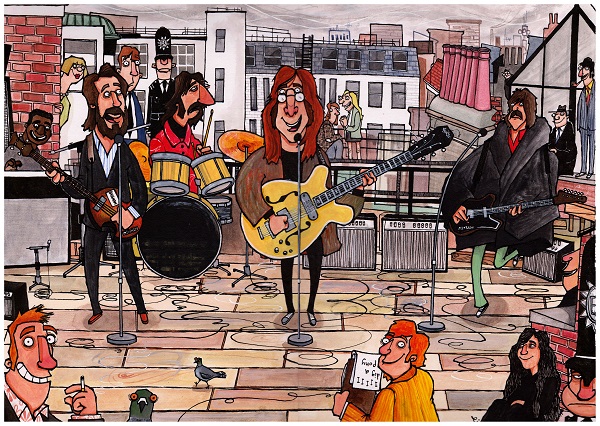
The Beatles play on the rooftop of their Savile Row office, January 1969
The Beatles, 3 Savile Row, London; 30th January 1969 (a Thursday)

The band began their set with Get Back. Now a song about as familiar to everyone in Britain as the National Anthem (they would play this too, incidentally, while the film crew changed the reels in their cameras), at the time it was so shiny new that it probably took anyone in earshot a minute or so to put together exactly what the hell was going on. They soon realised, however, and a genuine cross-section of British society all began to try as best they could to get a better look. In the film, we see excitable secretaries hurling themselves across busy roads, taxi drivers rubbernecking, businessmen who are old enough to have seen everything wearing faces of childlike wonder and, my own personal favourite, an old boy with a bowler hat and umbrella climbing up a ladder on the outside of a building to stand on his own roof and take in the scene with his hands in his raincoat pockets. The Beatles played Get Back twice in succession, with the first of these performances featuring in the final cut of the Let It Be film.

Next up was Don't Let Me Down, and again it was the first of the two performances of John Lennon's new song that afternoon that made it to the final cut of the movie, in spite of the fact that he forgets the words and fluffs a verse mid-way through. Don't Let Me Down would appear on the B side of the Get Back single that April, although it was inexplicably cut from the final Let It Be album by its producer. This would normally represent the biggest dick move of any producer's career, but in this case I think we can make an exception as the culprit in this instance was Phil Spector.

The fourth song of the set was a first of two versions of I've Got A Feeling. In the film, it accompanies a slew of interviews with the spectators who had gathered on the streets below and you can easily, even if you are familiar with the record, miss the fact that the version that appeared on the final album is this live performance. It is a persuasive hint of just how tight The Beatles' playing was that day. Having not played live to anyone in almost a thousand days, on a frigid London rooftop and singing to leaden, empty January skies, here was a band who still had it, never lost it and had sufficient left to just give it away. The next song in the set, One After 909 would also appear on the LP in its live form.

Song six is Dig A Pony. Ringo Starr bellows “hold it!” to halt the introduction because he had been trying to choke down a cheeky cigarette and needed to extinguish it. Lennon, meanwhile, is not confident in his lyrical recall and reads them off book – held in front of him by a lackey no doubt pondering that this will probably be the greatest thing that ever happens to him in his whole life.

By this point, there is considerable commotion in and around the streets of London, as one might expect when the world's greatest rock and roll band play a free concert completely on a whim in the centre of one of the world's great capital cities. Not everyone shares quite the sense of wonder that the whole occasion engenders within me, however. This is, after all, England and English people will always react accordingly. “This type of music is all right in its place and I think it's quite enjoyable,” explains a besuited business type who could be any age from an old 30 to a young 55, “but I think its a bit of an imposition to absolutely disrupt all the business in this area”. As a fellow Englishman, it is hard to argue with him on this point, even though I feel that there need to be exceptions to many a hard and fast rule, particularly if The Beatles are involved. Perhaps he was one of the people who called in the Old Bill to sort it out. Either way, there was by now a growing police presence in Savile Row. They were initially denied entrance to number 3 by the Apple Corps staff, perhaps mindful that the building probably contained all of the drugs in the entire world. However, once the rozzers began threatening arrests for obstruction, uniformed officers slowly began to percolate throughout the building and onto the roof itself.

Still treading the duck boards, The Beatles were by now onto their seventh and eighth numbers of the set, second versions of I've Got A Feeling and Don't Let Me Down. In the latter case, Lennon manages to get the lyrics right and as such a complete live version of the song could later be stitched together and released on Let It Be: Naked. By this point, the powers that be were really rather insistent that the band should stop making this unholy and unexpected racket. Perhaps they were just fed up with all the repetition and could have been placated with a few verses of Ticket To Ride? We'll never know.

Now surrounded by enough police officers to host an FA Cup tie, the band lurched into their final song, the last they would ever play in public together. It was a third performance of Get Back and it is the scuzziest yet, not helped by the fact that the groups' long-suffering personal assistant Mal Evans had been told to turn off the amplifiers by a police officer and, understandably enough, had complied with the instruction. The sound drops out as Lennon and Harrison try to wail on their axe only to get a handful of silence, before both men plug themselves in again on the fly while the song rolls on almost seamlessly. This third version is the one that was released in Anthology 3, complete with McCartney's improvised final verse: “you've been playing on the roof again, and that's no good, your momma doesn't like that, she's going to have you arrested!”. The song concludes hurriedly and is greeted by a loud cheer from Maureen Starkey, Ringo's wife. “I'd like to thank you on behalf of the group and myself and I hope we've passed the audition,” says Lennon to peals of part-sycophantic, part-nervous, part-genuine laughter. The Beatles may not have left the building, but they were no longer on its roof.

In the end, no-one was arrested, a fact made scarcely credible by the sheer quantity of narcotics contained within the Apple building. Perhaps The Beatles had built up enough residual goodwill that the police were willing to turn a blind eye. They had just played a killer gig, after all, and as a passing vicar points out in the finished film, “it's nice to get something for free in this country at the moment...”

However, the long term effects on the group would take their toll. The Get Back sessions had been marred by so much ill-feeling that the album and feature film were shelved, the group instead throwing themselves into recording what would become Abbey Road, a more fitting final hurrah for the band that had changed the course of Western culture forever. On April 10th 1970 (a Friday), Paul McCartney announced that he had left the band and The Beatles were no more. The following month, a Phil Spector-produced rehash of the turbulent Get Back sessions would be released as the Let It Be album, in tandem with a feature film of the same name. Both were hugely successful at the time but have subsequently been reviewed in a far harsher light, unfairly so in my view. There are brilliant moments in each and, although it isn't nice to see it when mummy and daddy fight, they both still love us all the same.

Imagine being there, though. That day in January, now fifty years ago. A moment of history, lovingly recorded so that we can all still be a part of it, unfolding before your very eyes and ears. It must have been hard to fully comprehend the magnitude of what you had witnessed, a process that could only truly begin once it was confirmed that these four brilliant men would never again play together. A process that still isn't over now, as current and future generations still come to grips with what The Beatles did and what they gave us. They were the big bang that created our cultural universe. This was their farewell.

Monday, 15 June 2015

Everything you thought you knew about dogs is wrong

I have a dog now. People who have been with me every step of this disjointed and increasingly stationary journey will no doubt be pleased to hear that it is the same dog as they have met before on these pages. He is still very much the same dog. I am still very much the same man. Although we are now both two-and-a-half years older, neither one of us has grown any wiser. We both smell a little worse and find standing up more of a chore but we remain, fundamentally, fuckwits.

The last time the dog and me had this association, he was just visiting. But now he is here to stay and we can dedicate ourselves full time to our ultimate goal, which is ruining each others' lives. He is winning and will win, as I was already convinced that my life was in ruin. Plus, you know, he is a dog and therefore pretty contented with his lot.

But even though the enriching life lessons part of pet ownership will almost invariably pass me by, I have nevertheless decided that I must use this opportunity for scientific enquiry and in so doing have discovered a great many things. Among these nuggets (of what are probably dog faeces) sit some pieces of information which will bust myths, explode paradigms and blow minds in equal measure. Everything you thought you knew about dogs, it turns out, is in fact wrong.

1. Dogs do NOT eat bones

Not a single bone. Not a one. Anyone expecting to see my dog sat down chowing into some osseous tissue will be shit out of luck. What dogs eat is in fact dog food, which is readily available in shops. But here's the rub: if you take your dog to the veterinary hospital and have it x-rayed (for example, on a night when there's nothing on the telly), you will find it to be completely full of bones. I do not know how these bones get in there.

Not a bone in sight

2. People who do not like dogs or are scared of dogs will NOT like your dog

Anyone with a caninically nervous disposition has heard this one. "Oh, you'll like MY dog". In fact, you will not. Most people who are nervous around dogs dislike the rush of the approach, the jumping up, the frenzied and slobbery attempts at friendship, the barking. My dog does all of these things. It is, to be fair, only a little dog and as such these tendencies are more potentially adorable than if it was one of those horse-sized dogs. But the fact remains. My dog acts like pretty much all the other dogs and as such, if you do not like dogs you will probably not like my dog.

3. All dogs owners clean up after their dog

I am aware that this is a contentious belief and one directly challenged by the fly-strewn, humming, practically sentient, mountainous egg piles that adorn pretty much every busy thoroughfare and public park in the land. However, I have never seen a dog owner without a sack full of brown swinging, or at the very least the paraphernalia to hand to address the situation.

Hove Recreation Ground, mentioned in the text any moment now


The massive, stinking, steamy curlers that you see everywhere are, therefore, utterly unexplained by science and may even be evidence of extra-terrestrial involvement in Earthly doings. A humbling thought and certainly one in the eye for anyone who has ever walked around Hove Recreation Ground this lunchtime and seen all of the dozens of piles of dog shit and thought to themselves, "for fuck's sake, clean up after your fucking dog, fuck me... Jesus, look at that one, fuck". It was as though the circus was in town and they'd been looking for somewhere to exercise the elephants. Or it would have been, had I not already explained that they were done by aliens.

Some of whom I would advise should probably consult a doctor.

The end.

Sunday, 1 September 2013

Does God exist?

Evidence for the non-existence of a God or any similar form of benevolent higher power

If God existed, when the inspectors checked the tickets on the train they'd look at how much the ticket had cost you, tut and say, "it's bloody shameful isn't it? I can only apologise".

Evidence for the existence of God or any similar form of benevolent higher power

The song Space Oddity by David Bowie.

Everything else is still firmly filed under "grey areas", I'm afraid.

Friday, 4 January 2013

Yay, new bench day

I live by the seaside which means that I'm no stranger to bench dedications. I've never quite understood what possesses people to get a bench dedicated to the memory of deceased relatives, but at the same time I have to admit that so far in my life I'm lucky enough to be able to say I've not lost any people to whom I was particularly close. Come that sad day, my initial thoughts may well turn to benches. And that will be handy because I live by the seaside.

It's difficult to find anywhere to sit down on the Sussex coast which isn't dedicated to someone's memory. Anyone suddenly waylaid by a wheezing fit or atomic anal cramps is likely to have to perch on Irene Gremlett, she loved it here or Morris Woodman, friend of the local sailing club. It's undeniable that the bench system is very efficient at keeping people's names in the memory of passers-by. Half the drug deals in Hastings go down next to Mildred Newton, who loved walking her dogs here. And have you seen the size of the dog turd by Percy Trelt?

Yesterday, I was lucky enough to see some brand new dedications. The plaques read 2012 for the date of death and a lot of the benches still had some fairly fresh floral tributes. But my favourite was Myrtle Polk-Sallett, thanks for the memories and enjoy the view. This is by far and away the best wording for a seaside bench dedication that I can imagine. Enjoy the view. The only thing it lacked was the mortal remains of Myrtle Polk-Sallett, propped up for all eternity looking blankly out toward the English channel, the seagulls scavenging on her putrefying skin. Perhaps she had been there, holding the flowers in her hand, but all the passing herring gulls, pigeons and foxes had put paid to that. If this is the case, I think it would be fitting to ask the council to attach similar plaques to all of the anuses of the local wildlife. Enjoy the view, Myrtle.

It's what she would have wanted. Not least because she always wanted to be able to fly.

NB: Unless it is not immediately obvious to the dimmer amongst you, all the names in this post have been changed.

Sunday, 28 October 2012

Causal determinism

Arthur Wellesley, the First Duke of Wellington,
no good beefy sumbitch
In Shoreham-by-Sea there is a pub called The Duke of Wellington. I've never been in it, possibly on account of the factor that I am about to relate. Above the door is a very large stone boot. This is presumably a Wellington boot. Maybe it's even one of the Duke of Wellington's very own. He was an impressive man, after all, and ate a lot of beef.

But this great big stone boot hangs there all the same. Sometimes I have to walk under it as it overhangs the pavement outside the door. And this always worries me. It is only suspended by chains, you see. Should they ever fail, that boot will fall earthward with terrifying force. If I know only one thing about physics - and I do - I know this: stuff that is up in the air will always want to go in a downward direction. This is because Sir Isaac Newton invented gravity.

One day I'll be underneath that boot and it will fall on my head, I just know it. I tell you what I will do to prove this to you. I'm going to go there right now and stand there. I'll stand there for a thousand years if I have to. But one day I'll be underneath that boot and it will fall on my head.

And that will be just my bloody luck.

Saturday, 29 September 2012

The Long Man of Wilmington is a prick

Heritage.

If I went out and broke my bloody back digging out a huge great big long man-shaped trough in a hillside and then filling it with limestone, frankly I'd expect the rozzers to catch me in the act and gently dissuade me from continuing by the means of a swift kick in the knackers. Even if I were able to finish it, I imagine that the National Trust or some other group of beardy people to say outraged things on the breakfast news and fix the damage to their hill - A HILL! - as soon as possible.

However, if I somehow managed to carve a 200-foot tall figure in the side of the hill and no-one kicked me in the spuds or noticed for about a thousand years, this piece of gibbering insanity becomes heritage and art and important. I understand this point of view. Heritage is a very important thing and should be protected.

This is not to say that the Long Man of Wilmington isn't a cunt. Because he is. I'll say it again. The Long Man of Wilmington is a cunt. Always has been and always will be. It hurts me to say it because Sussex Pride Should Never Be Denied. It's a bit of a stinger that the UK's finest county is also home to its lousiest hillside figure.

The Long Man of Wilmington: dreary

The UK, a global leader in heritage after all, only actually has two such human figures. To be honest, that's for the best. If there was shit drawn on every hill they'd start to lose their impact. There's the Long Man of Wilmington in East Sussex and the Cerne Abbas Giant in Dorset.

the Cerne Abbas Giant: hung

And therein lies the problem. Every day, a million conversations about the Long Man of Wilmington run thusly:

"I saw the Long Man of Wilmington yesterday."
"Oh yes?"
"Yep."
"Eh, you could have your eye out on that, eh? eh? Lads? Am I right? Cor."
"Ah no, that's the other one."
"Oh."
"No, the Long Man of Wilmington is the one who just stands there holding two walking sticks."
"Ah."
"Yeah, it's the Cerne Abbas Giant you're thinking of, with the knobbly club and the love truncheon and the face and the nipples and the awesome."
"So..."
"Yeah. The Long Man of Wilmington is just a cunt."

Global heritage sites shouldn't be this disappointing. It'd be like finding out that the Taj Mahal is made of Lego. I'm clearly not the only person to have felt this way. On the night of 17th June 2010, someone painted a 20-foot high phallus on the Long Man. This is by turns a disgraceful act of vandalism and a desecration of a world-famous historical site but also a brilliant thing to do. Such acts of wanton brazenness should, of course, be frowned-upon and discouraged but when they are just done with the line marker from a sports stadium (as was the case) and no permanent damage was done, we should probably try to retain some sense of perspective and sense of humour about it. Heritage is only worth anything if it helps to shape and inform the present. Plus, it gave a million conversations a moment of blessed respite.

The Long Man of Wilmington, June 2010: like a baby's arm

"I saw the Long Man of Wilmington yesterday."
"Oh yes?"
"Yep."
"Eh, you could have your eye out on that, eh? eh? Lads? Am I right? Cor."
"Yes, some cunt's drawn a massive boner on it."
"Really?."
"Yep."
"God, what a cunt."
"Funny though."
"Yeah."
"Shall we go and see it?"

Monday, 16 July 2012

Celebrity spotting masterclass

There are people who walk among us who are very adept at spotting celebrities. Celebrities are people who are better than us, so the people who can spot them are also very blessed. I represent neither group.

Holy crap, I think it's Zoë Ball!

Some people are just unlucky. Some people live in the wrong place. It's hard to spot celebrities if you live on Sark, for instance. However, I have no such excuses. I am just such an addled, clouded and brain-fugged numpty that I am simply incapable of registering what is going on in front of my eyes. I now present evidence of this complete lack of cerebral function for illustrative purposes.

Hatherley: elusive
Celebrity one: Charlotte Hatherley

CLAIM TO FAME
Popular musician, former guitar player with the group Ash.
ENCOUNTER
Sunday 17th June 2012.
LOCATION
The Garage, Highbury - at the Ash 20th birthday party gig, where to be honest one might be expecting to run into people who are affiliated with the above act.
DISTANCE
No more than 18 inches.
EXTENUATING CIRCUMSTANCES
I was looking the other way.

Buxton: stealthy
Celebrity two: Adam Buxton

CLAIM TO FAME
Radio and television presenter, actor and comedian. All-round renaissance man. Furry superhero. And one of my favourite funny people.
ENCOUNTER
Sunday 17th June 2012.
LOCATION
Ash20, The Garage, Highbury.
DISTANCE
No more than a foot. We may even have touched.
EXTENUATING CIRCUMSTANCES
I was looking for Charlotte Hatherley.

Izzard: practically a ninja
Celebrity three: Eddie Izzard

CLAIM TO FAME
Britain's most internationally famous stand-up comedian of all time, actor on stage, television and big screen.
ENCOUNTER
Sunday 15th July 2012.
LOCATION
De La Warr Pavilion, Bexhill-on-Sea
DISTANCE
10 feet
EXTENUATING CIRCUMSTANCES
Very few. I was on the roof of the De La Warr Pavilion looking at the Italian Job-themed art installation, surrounded by the paraphernalia - cameras, lights, stage, refreshments - of the show that Izzard was to play in that location that very evening. My girlfriend also said to me, "look, there's Eddie Izzard". What part of all of that failed to sink in, I am unsure.

The Olympic Torch relay passes through where I live today. I am in two minds as to whether or not I should go to see it, largely because I will probably miss it. Even if it sets fire to my sleeve.

CONCLUSION AND SUMMARY
I am a fucking idiot.

Sunday, 3 June 2012

Jubilee jubilee

I love a street party. There's nothing I like more than just chewing the fat with all the people who live my street. We all have so much in common. I mean, we all live in the same street, for one thing. We can discuss the fact all our bins are collected on the same day and perhaps find out who parked the huge, throbbing and possibly sentient pool of vomit where the road curves, or left a bottle of Desperado with an inch left in the bottom on next door's garden wall. Maybe they were the same person? All of this whilst eating really manky food.

Maybe I don't like these things after all, actually. Nevertheless, the old street party refuses to die in the United Kingdom, particularly for royal events such as coronation anniversaries, weddings and acrimonious divorces. So, I decided to look through the annals of history to find pictures of the street parties which took place for the Queen's coronation in 1953, which we are all celebrating this weekend even though most of us aren't and anyway we're not because 1953 was 59 years ago.

Fuck's sake.

Nevertheless, the Queen is now the Queen and then was the Queen and crowns were worn and curried chicken was consumed and diarrhoea was enjoyed by all. Here are how our ancestors celebrated a good old-fashioned royal shindig before we got all cynical because of MTV, smart phones and Tony Blair.

Liverpool, 1953: fancy dress
Here we see the true joy of the street party. A whole community coming together, putting their differences behind them and dressing their unwilling children as palace guards, policemen,Tinkerbell and Wilbur Smith. They have also let the street nutters - the ones who have a load of cats or who swear their budgie is a Catholic - out to join the fun.

Liverpool 1953 - no-one told him it didn't wash off
The whole Commonwealth is represented here, with particular regard to sailors, clowns and black people.

Edinburgh 1953 - wonky table
This one is bugging me. The industrial scale of the tressle tableage here is completely undone by the disconcerting wave of the decoration down the centre. This caused great outbreaks of seasickness.

Newham 1953 - close encounters
I love this one. The table location is rather reminiscent of something which has dropped from space to anally probe the populace to figure out their penchant for sausage rolls.

Trowbridge, Wiltshire 1953 - space saving
The good people of Trowbridge have obviously decided using up the whole length of their street is inefficient. Time and motion studies of their street party commemorating the first time Edward VIII fucked Wallis Simpson proved the doubled-back approach was the best one for distributing fish paste sandwiches.

Brighton 1953 - limited interest
This final one is from my home town. Totland Road in Brighton, just down from the racecourse. It seems that support wasn't easy to drum up here. Us Sussex folk are not easily excited by what's going on in that London. The people sat at this table here represent about two household's worth in austerity Britain of 1953. Note also that one homeowner has taped up their windows. Either this party was really expected to go off later or they were worried about the Red Menace.

Tuesday, 10 April 2012

The ballad of Terry and June


Let's talk about Terry. Someone is going to need to talk about Terry at some point. Terry has issues. Terry is a bit of a porker. Terry likes to eat out of bins. There's little hope of his wife June sorting this little foible out - June likes to eat out of bins too.

Terry and June live in Bexhill-on-Sea. I don't know how long they've lived in Bexhill. I've not yet managed to ask them, they're usually to busy with the bins. Terry and June are herring gulls. Their favourite foods are Pringles, nappies and Chinese takeaways. Terry loves the noodles.

Terry at work

Over the Easter weekend I got to see Terry and June at work. It wasn't easy for them as the wet weather rendered the bin lids slippery, but it's in moments of adversity like that where you get to see the real masters at their best. They gave those bins a really good going over. I watched them in some awe. By the time they'd finished with bin one the black bin liner was pretty much entirely absent. I don't know what they did to achieve that or what they did with it afterwards: maybe their nest will be the only one in town with a dedicated wetroom or pond. This morning, though, all the most delicious parts of that bin had been exhausted and they were on to bin number two. This was more of a breakfast bin.

Terry and June look quite well on it. They are of formidable size and their feathers are the kind of feathers you'd see in some sort of feather museum or on Princess Anne's hat for Royal Ascot.

Of course, the socially-minded people are disgusted by the mess they make, flinging bits of plastic (too chewy) and paper (not enough flavour) about the streets in order to get to the best bits. But it's well known that humanity wastes a scandalous amount of food and so Johnny and Sally Streetpride might well consider that, instead of investing in more secure bins, they should perhaps be less keen to throw away a whole roast chicken dinner because Johnny bought the wrong type of potato.

Until that glorious day comes, these exciting urban ecosystems will continue to flourish. I celebrate them! I am full of admiration for the gulls and pigeons and the foxes and rats and how they have adapted and learnt to thrive.

I only really have two reservations. Firstly, I wish that foxes would learn better road sense. Of course, the crows don't, which creates another urban ecosystem in itself. Secondly, I am forever mindful that evolution is a funny old goose. At the moment the sparrow who sidles up to your park bench asking for a bit of crust is a charming little opportunist. But yesterday I watched a sparrow, bold as brass, waiting around a van which sold hot pork sandwiches. If he'd been packing heat, no banger would have been safe.

My friend Moll has already reported to me a sighting of a pigeon in Brighton chowing down on some chicken from a discarded wrap, so it's clear that the birds are moving away from their traditional meaty treats of worms and things with five or more legs and onto the more readily available array of cooked comestibles discarded by us lot. How many long before sparrows form a posse and fly off with a pig of their own? Or maybe they'll evolve one big wing, ready to fell us with a right cross and steal our baguettes?

In so many ways we are living in a golden age. I'm doing my best to enjoy it before two foxes with a snooker ball in a sock mug me for my dinner.

Wednesday, 4 April 2012

Mow

I am pretty buff, as you well know. The reason for this is mowing the lawn. I have mowed acres and acres of grass in my lifetime and as such it makes me quite the expert in the fine art of swearing and complaining and, to a certain degree, mowing. As this is now the internet age and everyone is expecting everyone else to share all of their expertise, channel it into one great interactive repository of skills, I thought that I would commit my knowledge and experience to the ages.

There is something quite righteous about doing this. Like I am some kind of caveman elder. Come gather round people.

Tip 1: Know your enemy

Actually, that's a good place to start. Righteousness and tradition. The other day I was digging the vegetable beds a bit, doing some weeding and tending to my brassicas. There is something which feels so completely RIGHT about doing that. Primal. Fundamental. Tilling the soil to cultivating things to eat. It's what we human beings have done ever since we descended from the trees and headed straight to the garden centre.

Lawn mowing is very much not one of these things. It's one of those prissy and futile things that human beings do to try and make things neat and tidy, to kid ourselves that we're the masters of our surroundings. This is a strategy that always works, at least until the first tsunami or earthquake or giant snake arrives, spiriting your grandmother off and away to hither and yon. So my first top tip is: accept the futility of the action you're about to undertake. Embrace it. And swearing is very much par for the course. It's healthy! Even if it scares the neighbour's dog.

Tip 2: Hazards

There are all manner of pitfalls faced by the lawn mower, not least actual pits that you could fall into. However, these are rather less common than any of the following: trees; moss; ant hills; bees; frogs; brambles and other assorted bindweed; and, of course, fox turds. The key to all of this is to know every inch of your surface, like a golfer studying the green for a vital putt. When it all comes together, it can be quite beautiful - a balletic and rhythmic mastery of the elements. Swinging round that tree, pop a wheelie over the fox shit and give a tonsure to a passing bee.

Tip 3: Equipment

I'll be blunt, you're going to need a lawnmower. There are a number of main types: electric, petrol powered or hand-propelled. I favour the petrol-powered push mower. The petrol-powered remains a pipe dream and nothing but a pipe dream. Everyone should be relieved about that, as me in control of any type of motorised vehicle is a preposterous idea, let alone one with a rotary blade attached to it. People would die. The electric mower is OK for smaller gardens but for anything even approaching reasonable sized, buggering about with power cables will drive you insane.

I currently use a Hayter mower. It is splendid and green. Previously I used a Mountfield, which was very much not. It had clearly been designed by someone who had only ever read about lawns in books and therefore had nothing beyond a theoretical understanding of them. At the merest sight of any organic matter, let alone grass, the thing went to pieces. The petrol tank didn't have a filter, so the engine soon became clogged with stones, earth and wasps. If the motor ran long enough to make it to the lawn, the blade was no match for what it was trying to cut. I lost years of my life to that thing.  The Hayter mower is much better. I particularly like the fact it starts, cuts and works - although after the Mountfield experience, just one of those would have set it apart.

One warning: evolution is always in action. The latest array of petrol-powered push mowers will usually be motor assisted: that is to say, the rear wheels are driven by a motor to help you push it along. Back in the day, this sort of extravagance was far beyond the dreams or budgets of plebs like me. But since it became pretty well standard on all but the most entry-level models, my muscles have evolved to be completely useless without it. I even need rear-wheel drive on shopping trolleys nowadays. Evolution is the lawn mowing man's greatest foe, after cats, bees, frogs, ants and fox shit.

One other warning: no lawnmower has a good enough grass collection box. So don't even think about that. It's clearly impossible to design and will never going to happen. You're thinking about it, aren't you? Well don't. It's never, ever, going to happen. Lawnmowers are designed entirely to frustrate and annoy you. It's to emphasise the futility. Remember the futility?

Tip 4: Regularity

Alan Titchmarsh once told me, via the television, that you should mow the lawn once every 2 days during the growing season.


Hmm.


At best, I might manage once a week, but it's important to accept the fact that several times every year you will end up trying to mow something that looks like a Vietnam war film. You just are. The best advice is to know the wily ways of grass. Like everything else, it grows best when there's plenty of water and sun. A traditional British summer makes for a real bastard of a lawn. Blink and it will be as unkempt as a nun's beaver. Sometimes it will have all grown back by the time you've finished the other end.

If you're lucky enough to get a hot and dry spell, mow it plenty, as short as you can get it. This will render your lawn a sad, dusty and brown thing, virtually dead, which may not need further cutting for a month or more, even at the height of the growing season (which generally tends to be April to July).

5. Conclusions

You're never going to enjoy mowing your lawn. It is stupid and a complete waste of your time. So learn to accept that fact and relish its aching pointlessness. And, in an ideal world, learn to tarmac it.

Friday, 17 February 2012

Never underestimate the wolf shirt

For reasons of coldness and cheapness, I found myself in Primark in Brighton on Saturday, buying a pair of gloves with the structural integrity of a tramp's underwear. Still, they only cost a quid and now the cold snap seems to have ended, so I am currently smug.


Smug AND full of knowledge, as a trip to Primark can teach you a lot about fashion, particularly things which could well have been in fashion within the last decade or so. One item I saw, however, transcends the fleeting fads and trends of clothing fashions. It is simultaneously fashionable and not, having always been and never having been at the same time. It is the wolf shirt.


The wolf shirt gained some internet notoriety following a slew of joke favourable reviews on sites like Amazon and Wolfmaxx. These meme had it that the wolf shirt made the wearer sexually desirable to the point that you might well have to start carrying a stick with you at all times. However, in spite of that - or maybe, in the meta-meta-meta-übercool 21st Century, because of it - wearing a wolf shirt remains a potent statement and a powerful look. Who's to say that the wearers are not, in fact, up to their gills in fuzz?


When considering jumping someone who is wearing a wolf shirt, I think one must first consider whether or not the wearer is doing so as a conscious gesture of wry self-aware appreciation or just out of a strongly held conviction that the wolf shirt makes them a love man. The former is just as likely to be a dreary hipster twit who works in the games industry and thinks that Margaret Thatcher ruined their life (although they were born in 1991) as the latter is likely to be a musky, wolf-obsessed weirdo with an old Norton motorbike on his living room table.


For the wolf shirt is, after all, just an item of clothing. The wearer will prove to be as unique a person as any - all with their own foibles, talents, hopes and dreams. The danger of making the (admittedly tempting) decision to hit on anyone wearing a wolf shirt should be clear for any rational person to see. Never judge a book by its wolf cover - even if it is a book about wolves - and never judge a person by their wolf shirt. Even if that wolf shirt is a mint green fleece worn by a female pensioner in Hove. Be careful what you wish for, because that wish could just come true. And turn up at your wedding on a Harley Davidson wearing a wolf shirt.

Friday, 3 February 2012

Grocery acquisition and its role in class consciousness

I'm not sure where Margaret Thatcher did her food shop so that she could so confidently proclaim that we "(are) all middle class now", but I'm pretty sure I've not been there. Whether or not you subscribe to traditional theories of the British class system or feel that the modern world has led to an erosion or a convergance, it's hard to deny that social strata are still alive and well in supermarkets.

I'm not going to claim that people rigorously stick to their class in terms of supermarket, or that there is aspirational upward mobility - the majority of food shopping choice comes down to geographical convenience, economic circumstance and product range, after all - but there is still a very real sense of class lining our supermarket shelves.

Tesco and Asda. They're your working class shops. The food is cheap and cheerful. Nothing too peacocky (and certainly no frozen oven-ready peacocks) or anything with a flamboyant garnish that would end up with you getting nutted in the car park at The Rat and Trumpet later on. Offers on powerfully strong lager are plentiful and very generous, so as to keep the patrons in enough of a fug of drunkeness that they never achieve class consciousness. Clientele include careful pensioners, 15-year old mothers of two and children called Jayden and Candis who climb the shelves in the Kosher food aisle and throw Matzos at everyone, whilst shrieking like apes.

Morrisons and the Cooperative, that's your lower-middle class supermarket. They have low enough prices because you're probably saving up for a conservatory that will look out of place and probably won't ever be finished or the roof will leak. But it's also the sort of place where you feel a step up from Asda. Yes, you can still get 24 Stella for a tenspot, but you can also buy chorizo and mascarpone for definite.

Sainsbury's, there's your middle class supermarket. The biscuits come in boxes and are delicious but ironically the clientele are more likely to set your teeth on edge than those in Morrisons or the Co-op. The people who shop there have one eye on improving themselves and for the most part make their children behave or tie them up to a lamppost outside. In Sainsbury's people are largely happy with their lot. They (badly and staggeringly thoughtlessly) park their Lexus across two parent and child spots and then let little Tarquin and Poppy run around, pointing at the poor and eat grapes that haven't been paid for yet and NEVER WILL.

Waitrose is the upper-middle class supermarket. The food is excellent. You even know for sure that the fruit is going to be good, because they source it right. It's the sort of shop where you can get artisan cheese and venison and bulgar wheat as impulse buys by the checkouts. But the people in there are just the worst kind of hempy, superior, Margot Leadbetter titwitches. The majority of the women in there take a footstool to facilitate looking down their nose at you, and are likely to assume anyone not wearing a mink stole is on the staff. Their husbands, still virtually moribund from a solid decade of marijuana and acid in the 1960s and 70s, made their fortune by being Status Quo's road crew but now can barely speak and shuffle behind obediently. Even the people on the checkout think you're an escaped convict unless you've got a micro pig in your bag for life. They don't sell large sizes of anything because they wouldn't go with the Smeg fridge and no-one who has ever shopped there realises that a chicken even has wings. Upside: no-one who shops regularly in Waitrose has children, even the married couples. Some of whom may even have sold theirs.

Marks and Spencers is your upper class supermarket. You can't get proper brands, you have to get their own which, in true upper class style are more expensive and worse. Most of the fruit in there is pre-prepared so as to save the houseboy a job. But the clientele are nicer than the Waitrose lot, as are the clientele in any shop where the fact they would rather that you'd die is largely absent from their facial expressions.

There are other shops but I'm either too posh or too common to have been in them. The end.

Wednesday, 1 February 2012

Dangerous times in east London's Benelux magazine collecting community

Did you know that the first ever edition of Private Eye magazine is worth £1 million? It is also small, the size of a Mr. Men book. However, when money like that is involved, you know that magazine collecting Dutch gangsters won't be far behind.

My source of information was a former Belgian track athlete, whose family had emigrated from the Belgian Congo in the 1950s. He was in Whitechapel in hot pursuit of the magazine, which he was planning to acquire from the less financially-aware and then sell at auction. However, he was not that familiar with the mean streets of London's east end. This is where I come in.

Thanks to my intimate knowledge of the Jack the Ripper case, I was the ideal candidate. Especially seeing as I never do any bloody work and therefore wasn't busy. We tracked down the volume in a small shop (I am not sure where exactly, in reality I don't know London from the arse end of a donkey) but that was where our trouble started, as well-organised Dutch gangsters and magazine enthusiasts descended upon us on high-performance motorcycles. They knew exactly what they were looking for.

Fortunately, perhaps the last remaining broadsheet copy of The Independent was lying discarded on the pavement, principally because London is a filthy hole that needs cleaning (vote Ken Livingstone, folks). Concealing the valuable magazine within the newspaper I was able to saunter away unsuspected.

We crossed the river and went to my Belgian contact's riverside flat in Thamesmead. It was a strange issue of Private Eye. Although smaller format, it retained much of the modern day structure: political journalism followed by more satirical pieces. However, vast swathes of the back of the issue were dedicated to a multiple page Garfield comic strip adventure set at the Battle of Rourke's Drift. Luckily for me, my decisive action was rewarded by my Belgian partner, who agreed that without my quick thinking the magazine would have been lost to the Dutch - many of whom were trying to phone us to pinpoint our location - and agreed I should receive 75% of the proceeds from selling the magazine at auction.

The risk, of course, was that we would again have to head out onto the streets away from the safety of our hideout to get the sales process in motion. Good fortune struck again, however, and I woke up before I had to go through any of that. Although my pillow was gone.

Friday, 6 January 2012

Standing in the way of progress, looking to one side

Today's post was inspired by yesterday's journal entry over at The Middle Class Handbook, which is a site that I personally think it's a good idea to read.

I don't know about you, but when I cross a road, I always like to avoid being killed so wherever possible I use crossings. I'm quite defiant about it. I'll stand there long after the last jaywalker has made their excuses, waiting for the little green man to appear. The thing is, I think people who jump that particular gun are thinking that the trade off of possibly getting really very seriously injured for arriving at their destination several seconds earlier is worth it. Having been really seriously injured, I must assure you that it is not.

Which leaves me standing at the crossing. I've pressed the button and everything - this is something which often escapes people's notice but I find it's an important step in the whole road crossing process. I'm going across the road. Across the road is where I am going to go. Straight ahead of me is my destination. Head up. Wait for that green man. He'll see me right.

And in the good old days (yes, this is going to be one of these. But I'm right, so suck it up) it was as simple as that. The little green man was waiting for you, straight ahead on the other side of the road (which as you may recall is my destination).
Road safety in action, and in Acton

But progress is an important thing. You should not and cannot, we are told, stand in its way. In this particular incidence, this is possibly because you'll get run over by a bus. Because yes! For reasons best known to someone presumably, the little green man has moved down to your side. Hip-mounted road safety is the way forwards, or indeed sideways. This is so stupid it actually hurts my brain. Not only has 'head up, look straight ahead' been the system worldwide since time begun, but it has also been the system for a good reason. On top of all of that has become a reflex, a muscle memory.

Watch a busy crossing today. I guarantee you will see at least one person look ahead, look confused, look around... then remember and look down to their side. Possibly whilst rolling their eyes to the heavens. They may even look thoroughly pissed off, as they should.

This new system makes me so angry that I'm worried my head will explode. But I reserve particular ire for the ones where the little box containing all the red man green man goodness is oriented in such a way that only people on YOUR side of the road can catch a glimpse of it. This isn't the bloody Crystal Maze for heaven's sake. Sweet Christ.

If course, in a generation's time, it will have become second nature. The children growing up now will be so used to it that changing it back to the right and proper way would be just as disorientating. However, I'm still fuming about this so all I can say is that I hope all the children of today grow up with a bleedin' permanent crick in their neck and a slight lean.

I always knew that I would turn into a disagreeable old coot sooner rather than later. But I'd never have predicted that it would be my adherence to the tenets of basic road safety that would push me over the edge.

Monday, 26 December 2011

Hello

Hello. That's what they say. When you are walking, that is. I'm not sure what happens to British people as soon as they get off public highways and onto promenades and footpaths but they seem hell-bent on saying "HELLO!" to people as they pass. Whatever it is I am clearly immune to it. In many ways I would quite like to try it, but never on a footpath on the Downs or along the seafront or in the woods. I'd prefer to try it in central London at 8.15 a.m. on a Tuesday morning.

I digress slightly. Today I went for a walk to Shoreham Old Fort. This is in Shoreham. Shoreham Beach, to be precise. West Sussex. Although by that point you're getting quite close to being in East Sussex, so close that you can smell the refinement. Or you would be able to if it weren't for the diesel fumes of heavy industry.

Anyway, I took pictures of it, so if you are a fucking lazy bastard or something, you can vicariously live my thrilling life. But rest assured that I hate you. Unless I don't. So, that's that cleared up. (Click them to make them bigger)

This beach hut looks like Adolf Hitler.

This bin comes with instructions about what to put in it.

Lonely egret is lonely.

Shoreham in the distance, houseboats in the middle & loads of green stuff in front of that.

Shoreham fort. Designed to keep the Egyptians at bay. It's working.

R.I.P. Harry Ayre, whoever you are. I imagine he drowned.

Shoreham power station busily making power which does not interest seagull.

There's an entire army division in this shed (re: Egyptians)

Shoreham lighthouse and lifeboat station. To prevent deaths (sadly not that of Harry Ayre).

I don't know what this is.

Cormorant. Maximum speed 6 knots.

Here are some boats going to B&Q.

Here is Shoreham lighthouse again BUT! from a different angle.

These boats are a bit knackered. Sort your boats out, people.

BEACH. Looking back towards Worthing. Wherever the hell that is.

There are some hardy souls fishing here. They have caught some birds.

There is Shoreham High Street, where everyone is high. HIGH ON LIFE. And some drugs.

I should also point out that I could have walked past the Shoreham houseboats but chose not to. This is because my photography skills are largely limited to taking wonky pictures of seagulls and falling over. Luckily for you, though, in November I walked along there with my friend Lolly and she is super-blazing-OMG-awesome at photography so you should have a look at her pictures instead. Go on!

Attention

You have reached the bottom of the internet