Pages

Showing posts with label History. Show all posts

Wednesday, 30 January 2019

Get Back, outside

Speaking personally, I avoid going out wherever possible, but other people do venture forth into the wide blue and when this happens they will no doubt sometimes find themselves in attendance at live music performances. There are countless of these taking place right now all over the world, and save for the occasional unplanned pregnancy or Damascene moment of self-realisation, little or nothing about them will be remembered by history.

Of course, it is not always this way. Nothing that is possessed of the power of music could always slide by unnoticed and as a result there have been some performances so shattering, so profound and so memorable that they have – directly or otherwise – shaped the course of more or less everything that happened next. This is a fact that is particularly on my mind today, for reasons that I will get into shortly. However, I feel it would be germane at this point to first provide some examples of gigs that sent ripples far beyond their own pond, just in case any of you think that I am lying.

Case study 1: Bob Dylan is so Punk it's unbelievable 1965-1966

One of the curious and unexpected effects of the rise of technology that still threatens to end us all was the re-emergence of the folk music scene in America during the 1950s and 1960s. The apex of this movement was the Newport Folk Festival, an annual three-day analogue happening on the picturesque New England coast; THE place for all the insufferable hairshirt-wearing, hempy draft-dodgers to assemble for a coffee clatch, smoke a doobie and listen to Pete Seeger sing a scurrilous eighteen-verse song about King George II as two shirtless men chop wood at the side of the stage.

Dylan's gig there in 1964 had been greeted by the kind of fervent, rapturous response normally reserved for Jesus Christ on Palm Sunday. Perhaps mindful of what happened to the J man subsequently, the following year the prophet of all of the oakiest folkies decided that the time had come to mix things up a little. On Saturday 24th, Dylan played a three-song acoustic set at an afternoon workshop, accompanied only by his guitar, harmonica and (presumably) two blacksmiths casting pewter tankards, before making the spontaneous and momentous decision to play an electric set the following day to showcase his new material accompanied by the Paul Butterfield Blues Band.

Bob Dylan injects some electricity into the Newport Folk Festival 1965
Bob Dylan at the Newport Folk Festival 1965: Sing while you slave but I just get bored

This Sunday evening set was completely incendiary. Dylan would again play three songs, but this time his output came courtesy of RAW POWER. He clattered through this truncated set, playing into a wall of discontent and studied outrage, before leaving the stage to a cacophony of jeering and politically appropriate anger. The evening's master of ceremonies Peter Yarrow was left on the verge of tears. Neither in his role as King of the Hippies nor or as Peter from Peter, Paul and Mary had he ever had to deal with such overt and voluble hostility and Yarrow begged Dylan to return to the stage and continue his performance. This he did, unaccompanied once more, cheered to the echo by the same crowd who minutes before had been baying for his blood. An unprepared Dylan didn't have the correct mouth organ and asked the crowd whether or not anyone had an E harmonica. The subsequent volley of metal objects that hurtled towards the stage had been quite unmatched in the area since the Revolutionary War and, now musically replete, Dylan performed two more songs to placate the crowd, whom rock historians by this point may have started to suspect of being a load of reactionary idiots. Dylan wouldn't return to folk music's hallowed spot again until 2002 where, possibly still wary of reprisals from hacky sack-playing beatnik wastrels, he played his set decked out in a wig and false beard.

But it wasn't just American folk fans who had temporarily lost the Zeitgeist: it turned out that British people can be idiots as well, and idiocy without the consoling prospect of the imminent tour of duty in Vietnam is a deadly combination indeed. The following year, during a rambunctiously adversarial European tour, on 17th May 1966 (a Tuesday) Dylan played a concert at the Free Trade Hall, Manchester which would become perhaps the most notorious, bootlegged and discussed non-festival gig ever played in the United Kingdom.

Anyone who believes that trolling is a modern phenomenon that came about with the advent of online communities need only look at the set list from that night in order to see the errors in their thinking. The first half of Dylan's show, solo and accompanied only by himself on acoustic guitar and harmonica, was largely comprised of pared-down versions of his newer material, cribbed from the contentious electric era albums. When he returned for the second half it was in the company of five other musicians, four of whom were on the cusp of finding stardom in their own right as The Band. Here, Dylan played eight more numbers, this time mainly older songs from the folk era but with a thousand volts shoved right up them. The crowd grew increasingly restless, chanting, shouting and slow handclapping their way through the gaps between songs, only for Dylan and his band to beat them back into submission with another wall of noise. The whole affair culminated in the most famous heckle in rock and roll history: “Judas!”, followed by its most famous riposte: a version of Like A Rolling Stone that, as per Dylan's instruction to his group, was played “fucking loud”. Dylan would suffer a serious motorcycle accident two months later and following his recuperation would choose instead to tread a less confrontational path: country rock.


Case study 2: Otis Redding makes black all right for the all whites, 1967

The United States of America's black community had been quietly producing all the music that mattered for generations, only for the rest of the population to ignore it and then have it sold back to them by more "palatable" (i.e. white) British acts for much of the preceding decade. The 1967 Monterrey Pop Festival was when White America finally woke up to this fact and realised they could cut out the middle man and, in turn, help make America great again. The Jimi Hendrix Experience blew a few minds later that weekend (lest we forget that Hendrix himself had needed to leave America and go to the UK in order to gain any recognition as a solo artist, a fact which history has rendered completely absurd), but the standout moment was Otis Redding's set on 17th June 1967, a Saturday. Backed by the Stax Records house band Booker T and the MGs, it culminated in a screaming rendition of Try A Little Tenderness so shattering that it can, even now, still peel the skin from your face. White America, suitably chastened, would never again so wilfully close its ears en masse to the music of their black brethren. This is a considerable legacy for just an hour's work and all suitably marvelled. Unfortunately for Redding, his personal legacy would be cemented by his untimely death in an aeroplane crash just six months later.

Case study 3: James Brown saves Boston

Martin Luther King, one of the great orators and humanitarian figures of the 20th Century was assassinated on April 4th 1968 in Memphis, Tennessee. This was a Thursday and by Friday morning, many of America's inner-cities were already counting the cost of a night of protest, anger and civil disobedience. In Boston, MA, the powers that be had a bright idea: if they could get WBGH-TV to film and broadcast the James Brown show scheduled for the night of April 5th at the Boston Garden, perhaps everyone who might otherwise be keeping themselves occupied by rioting would instead be glued to their television sets.

Brown himself took some convincing: he had already signed a contract with a rival TV station for the exclusive filming of a later show in the same tour and if he allowed the Boston gig to be broadcast he would break its non-compete clause, costing him a cool $60,000. No matter: the Boston city government put their hands in their pockets and paid him the difference, in what turned out to be a particularly savvy move for all concerned. Brown's electrifying eleven song set and legendary stage show had the effect that the city council had desired. Having succumbed to riots and fires on Thursday evening, Boston remained calm that Friday night while many other major American cities continued to burn.

All of this is not to say that the whole event was without a frisson of tension, however. In fact, the whole gig was a tinderbox, but one that would be masterfully handled by the hardest working man in showbusiness. The overall effect is completely electrifying, as well as pregnant with a sense of historical significance. In the most famous point in the show, the stage was invaded by over-enthusiastic fans and Brown had to stop the concert in order to prevent the police and venue security from over-reacting in their attempts to make them stand down. Having re-established control and his authority over the situation, Brown would then turn on his audience, admonishing the crowd: “Wait a minute, wait a minute now WAIT!” Brown yelped. “Step down, now, be a gentleman….Now I asked the police to step back, because I think I can get some respect from my own people!”

Case study 4: Jimi Hendrix breaks the national anthem, 1969

As we have previously discussed, Jimi Hendrix had gone to some lengths to get some respect from his own people and at The Woodstock Festival, New York on 18th August 1969 (it was a Monday), he would crystallise his entire experience of race and of national identity down into a single unforgettable moment. With his new band, Gypsy Sun and Rainbows, Hendrix closed the 20th Century's most legendary countercultural gathering with a middling twelve-song set (beginning at the decidedly un-rock'n'roll time of 9 am) that would become infamous for a wailing three-minute long electric guitar rendition of The Star Spangled Banner. Filled with feedback, distortion and notes bent way out of shape by his Stratocaster's tremolo bar, it was viewed by many as a protest - against prevailing racial politics in the US and against its ongoing war in Vietnam - and it caused quite a stir in the United States at large, already a country notably and visibly fractured along generational lines. Hendrix himself later told talk show host Dick Cavett that he didn't consider his performance unorthodox in the least. "I thought it was beautiful". Perhaps it was. Perhaps his tongue was in his cheek. It is a moment frozen in time, whose power to move and shock and provoke is seemingly captured inside the same amber.

David Bowie as Ziggy Stardust, with toucan
David Bowie and friend, 1973. Only one of these men is telling the truth

Case study 5: David Bowie kills an alien, 1973

Tuesday 3rd July 1973. As his alter-ego Ziggy Stardust, Bowie - a man who craved fame but who just two years previously couldn't even have gotten himself arrested - sent the entire world's youth population into spasms of uncontrollable grief with a spontaneous announcement that this would be "the last show that we ever do". That night, July 3rd 1973 (a Tuesday) Bowie - backed by Mick Ronson, Woody Woodmansey and Trevor Bolder (with additional help from Jeff Beck) - played an extensive seventeen song set, drawing on all his previous album releases as well as covers of songs by both The Velvet Underground and Jacques Brel. The resulting concert entered legend both for Bowie's dramatic announcement of his retirement (actually, he was just off to return to his home planet) and the fact the whole happening was filmed by feted rockumentarian D.A. Pennebaker.

What the anguished teens who were still reeling from the Ziggy-shaped void that had just been ripped into their souls were not to know is how lucky they had been to be getting any of this at all: earlier that day, a notorious gang of Shepherd's Bush herberts had broken in to the Hammersmith Odeon and nicked thousands of pounds worth of high end public address and recording equipment. They were, however, to put it to good use.

Case study 6: Manchester's Big Bang, 1976

At the Lesser Free Trade Hall, Manchester on 4th June 1976 (a Friday), a then little-known group of London herberts (featuring Shepherd's Bush's very own Steve Jones on lead guitar) called the Sex Pistols played to an estimated crowd of as many as 40 people. Such would prove to be the cultural impact of what happened that night, almost everyone who worked in the music industry alive on Earth at the time has subsequently claimed to have been one of them.
Steve Jones of the Sex Pistols
Steve Jones of the Sex Pistols, off out shopping


The Pistols wouldn't achieve their national notoriety until the December 1st that year (Wednesday) when Jones dropped the F-bomb on tea time television. Six months prior, on that night in Manchester the band played thirteen songs, five of which were covers, some indication as to how limited their repertoire still was at this point. The crowd sat transfixed by this clattering, antagonistic and utterly indifferent performance and then staggered out into the world with an urgent need to create their own music. Confirmed attendees that night included Mark E. Smith of The Fall; Bernard Sumner, Peter Hook, Steve Morris and Ian Curtis (later Joy Division and three-quarters of New Order); Pete Shelley, Steve Diggle, John Maher and Howard Devoto of The Buzzcocks; Stephen Morrissey (later of The Smiths, Morrissey and other notoriety); TV producer and future record label impressario Anthony H. Wilson and, yes, Simply Red's and sex with ladies' Mick Hucknall. "It was our Big Bang," Hook would tell the BBC years later. "It created our musical universe". It was, and it did. The course of British culture was definitively and permanently diverted as a result, in ways which can still be seen and felt over forty years later. No-one had even so much as thought to record it, one of rock's greatest oversights.

Case study 7: Radio Ga-Ga, 1985

In 1985, Bob (now Sir Bob) Geldof and Midge (he got an OBE in 2005) Ure (with a smattering of help, no doubt, from Harvey Goldsmith) organised the world's biggest ever charity concert, to raise money for the victims of the brutal, pitiless, civil war and famine in Ethiopia. This became known as Live Aid and took place on 13th July 1985 (which was a Saturday) at both Wembley Stadium in London and the John F. Kennedy Stadium in Philadelphia, PA. The London gig had been rattling along nicely for six hours and 41 minutes by the time that Queen - a band who, variously, were largely considered to be at the time either all washed up, rock dinosaurs or (rather more troublingly) mercenary shills of the Apartheid regime in South Africa - took to the stage, introduced by comedians Griff Rhys-Jones and Mel Smith dressed as policemen.

They would play six songs in a set lasting just over twenty minutes, including fragments of classic hits Bohemian Rhapsody, We Will Rock You and We Are The Champions, as well as their current single Hammer To Fall. But it was their unremittingly powerful rendition of Radio Ga-Ga that stole the show, no small boast for a show that an estimated FORTY PERCENT OF THE WORLD'S POPULATION was actively engaged in watching. Freddie Mercury's charismatic pull was astonishing to an extent that it has later drawn parallels with the performance of Adolf Hitler at the Nuremburg Rallies in the 1930s. This was perhaps not what the band were aiming for but then Hitler couldn't possibly compete with their record sales, which went through the roof almost immediately. It guaranteed that it this would be another good year all round for the band. And for the starving Africans, of course.

It was, and is, a mesmeric performance, its power to affect quite undimmed by time, its impact still tangible from watching the recording back on YouTube 34 years removed, which I would heartily advise.

Up on the roof, January 30th 1969

But for all of this: for all of the cultural impact, for all the lives touched and the paths changed, it all pales into insignificance next to an impromptu 42-minute performance in central London fifty years ago today. It is, for me, surely the greatest concert ever played in the history of popular music. The band who gave it played just nine songs. Of these nine, only five were different: one number was repeated on no fewer than three occasions and two others were played twice.

No-one had heard any of these songs before, either: the group eschewed the potential to run through their greatest hits and instead picked all new numbers from a forthcoming LP that wouldn't be released for another 14 months, by which time the band itself had broken up. Two of them were wearing their wife's coat to keep warm in the January air and the gig itself would be curtailed by the intervention of the Metropolitan Police. It was 30th January 1969, a Thursday, on the roof of a terraced office building at number 3 Savile Row, Mayfair. The group in question were The Beatles, accompanied by Billy Preston on an electronic piano. It would be the last time they ever played together in public.

Indeed, this was the first time that The Beatles had performed live ANYWHERE outside of a recording studio for 886 days, since their concert at Candlestick Park, San Francisco on 29th August 1966 (a Monday). For one of their number, it would prove to be the penultimate live performance of a brilliant career: John Lennon would appear before an audience just once more before his untimely death in 1980, once again unbilled, during the encore of an Elton John concert at Madison Square Garden, New York City on 28th November 1974. Which was a Thursday.

The genesis of the idea that led them to the rooftop was a desire to recapture the spirit of live performance after two and a half years of studio-based nurdling, radical experimentation and fierce, circular arguments that had left the group on the brink of dissolution. It stemmed from the death of their manager, Brian Epstein, in the summer of 1967: the group had reinvented the possibilities of popular music but were, from a personal and professional point of view, now completely rudderless. Step forward Paul McCartney, who as the band's new self-appointed leader would spend the remainder of the group's life royally pissing everyone off.

After the backbiting and ill-feeling that had marinaded the recording sessions for The White Album, McCartney had developed the theory that the solution to all of The Beatles problems would be to play live together again just as they had in the olden days, after these lost years of overdubs, tape loops and pissy arguments in windowless rooms. The rest of the band, despite some serious misgivings, went along with this idea if only to shut McCartney up and so the Get Back project was born. McCartney's idea ran as follows: just after the new year in 1969, the band would reconvene at Twickenham film studios to begin rehearsals for their triumphant return to the stage. The songs that they produced would form the basis of this mooted concert at the Royal Albert Hall, as well as being the contents of their next album. In addition, a film crew would accompany the group throughout, making a fly-on-the-wall documentary about how it all came together.

The eventual documentary, Let It Be, was released the following year and portrays four men who had grown apart, going through the motions of being in The Beatles because they didn't yet know any other life. John Lennon spends much of the time huddled in a corner giggling conspiratorially with Yoko Ono and Ringo Starr sits forlornly behind his drum kit, hoping that someone, somewhere, would give him something to do. The sessions were particularly tough on George Harrison, who was the Beatle with the strongest distaste for the return to live performances. Early in the film we watch him get electrocuted twice by a microphone stand, before he receives an equally unwelcome dressing down from the matronly McCartney for his failure to play his guitar parts properly.

Thankfully, what happened next did not make it into the film. On January 10th (a Friday), he and Lennon had a fearsome argument which some reported turned into a physical altercation (although this was later denied by both parties). At issue was Yoko Ono's continued attendance at rehearsals (that old chestnut) and Lennon's strident dismissals of Harrison's new material. At this point, Harrison had flourished as a songwriter – in one scene in the Let It Be film we hear him working his way through the chords for Something – and Lennon and McCartney's continual treatment of his creative output as an afterthought, a mere trifle or good only as album filler was becoming a serious issue. Serious enough, in fact, for Harrison to walk out of Twickenham Studios and announce to the rest of the group he would not be coming back.

Days of mediation followed (although the hard-boiled Lennon's idea was to “just get Eric Clapton in”) and when George agreed to make the Fab Four again it was on the understanding that he would not be a part of any concert, at the Royal Albert Hall or otherwise. George would return to the fold with his friend, keyboard player Billy Preston, in tow. This was a time honoured Harrison trick: bring an outsider with you to recording sessions in the hope it would make the others behave. It worked, too, but McCartney's grand plans seemed to be dead in the water.

Eventually, a compromise solution was agreed where the band would go up onto their office roof and play a set of the material they had been filmed working up, completely unannounced. And so it came to pass that after lunch on January 30th 1969, the Beatles emerged to play in the open air one last time. Many of the staff at Apple Corps would join them to spectate, too, taking a break from their normal day-to-day office activities – chiefly making reverse charge telephone calls to Canberra and smoking ounce after ounce of Moroccan black, according to Ringo Starr's later account of his erstwhile employees' labours.
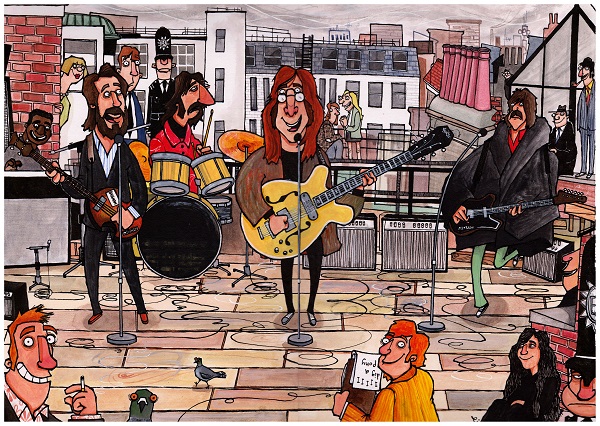
The Beatles play on the rooftop of their Savile Row office, January 1969
The Beatles, 3 Savile Row, London; 30th January 1969 (a Thursday)

The band began their set with Get Back. Now a song about as familiar to everyone in Britain as the National Anthem (they would play this too, incidentally, while the film crew changed the reels in their cameras), at the time it was so shiny new that it probably took anyone in earshot a minute or so to put together exactly what the hell was going on. They soon realised, however, and a genuine cross-section of British society all began to try as best they could to get a better look. In the film, we see excitable secretaries hurling themselves across busy roads, taxi drivers rubbernecking, businessmen who are old enough to have seen everything wearing faces of childlike wonder and, my own personal favourite, an old boy with a bowler hat and umbrella climbing up a ladder on the outside of a building to stand on his own roof and take in the scene with his hands in his raincoat pockets. The Beatles played Get Back twice in succession, with the first of these performances featuring in the final cut of the Let It Be film.

Next up was Don't Let Me Down, and again it was the first of the two performances of John Lennon's new song that afternoon that made it to the final cut of the movie, in spite of the fact that he forgets the words and fluffs a verse mid-way through. Don't Let Me Down would appear on the B side of the Get Back single that April, although it was inexplicably cut from the final Let It Be album by its producer. This would normally represent the biggest dick move of any producer's career, but in this case I think we can make an exception as the culprit in this instance was Phil Spector.

The fourth song of the set was a first of two versions of I've Got A Feeling. In the film, it accompanies a slew of interviews with the spectators who had gathered on the streets below and you can easily, even if you are familiar with the record, miss the fact that the version that appeared on the final album is this live performance. It is a persuasive hint of just how tight The Beatles' playing was that day. Having not played live to anyone in almost a thousand days, on a frigid London rooftop and singing to leaden, empty January skies, here was a band who still had it, never lost it and had sufficient left to just give it away. The next song in the set, One After 909 would also appear on the LP in its live form.

Song six is Dig A Pony. Ringo Starr bellows “hold it!” to halt the introduction because he had been trying to choke down a cheeky cigarette and needed to extinguish it. Lennon, meanwhile, is not confident in his lyrical recall and reads them off book – held in front of him by a lackey no doubt pondering that this will probably be the greatest thing that ever happens to him in his whole life.

By this point, there is considerable commotion in and around the streets of London, as one might expect when the world's greatest rock and roll band play a free concert completely on a whim in the centre of one of the world's great capital cities. Not everyone shares quite the sense of wonder that the whole occasion engenders within me, however. This is, after all, England and English people will always react accordingly. “This type of music is all right in its place and I think it's quite enjoyable,” explains a besuited business type who could be any age from an old 30 to a young 55, “but I think its a bit of an imposition to absolutely disrupt all the business in this area”. As a fellow Englishman, it is hard to argue with him on this point, even though I feel that there need to be exceptions to many a hard and fast rule, particularly if The Beatles are involved. Perhaps he was one of the people who called in the Old Bill to sort it out. Either way, there was by now a growing police presence in Savile Row. They were initially denied entrance to number 3 by the Apple Corps staff, perhaps mindful that the building probably contained all of the drugs in the entire world. However, once the rozzers began threatening arrests for obstruction, uniformed officers slowly began to percolate throughout the building and onto the roof itself.

Still treading the duck boards, The Beatles were by now onto their seventh and eighth numbers of the set, second versions of I've Got A Feeling and Don't Let Me Down. In the latter case, Lennon manages to get the lyrics right and as such a complete live version of the song could later be stitched together and released on Let It Be: Naked. By this point, the powers that be were really rather insistent that the band should stop making this unholy and unexpected racket. Perhaps they were just fed up with all the repetition and could have been placated with a few verses of Ticket To Ride? We'll never know.

Now surrounded by enough police officers to host an FA Cup tie, the band lurched into their final song, the last they would ever play in public together. It was a third performance of Get Back and it is the scuzziest yet, not helped by the fact that the groups' long-suffering personal assistant Mal Evans had been told to turn off the amplifiers by a police officer and, understandably enough, had complied with the instruction. The sound drops out as Lennon and Harrison try to wail on their axe only to get a handful of silence, before both men plug themselves in again on the fly while the song rolls on almost seamlessly. This third version is the one that was released in Anthology 3, complete with McCartney's improvised final verse: “you've been playing on the roof again, and that's no good, your momma doesn't like that, she's going to have you arrested!”. The song concludes hurriedly and is greeted by a loud cheer from Maureen Starkey, Ringo's wife. “I'd like to thank you on behalf of the group and myself and I hope we've passed the audition,” says Lennon to peals of part-sycophantic, part-nervous, part-genuine laughter. The Beatles may not have left the building, but they were no longer on its roof.

In the end, no-one was arrested, a fact made scarcely credible by the sheer quantity of narcotics contained within the Apple building. Perhaps The Beatles had built up enough residual goodwill that the police were willing to turn a blind eye. They had just played a killer gig, after all, and as a passing vicar points out in the finished film, “it's nice to get something for free in this country at the moment...”

However, the long term effects on the group would take their toll. The Get Back sessions had been marred by so much ill-feeling that the album and feature film were shelved, the group instead throwing themselves into recording what would become Abbey Road, a more fitting final hurrah for the band that had changed the course of Western culture forever. On April 10th 1970 (a Friday), Paul McCartney announced that he had left the band and The Beatles were no more. The following month, a Phil Spector-produced rehash of the turbulent Get Back sessions would be released as the Let It Be album, in tandem with a feature film of the same name. Both were hugely successful at the time but have subsequently been reviewed in a far harsher light, unfairly so in my view. There are brilliant moments in each and, although it isn't nice to see it when mummy and daddy fight, they both still love us all the same.

Imagine being there, though. That day in January, now fifty years ago. A moment of history, lovingly recorded so that we can all still be a part of it, unfolding before your very eyes and ears. It must have been hard to fully comprehend the magnitude of what you had witnessed, a process that could only truly begin once it was confirmed that these four brilliant men would never again play together. A process that still isn't over now, as current and future generations still come to grips with what The Beatles did and what they gave us. They were the big bang that created our cultural universe. This was their farewell.

Friday, 17 March 2017

(Sometimes) With The Beatles

Have you ever considered the possibility that all musicians are a bunch of shiftless, dishonest bastards? It is a tantalising possibility, isn't it? Particularly with regard to groups. If you settle down to listen to a Bob Dylan LP, for instance, you can be pretty sure that ol' Bob was responsible for at least some of the sounds that you are hearing. But groups are a very different dynamic: the achingly fashionable Johnnies you saw on Top of the Pops last week might have had very little to do with their latest 45.

That said, there's nothing particularly wrong with this state of affairs. Artists have employed assistants for centuries to do all kinds of different work for them, often completely anonymously and without any expectation of credit. It is said that the modern day artist is more of a manager than a craftsperson, but it was ever thus: Andy Warhol got his mum to sign his work for him and while Michaelangelo did most of the figurative painting on the ceiling of the Sistine Chapel himself, he still had a grunt on the ground telling him where to put extra pubes, mixing his paint and passing him up sausage rolls.

It is, of course, particularly rife in popular music. The majority of The Beach Boys' most famous recordings were made by the Wrecking Crew, a Los Angeles-based supergroup of session musicians. Led Zeppelin were similarly formed by players from the London recording scene. And the less said about Milli Vanilli, the better.


The Beatles: Jim, Peter, Gregory and Roland

Which brings me to The Beatles, who whether you like it or not happen to be the most famous and notable recording artists in history. This is a major advantage, as from a point in around the middle of 1962, no-one closely involved in their story has been able to do so much as a fart without Mark Lewisohn noting it down. As such, we are able to establish exactly who did what, where and when. The following is a list (possibly incomplete but hopefully not too badly so) of recordings released by The Beatles which did not have all four canonical members of the group playing on them. There will be a test later.

YESTERDAY
Only Paul McCartney appears on the record: the other musicians were a string quartet, arranged by George Martin and comprised of Tony Gilbert, Sidney Sax, Kenneth Essex and Peter Halling or Francisco Gabarro.

WE CAN WORK IT OUT
Is is unknown for sure whether or not George Harrison is present on this recording: some have argued that he provided the tambourine but others believe that this was played by Ringo Starr. Harrison did, however, contribute to the song's composition.

ELEANOR RIGBY
Ringo Starr is absent from this track, with John Lennon and George Harrison only providing vocals. The music was provided exclusively by a string nonet arranged by George Martin and comprising Tony Gilbert, Sidney Sax, John Sharpe and Jürgen Hess on violin; Stephen Shingles and John Underwood on viola and Derek Simpson, Stephen Lansberry and Peter Halling on cello.

LOVE YOU TO
John Lennon is absent from this recording, with Paul McCartney only offering vocals and Ringo Starr on tambourine. The group was bolstered by the addition of Anil Bhagwat on tabla and musicians from the Asian Music Circle on sitar and tambura.

WITHIN YOU WITHOUT YOU
George Harrison recorded this solo, assisted by musicians from the Asian Music Circle providing dilrubas, tabla, swarmandal and tambura accompaniment.

SHE'S LEAVING HOME
Features only Paul McCartney and John Lennon, who provide only vocals. She's Leaving Home is one of a scant few Beatles tracks on which none of the canonical four play any musical instrument.

THE INNER LIGHT
Ringo Starr is absent from this recording. Parts of this song, which appeared as the B-side of the single Lady Madonna, were recorded at a session in Bombay during the group's stay in India. It is the only song ever issued by The Beatles not to have been recorded solely in the UK.

BACK IN THE U.S.S.R.
DEAR PRUDENCE
Ringo Starr left The Beatles following a series of escalating intra-band arguments and did not appear on either of the opening songs on the white album. Paul McCartney provided the percussion instead.

WILD HONEY PIE
BLACKBIRD
All exclusively solo Paul McCartney projects.

MARTHA MY DEAR
Paul McCartney was again the sole representative on this recording, which was bolstered by a 15-man brass and string orchestra arranged by George Martin.

DON'T PASS ME BY
The first Beatles song solely written by Ringo Starr, only Paul McCartney joins him on the recording; with additional violin by Jack Fallon.

WHY DON'T WE DO IT IN THE ROAD?
Paul McCartney recorded this song solo, although Ringo Starr would later overdub his own drum track which eventually appeared in the finished version.

I WILL
George Harrison was otherwise occupied for the recording of this song, which required 67 takes.

JULIA
John Lennon's first and only exclusively solo effort as a Beatle.

MOTHER NATURE'S SON
Ironically recorded at a time of great disharmony within the group, McCartney recorded the song alone, later adding in a George Martin brass arrangement. Lennon and Starr were, reportedly, extremely peeved that McCartney had taken his own initiative.

LONG, LONG, LONG
SAVOY TRUFFLE
Lennon was absent from the session in which both of these songs were recorded.

GOOD NIGHT
Ringo Starr provides the vocal for this John Lennon-penned song, with orchestral accompaniment arranged by George Martin and backing vocals from The Mike Sammes Singers.

ACROSS THE UNIVERSE
Paul McCartney is absent from the Phil Spector-produced version that appeared on the Let It Be album, although he appears on the "birdsong" version recorded for the World Wildlife Fund at the request of Spike Milligan, which was subsequently released on Past Masters volume 2.

I ME MINE
John Lennon had left the band by the time this Harrison composition was recorded. However, the session - in which John Lennon instead spent his time dancing in the corner of the studio with Yoko Ono - appeared in Michael Lindsay-Hogg's film Let It Be and therefore had to be included on the finished album.

THE BALLAD OF JOHN AND YOKO
George Harrison was on holiday and Ringo Starr away filming The Magic Christian when inspiration struck Lennon to write this song, which he recorded with help from McCartney on vocals, bass, percussion and piano.

MAXWELL'S SILVER HAMMER
HERE COMES THE SUN
GOLDEN SLUMBERS
John Lennon was in a car accident in Scotland on July 1st 1969 which saw him hospitalised for six days and absent from several sessions for the Abbey Road album. Lennon had returned to London and to the studio by the time work began on Maxwell's Silver Hammer, but declined to take part because he thought the song was "rubbish".

BECAUSE
Ringo Starr is absent from this song, which required no percussion. Or at least, that was their story.

HER MAJESTY
A Paul McCartney solo.

(honourable mention: The version of Love Me Do that appears on the Please Please Me album (and also released as a single in the US market) features session musician Andy White on drums instead of then-newcomer Ringo Starr. However, Ringo is on the record, playing the tambourine. The version of Love Me Do that appears on Past Masters Vol. 1 has Ringo restored to his rightful seat.)

Wednesday, 30 November 2016

Naked POTUS, number 40: Ronald Reagan

"Even the President of the United States must sometimes have to stand naked" - BOB DYLAN


His nipples are clearly visible and he used to be a film actor, it is the 40th President of the United States, Ronald Reagan (1911-2004). Here's what he got up to:

RONALD REAGAN

Born 6th February 1911, Tampico, Illinois
Died 5th June 2004, Los Angeles, California

Presidential Term 20th January 1981 - 20th January 1989

Ronald Reagan was the first divorced man to have  been the President of the United States, having separated from Jane Wyman in 1949. Three years later he would marry Nancy Davis. He was also the oldest man elected to the US Presidency, a record since beaten by Donald Trump.

He is the only President to have been born in Illinois.

Prior to politics, Reagan was a sports announcer on a radio station in Des Moines, Iowa. He first rose to national prominence as an actor, after his then girlfriend convinced him to take a screen test at Warner Brothers, where he would make over fifty movies.

He became active in politics in the 1940s, becoming the head of the Screen Actors Guild in 1947. He also testified at Senator McCarthy's House Un-American Activities Committee, although refused to name any names.

Following his acting career, Reagan worked for General Electric as a spokesman and advertiser but left the role after GE demanded that he keep his growing interest in politics out of his personal appearances. His speech at the 1964 Republican National Convention, in support of candidate Barry Goldwater, thrust him to the forefront of Conservative politics in the United States.

In 1967, Reagan was elected Governor of California, a role he served until 1975. He attempted to win the Republican Presidential nomination in both 1968 and 1976.

Reagan was shot by John Hinckley, a mentally ill man who was trying to impress Jodie Foster, in Washington D.C. on 30th March 1981. The President suffered a collapsed lung but returned to full health.

The biggest crisis of his Presidency was the Iran Contra scandal. Money from illegal arms sales to Iran was given to guerilla fighters in the Nicaraguan civil war. Ultimately, an army Colonel, Oliver North, took the fall.

Reagan initially weathered a storm of escalation of Cold War tensions. These peaked in on 1st September 1983, when Korean Air flight 007 from New York to Seoul via Anchorage accidentally strayed into Soviet airspace and was shot down. However, following the appointment of Mikail Gorbachev as the Soviet Premier, relations quickly thawed. Reagan and Gorbachev signed major nuclear arms reduction treaties and the Soviet Union began to fragment.

His domestic economic policies, which came to be known as Reaganomics, helped to rejuvenate and consolidate America as the leading global power. All of this despite the obvious handicap of being an idiot. Reagan is now held up by Conservatives as one of the greatest American Presidents.

Reagan was the first person to serve out a full two-term Presidency since Dwight D. Eisenhower, 28 years beforehand.

N.B. Some parts of the above image have been redacted by the CIA for reasons of national security. An unexpurgated version of all the naked Presidents will be made available at the end of the project.

Naked POTUS, number 38: Gerald R. Ford

"Even the President of the United States must sometimes have to stand naked" - BOB DYLAN


No-one asked him to be naked, but here he is. The 38th President of the United States, Gerald R. Ford (1913-2006). Here are the pertinent details:

GERALD R. FORD

Born 14th July 1913, Omaha, Nebraska
Died 26th December 2006, Rancho Mirage, California

Presidential Term 9th August 1974 - 20th January 1977

Gerald Ford attended college on an American Football scholarship and was offered the opportunity to turn professional. Instead, he decided to attend Yale Law School.

He saw action in the Philippines during World War 2. On his return to the United States he turned his efforts to politics. He was elected to the House of Representatives and would be re-elected on eleven other occasions.

Ford was a part of the Warren Commission on the Assassination of President Kennedy.

Gerald Ford is the only US President to have never been elected to either the Presidency or the Vice Presidency. He had been promoted to Vice President the year before Nixon's resignation after the elected incumbent Spiro Agnew was forced to resign due to his financial improprieties.

One of Gerald Ford's first actions as President was to officially pardon Richard Nixon.

Ford was subject to two assassination attempts, both in September 1974. On the 5th, Manson Family member Lynette Fromme tried to shoot him and on the 22nd Sara Jane Moore did likewise. On both occasions their firearm failed to function properly.

Gerald Ford's wife, Betty, established a famous addiction clinic in California after her husband's retirement from politics.

The R stood for Rudolph. He is the only President to come from Nebraska.

N.B. Some parts of the above image have been redacted by the CIA for reasons of national security. An unexpurgated version of all the naked Presidents will be made available at the end of the project.

Tuesday, 29 November 2016

Naked POTUS, number 37: Richard M. Nixon

"Even the President of the United States must sometimes have to stand naked" - BOB DYLAN


Not a crook, it's the bare arsed 37th President of the United States, Richard M. Nixon (1913-1994). Here's some knowledge:

RICHARD M. NIXON

Born 9th January 1913, Yorba Linda, California
Died 22nd April 1994, New York City, New York

Presidential Term 20th January 1969 - 9th August 1974

Richard Nixon is the only US President to have been born in California. He studied and practised law before enlisting in the US Naval Reserve and serving in the Second World War. Upon his return to the United States he was elected to the House of Representatives in 1946 and the Senate in 1950, both times after tenacious and aggressively-fought campaigns.

He rose to national prominence during the House Un-American Activities Committee for his tireless pursuit of former Roosevelt aide Alger Hiss, suspected of Communist leanings.

Nixon served as the Vice President under Eisenhower from 1953 to 1961. He was the caretaker President for two months in the autumn of 1955 as Eisenhower recovered from a heart attack. Nominated as the Republican Party's candidate for the 1960 Presidential Election, he narrowly lost out to John F. Kennedy. Two years later he also missed on being elected as the Governor of California. After this defeat, he gave a bitter press conference, famously saying "you won't have Nixon to kick around any more".

During the 1960 campaign, Nixon took part in the first ever televised Presidential Election debate.

Nixon won two landslide election victories after he returned to front line politics in the late 1960s. His victory over George McGovern in 1972 was the most dominant election in American history: he won 49 States and 520 electoral votes, nearly double the amount required to win.

Nixon passed the 26th Amendment, allowing all citizens aged 18 and over to vote.

Nixon was the President when man first landed on the moon on 20th July 1969. In 1970, he created the Environmental Protection Agency. However, he also signed off on National Guard involvement in a student protest at Kent State University, in which 4 students were shot dead.

Nixon became the only President in history to resign from office on 9th August 1974. He was facing impeachment due to his administration's involvement in a break-in at Democratic Party national headquarters at the Watergate building in Washington D.C.

Nixon was the first US President to visit China, having also visited the Soviet Union whilst Vice President.

The M stood for Milhous.

N.B. Some parts of the above image have been redacted by the CIA for reasons of national security. An unexpurgated version of all the naked Presidents will be made available at the end of the project.

Naked POTUS, number 36: Lyndon B. Johnson

"Even the President of the United States must sometimes have to stand naked" - BOB DYLAN


Bum and balls flapping, it is the 36th President of the United States, Lyndon B. Johnson (1908-1973). This is all about him:

LYNDON B. JOHNSON

Born 27th August 1908, Stonewall, Texas
Died 22nd January 1973, Stonewall, Texas

Presidential Term 22nd November 1963 - 20th January 1969

Like his predecessor, Johnson was a decorated war hero: he won the Silver Star for gallantry while serving in the US Navy. Following his return to the USA, Johnson moved into politics.

Johnson won a seat in the US Senate in 1949. By 1955 he was the Majority Leader of the House, the youngest man ever to hold the position. He was the favourite for the Democratic Presidential nomination for 1960 but his refusal to leave the Senate to attend the  Primaries cost him dear: by the time of the Democratic Convention, John Kennedy enjoyed unstoppable momentum and support. Johnson was selected as the Vice President in order to appeal to the Southern States.

Upon Kennedy's death, Johnson became the seventh Vice President to be promoted to the top office. He had been two cars back from Kennedy in the Dallas motorcade and was sworn in as President on board Air Force One as it stood on the tarmac at Dallas Love Field airport.

Johnson's Presidency is notable for its social progressiveness as he continued the Kennedy administration's program of civil rights reform. In 1964 he signed the Civil Rights Act, making racial discrimination illegal in the USA.

Johnson was also responsible for the Voting Rights Act of 1965, which made any techniques of voting suppression illegal, and the Civil Rights Act of 1968, which made housing discrimination on racial grounds illegal. Johnson was perhaps the most progressive US President since Abraham Lincoln, a century before.

Johnson's own initiative was The Great Society, an umbrella of social reforms that included Medicare, Medicaid and environmental protection laws, in addition to civil rights reforms and a declaration of war on poverty in the US. As with all of his crusades, Johnson used his exhaustive network of political contacts, friends and colleagues to barter them into existence.

The war in Vietnam, a program that had been supported by the previous two US administrations, began in earnest under the Johnson government. Following the Gulf of Tonkin Incident on 2nd August 1964, Johnson finally formally committed US ground troops.

Johnson refused to stand for a third term of office at the 1968 election, stepping down in a speech to the nation on 31st March 1968. This was variously attributed to public anger over the escalating Vietnam War, his personal rivalry with Robert Kennedy (who had declared his candidacy for the top office earlier in the month) and fears about his own health - both his father and grandfather had died of a heart attack at the age of 64, which would be his own age at the end of his office.

Lyndon Johnson died of a heart attack in 1973, aged 64.

The B stood for Baines. His wife (Lady Bird), daughters (Lynda Bird and Luci Baines) and dog (Little Beagle) all shared his initials LBJ, which was also how he was popularly known.

N.B. Some parts of the above image have been redacted by the CIA for reasons of national security. An unexpurgated version of all the naked Presidents will be made available at the end of the project.

Thursday, 10 November 2016

Naked POTUS, number 35: John F. Kennedy

"Even the President of the United States must sometimes have to stand naked" - BOB DYLAN


The hope of a new generation of naked Americans, it is the 35th President of the United States John F. Kennedy (1917-1963). Here's the stuff to know:

JOHN F. KENNEDY

Born 29th May 1917, Brookline, Massachusetts
Died 22nd November 1963, Dallas, Texas

Presidential Term 20th January 1961 - 22nd November 1963

Kennedy was the son of John Kennedy Sr, a diplomat who served as the Ambassador to Great Britain during the 1930s. Kennedy served under him as a graduate before the outbreak of hostilities. He was the first American President to have been born in the 20th Century.

Kennedy rose to national prominence during the war in the Pacific, winning the Navy and Marine Corps Medal for his actions in saving the crew of his small boat, PT-109 after it was scuttled by a Japanese destroyer. After his return and recuperation, Kennedy turned to politics.

Kennedy was elected to the House of Representatives in 1947 and to the Senate in 1953, winning an unlikely victory over Henry Cabot Lodge, who he would later appoint ambassador to Vietnam. Kennedy in fact never lost an election in which he was a candidate.

During the 1960 campaign, Kennedy took part in the first ever televised Presidential Election debate.

Kennedy is the only US President to have won a Pulitzer Prize. He received it for his book "Profiles In Courage", in 1957.

Kennedy spent his Presidency and life as a sickly man. He suffered from Addison's Disease, which required daily cortisone injections. He also had osteoporosis, which would frequently leave him in so much pain that he required a back brace in order to walk.

He was the first Roman Catholic to be elected President and the youngest person to be elected to the office, aged 43. He would later also become the youngest to die.

His Presidency was marked with turbulence at home and abroad. It began with the disastrous Bay of Pigs invasion of Cuba by CIA-backed Cuban rebels in 1961. The following year, the US discovered that the Soviet Union had installed nuclear missiles on Cuba, resulting in the Cuban Missile Crisis of October 1962, when the world came to the brink of nuclear war.

Domestically, the US was beset with Civil Rights struggles and the rise of the movement for change led by Martin Luther King.

Kennedy oversaw the beginning of the Vietnam War, which you may have heard of.

Kennedy was assassinated during a trip to Dallas in November 1963, shot by Lee Harvey Oswald with a sniper rifle from the sixth floor of an office building. He was the fourth President to be assassinated and the seventh to die in office.

The F stood for Fitzgerald. He almost certainly porked Marilyn Monroe. Like Warren G. Harding before him, Kennedy's wife was a very tolerant sort who was in full possession of the facts about her husband's indiscretions.

N.B. Some parts of the above image have been redacted by the CIA for reasons of national security. An unexpurgated version of all the naked Presidents will be made available at the end of the project.

Naked POTUS, number 34: Dwight D. Eisenhower

"Even the President of the United States must sometimes have to stand naked" - BOB DYLAN


Wary of the military industrial complex but obviously not carrying any weapons himself, it is the 34th President of the United States, Dwight D. Eisenhower (1890-1969). Fact me do:

DWIGHT D. EISENHOWER

Born 14th October 1890, Denison, Texas
Died 28th March 1969, Washington D.C.

Presidential Term 20th January 1953 - 20th January 1961

Following on from Andrew Jackson and Ulysses S. Grant, Dwight Eisenhower was the third great popular military hero to be elected President of the United States. Eisenhower rose to prominence as the commander of the troops in the European theatre of the Second World War.

Although born in Texas, his family relocated to Abilene, Kansas a year after his birth, which became his home. He was originally named David Dwight, like his father and elder brother. This proved sufficiently gormless for his mother to quickly reverse his names.

Eisenhower, like Grant, attended West Point Military Academy. However, this was not the result of any great military ambition, rather it was in order that he might gain a good, free education. Initially his primary interest and focus was on playing American Football, though a potentially promising career was quickly ended by injury. Eisenhower spent 35 years in the army but retired having never seen active combat.

After the Second World War, Eisenhower was appointed Head of NATO by Harry S. Truman.

Though reluctant to enter public politics - having previously been invited to join the Democrats by President Truman - the advent of Senator Joseph McCarthy's anti-communist crusade and the candidacy of the isolationist, anti-NATO Senator Robert Taft (son of William Taft, 27th President of the United States) for the Republican nomination convinced him to act.

Eisenhower continued the Truman Doctrine in US foreign policy, which stated that the US had the right to defend any country that was being threatened by Communism. Eisenhower was notably anti-war in his overall policies, however, opting to retain the passive strategy of containment that had been begun by his predecessor.

Eisenhower was particularly concerned with the corrosive effect that excessive defence spending had on everyday life in American society, as well as it being used to gain power and influence in Washington via what he termed the Military-Industrial Complex. He favoured the maintenance of a strong nuclear capability so that spending on conventional weapons could be curbed in favour of civic projects.

Eisenhower suffered a heart attack in September 1955 and was forced to take two months off. His Vice President, Richard Nixon, was his caretaker.

Other key incidents of the Eisenhower Presidency include the U2 Spy Plane incident, where Gary Powers' U2 was shot down over the Soviet Union shortly before planned talks aimed at arms reduction; and Brown versus The Board of Education in Topeka, Kansas. This landmark legal decision forced the desegregation of all schools in the United States and began the turbulent Civil Rights struggle of the 1960s.

During Eisenhower's Presidency, the United States in its current form was completed with the admission to Statehood of Alaska and Hawaii in 1959.

The D stood for David.

N.B. Some parts of the above image have been redacted by the CIA for reasons of national security. An unexpurgated version of all the naked Presidents will be made available at the end of the project.

Naked POTUS, number 33: Harry S. Truman

"Even the President of the United States must sometimes have to stand naked" - BOB DYLAN


Atomic fresh and ready for anything Communism can throw, it is the 33rd President of the United States, Harry S. Truman (1884-1972). Facts:

HARRY S. TRUMAN

Born 8th May 1884, Lamar, Missouri
Died 26th December 1972, Kansas City, Missouri

Presidential Term 12th April 1945 - 20th January 1953

Harry S. Truman grew up in Independence, Missouri. He remains the only US President to hail from that State. As a child he dreamt of becoming a concert pianist. His family were staunch segregationists. Truman's mother held John Wilkes Booth, Lincoln's assassin, up as a hero.

After graduating high school, Truman was unsuccessful for much of his early life. Having failed to finish his law degree due to a lack of money, Truman worked on the family farm until his father's death in 1914. By then aged 30 and eager to strike out on his own, Truman headed to Oklahoma. He first invested in a zinc mine and then in an oil expedition, both of which proved unsuccessful and left him close to broke. (The oil rig, bought by another company, ultimately bore fruit with some additional drilling. It would have made Truman's fortune had he persisted.)

Truman instead went to fight in the Great War, the only US President to have done so. He was virtually blind in one eye but learned the eye chart beforehand and was declared fit for duty. Upon his return to the United States, Truman opened a men's clothing shop. When this also failed it left him, aged 38, bankrupt and without employment.

It was not until he turned to politics that his fortunes began to change. Within ten years of being elected to the Senate, Truman had become President of the United States.

Truman had only been Vice President for 82 days when he was summoned to the White House to be informed of President Roosevelt's death. He had only met with Roosevelt twice during this time, having been chosen by the Democratic Party for the role rather than by the President himself.

Truman was the first person to sanction the use of nuclear weapons. The US dropped an atomic bomb on Hiroshima in Japan on 6th August 1945 and another at Nagasaki three days later, effectively ending the Second World War. Truman, largely sidelined from Roosevelt's inner circle, only discovered about the Manhattan Project several days after he had assumed the Presidency.

Truman's Presidency was marked by the new Cold War realities of the atomic age. The Korean War, the Soviet Union's own acquisition of nuclear weapons and Mao Tse-Tung's Communist uprising in China all destabilised the status quo. At home, Senator Joseph McCarthy of Wisconsin began his House Un-American Activities Committee to weed out Communist sympathisers and fifth columnists in American society.

Truman himself had invoked fears of the spread of Communism in order to suit his legislative agenda, in what came to be known as The Red Scare. The Truman doctrine argued that the United States had the right to intervene when a country abroad was threatened by Communist tyranny.

Truman took numerous steps towards civil rights in American society, including desegregating the US Army and being the first President to address the NAACP. He also passed the Marshall Plan, a major humanitarian aid effort for post-war Europe, in 1947.

In 1948, Truman won one of the most unlikely election victories in American history. The Republican candidate, Thomas Dewey, led the polls so strongly that Gallup ceased all polling activity a month before the election took place. Truman's energetic, cross-country campaign had won a wavering electorate over, thanks to aggressive challenges to the Republican Senators (who had blocked legislation he wished to pass and now used Truman's failure to do so to form their own manifesto pledges) as well as his progress on civil rights and support for the new state of Israel.

Truman was the subject of an attempted assassination on 1st November 1950. Puerto Rican nationals Oscar Collazo and Griselio Torresola stormed the Blair House in Washington D.C., where the Trumans were staying during the renovation of the White House with the intention of killing the President. Torresola and a policeman were killed during a gunfight but Collazo was captured and sentenced to death. However, Truman commuted his sentence to life in prison.

By the way, the initial in his name didn't stand for anything, making him the second US President to have a fake middle letter. Like the first, Ulysses Grant, he chose 'S'.

N.B. Some parts of the above image have been redacted by the CIA for reasons of national security. An unexpurgated version of all the naked Presidents will be made available at the end of the project.

Naked POTUS, number 32: Franklin D. Roosevelt

"Even the President of the United States must sometimes have to stand naked" - BOB DYLAN


He is twice as naked as any other American President, it is the 32nd President of the United States, Franklin D. Roosevelt (1882-1945). Here are the details:

FRANKLIN D. ROOSEVELT

Born 30th January 1882, Hyde Park, New York
Died 12th April 1945, Warms Springs, Georgia

Presidential Term 4th March 1933 - 12th April 1945

Roosevelt was born into considerable wealth and privilege in New York. His fifth cousin Theodore was the 26th President of the United States. Franklin studied law and practised as a lawyer before going in to politics.

By the outbreak of the Great War he was part of the apparatus of government, serving as the Assistant Secretary to the Navy and visiting the front line in France and Belgium during early 1918. Following the Wilson administration, Roosevelt was elected Governor of New York.

Roosevelt was crippled throughout his Presidency. He contracted polio during the summer of 1921 and was unable to walk unaided until the end of his life. However, this fact was artfully concealed from the majority of the American public.

Roosevelt devised and implemented The New Deal in order to create jobs, boost manufacturing and stimulate the US economy out of Depression. As part of the program, Mount Rushmore was completed in 1939.

One of Roosevelt's first acts as President was to pass the 21st Amendment, which repealed the 18th Amendment and ended Prohibition.

He is best remembered for being the President who took America into the Second World War. Roosevelt was pro-war but unable to raise enough popular sentiment until the Japanese attack on Pearl Harbor on 7th December 1941. Before this he had been instrumental in the creation of the Lend Lease Act, which assisted Britain with food and materiel in their fight against Germany.

Roosevelt is the only US President to have served more than two terms of office. In the end he won four, although he died shortly after the beginning of his final term, which began on January 20th 1945. January 20th, now the traditional day of the Presidential Inauguration, became the date during the Roosevelt administration, after his re-election in 1936.

Roosevelt was the first American President to visit Russia, for the Yalta Conference in 1945. He was also the first American President to fly in an aeroplane during his term of office, although his cousin Theodore had done so while he was a private citizen.

Roosevelt was the seventh President to die in office. His health had been failing throughout much of the War years. He suffered a fatal cerebral haemmorhage at his holiday retreat at Warm Springs, Georgia on 12th April 1945, just four weeks before the end of hostilities in Europe.

The D stood for Delano, his mother's maiden name.

N.B. Some parts of the above image have been redacted by the CIA for reasons of national security. An unexpurgated version of all the naked Presidents will be made available at the end of the project.

Naked POTUS, number 31: Herbert Hoover

"Even the President of the United States must sometimes have to stand naked" - BOB DYLAN


Unable to afford clothes, it is the 31st President of the United States, Herbert Hoover (1874-1964). Let's absorb information:

HERBERT HOOVER

Born 10th August 1874, West Point, Iowa
Died 20th October 1964, New York City, New York

Presidential Term 4th March 1929 - 4th March 1933

Herbert Hoover was the son of a blacksmith. He was the first Quaker to be the President of the United States and the only Chief Executive so far to have been born in Iowa.

He and his wife were in China during the Boxer Rebellion. During their escape back to the United States they became fluent in Mandarin and would often speak it later in the White House if they didn't want anyone to know what they were saying.

He is most famous for being the President during the Great Depression, which began after the Wall Street Crash on 24th October 1929. This made him a particularly unpopular President.

Hoover came out of retirement in 1946 to help co-ordinate post-war famine relief.

In spite of the fact that they had pretty much the exact same head, Herbert Hoover was no relation to the head of the FBI, J. Edgar Hoover.

N.B. Some parts of the above image have been redacted by the CIA for reasons of national security. An unexpurgated version of all the naked Presidents will be made available at the end of the project.

Friday, 28 October 2016

Naked POTUS, number 30: Calvin Coolidge

"Even the President of the United States must sometimes have to stand naked" - BOB DYLAN


He might be quiet, but I assure you that this is the naked 30th President of the United States, Calvin Coolidge (1872-1933). Here are the details:

CALVIN COOLIDGE

Born 4th July 1872, Plymouth Notch, Vermont
Died 5th January 1933, Northampton, Massachusetts

Presidential Term 2nd August 1923 - 4th March 1929

Coolidge was the sixth Vice President to be promoted to President. In 1924, he became the second after Theodore Roosevelt to be elected to a second term of office.

He was the son of a storekeeper who was also a Justice of the Peace. Coolidge is the only President of the United States to have been born of the 4th of July.

His wife, Grace, was deaf. Their son Calvin Junior died of septicaemia after a blister he sustained playing tennis became infected while his father was the sitting President.

Coolidge was responsible for the passage of the 1924 Immigration Act, which limited the number of migrants to the United States to 150,000 per year.

He chose not to seek a third term of office, instead pursuing other interests. He was the chairman of the Railroad Commission, honorary president of the Society of the Blind and wrote a weekly newspaper column called "Calvin Coolidge Says".

He died of coronary thrombosis in 1933.

N.B. Some parts of the above image have been redacted by the CIA for reasons of national security. An unexpurgated version of all the naked Presidents will be made available at the end of the project.

Naked POTUS, number 29: Warren G. Harding

"Even the President of the United States must sometimes have to stand naked" - BOB DYLAN


Pictured here with no clothes on, his usual plumage, it is the 29th President of the United States Warren G. Harding (1865-1923). All about him:

WARREN G. HARDING

Born 2nd November 1865, Corsica, Ohio
Died 2nd August 1923, San Francisco, California

Presidential Term 4th March 1921 - 2nd August 1923

Warren G. Harding was the son of two doctors, but he made his name as a newspaper editor and proprietor. He made his paper, The Marion Daily Star, into one of the largest in the country before he turned to politics.

Harding was the first US President to have been born post-American Civil War.

He was a divisive figure. Harding controversially filled his cabinet with close personal friends. The major fallout from this was the Teapot Dome scandal, where a Harding crony - Secretary of the Interior Albert Fall - secretly sold the oil rights to Teapot Dome, Wyoming in exchange for money and cattle.

Harding was a progressive, ordering that the White House and Washington D.C. be desegregated. He also pardoned the Communist politician Eugene V. Debs, imprisoned by his predecessor Woodrow Wilson for speaking out against the Great War. Harding was in fact responsible for ending that war: due to the US Senate's refusal to join the League of Nations, the conflict was not technically over until ratified by the US President.

Harding is best remembered for his magnificent sexual incontinence. He had a lengthy affair with Laurie Fulton Phillips, while another mistress Nan Fulton, sired him an illegitimate daughter. His wife was a peculiarly understanding woman.

Harding became the sixth US President to die in office. He had a heart attack while visiting San Francisco on 27th July 1923. Subsequent examination showed that he was also suffering from pneumonia and he died of a cerebral haemmorhage a week after he fell ill.

The G stood for Gamaliel.

N.B. Some parts of the above image have been redacted by the CIA for reasons of national security. An unexpurgated version of all the naked Presidents will be made available at the end of the project.

Naked POTUS, number 28: Woodrow Wilson

"Even the President of the United States must sometimes have to stand naked" - BOB DYLAN


Say it loud, he's naked (and white) and he's proud. It's the 28th President of the United States, Woodrow Wilson (1856-1924). Here are the details:

WOODROW WILSON

Born 28th December 1856, Staunton, Virginia
Died 3rd February 1924, Washington D.C.

Presidential Term 4th March 1913 - 4th March 1921

Woodrow Wilson was the first US President to have a Ph.D; he gained his in the study of Political Science at Johns Hopkins University. He gained national prominence as the progressive President of Princeton University.

Wilson passed the 17th and 18th Amendments to the US Constitution. The 17th made the election of members to the US Senate a matter for the popular vote. The 18th proved significantly less popular: in 1920 it outlawed the purchase or manufacture of alcoholic beverages.

Wilson's wife, Ellen, died from kidney failure on 5th August 1914, just days after Germany had declared war on Russia and invaded neutral Belgium, drawing Britain and France into the conflict and beginning the Great War.

During the Wilson Presidency, America found itself heavily involved in foreign affairs. The US Army overthrew Pancho Villa to quell the Mexican Rebellion in 1916.

He is best remembered for being the President who took the US into the Great War. Anti-German sentiment began to rise after their U-Boats sank the British passenger ship Lusitania, with many US citizens aboard. Wilson demanded that Germany cease their submarine warfare, severing diplomatic ties in protest in February 1917. The US formally entered the war on 6th April 1917.

Wilson became the second American President to win the Nobel Peace Prize in the conflict's aftermath for his efforts to form the League of Nations. Ironically, the United States would never join the League of Nations after the Senate opposed it. This diminished its importance and efficacy on the world stage and ultimately led to its collapse.

Wilson wasn't all wine and roses. He was a virulent racist who supported segregation and whose book "History of the American People" was quoted in D.W. Griffiths' infamous pro-Ku Klux Klan historical epic motion picture Birth of a Nation. Under the Wilson administration, Washington D.C. was re-segregated.

On 2nd October 1919, Wilson suffered a major stroke while visiting Pueblo, Colorado. This left him paralysed down his left side and a virtual recluse for the final year of his Presidency. Many of his duties were carried out in secret by his new first lady Edith, whom he had married in December 1915. Wilson never fully recovered and died three years after his term had ended.

N.B. Some parts of the above image have been redacted by the CIA for reasons of national security. An unexpurgated version of all the naked Presidents will be made available at the end of the project.

Naked POTUS, number 27: William H. Taft

"Even the President of the United States must sometimes have to stand naked" - BOB DYLAN


Your eyes don't deceive you, this really is the bath-fresh 27th President of the United States, William H. Taft (1857-1930). Fact:

WILLIAM H. TAFT

Born 15th September 1857, Cincinatti, Ohio
Died 8th March 1930, Washington D.C.

Presidential Term 4th March 1909 - 4th March 1913

Taft came from a political family. His father helped found the Republican Party. Like his father, Taft was a lawyer before he began his own political career. He spent the early 20th Century as Theodore Roosevelt's Vice President.

Supported by Roosevelt, he won the 1908 Presidential election from William H. Bryan. His time in office was marked by a strong pursuance of the anti-Trust policies of his immediate predecessors.

During his Presidency, the 16th Amendment was added to the US Constitution, allowing the collection of Federal income taxes for the first time.

Taft presided over the completion of the 48 Contiguous United States, with the admission of New Mexico and Arizona to Statehood in 1912.

Taft (the 'H' stood for Howard) was the largest ever US President. He stood 1.82 metres in height and at his heaviest, weighed in at an enormous 332 lbs. He once got stuck in the White House's bathtub, forcing a larger model to be installed.

He was opposed by Roosevelt for the 1912 Presidential Election. T.R. went as far as to run against him for the Republican Party nomination, before forming his own rival party which allowed the Democrats to split the vote. Following his loss in the election, Taft returned to law. In 1821 he was appointed the United States' Chief Justice, where he served until a month before his death in 1830. Taft remains the only former Chief Executive to have held the role.

N.B. Some parts of the above image have been redacted by the CIA for reasons of national security. An unexpurgated version of all the naked Presidents will be made available at the end of the project.

Thursday, 20 October 2016

Naked POTUS, number 26: Theodore Roosevelt

"Even the President of the United States must sometimes have to stand naked" - BOB DYLAN


Neither a bull nor a moose, it is the 26th President of the United States, Theodore Roosevelt (1858-1919), in the nip. Fact squad:

THEODORE ROOSEVELT

Born 27th October 1858, Manhattan, New York
Died 6th January 1919, Oyster Bay, New York

Presidential Term 14th September 1901 - 4th March 1909

Theodore Roosevelt had not been expected to survive his childhood due to his severe asthma. However, he built up his strength and confidence through the practice of boxing. Tirelessly energetic, he also spent his childhood - as well as the rest of his adult life - as a keen naturalist.

Roosevelt began in politics at an early age. He was already a US Senator when his first wife Alice died during the birth of their first child, also named Alice.

Roosevelt briefly resigned from politics in order to serve in the Spanish-American war, heading up a volunteer cavalry regiment that was known as the Rough Riders. On 1st July 1898, Roosevelt's men won a famous victory at the Battle of Kettle Hill.

Roosevelt was the fifth Vice President to have been promoted to the Presidency. At the time, he was also the youngest man to have served in the role.

His term was marked by stability at home and abroad, much to Roosevelt's chagrin. During his Presidency, the Panama Canal was constructed. He is mainly remembered for his contribution to foreign policy, coining the term "walk softly and carry a big stick". This was allied to The Roosevelt Corollary to the Monroe Doctrine: Monroe sought to prevent European expansion within the Americas, but Roosevelt expanded the scope to include intervention throughout the Western world. This mixture of a strong military and a brief to protect both the interests and ideals of the American people forms the basis of the United States' foreign policy to the present day.

For all his bullishness, Roosevelt was the first American President to win the Nobel Peace Prize, for his efforts in negotiating peace in the Russio-Japanese War of 1904-05.

In 1904, Roosevelt became the first promoted Vice President to win a Presidential election in his own right.

Upon winning the 1904 election, Roosevelt immediately announced he would not seek a further term.  He came to regard as this his greatest mistake. He found that he disagreed with the direction of his designated successor, William Taft. By 1912 he was seeking election again. Passed over by his Republican Party for the nomination, he formed his own Bull Moose Party. This considerably split the Republican vote but served only to allow the Democratic candidate Woodrow Wilson to win the Presidency.

During the 1912 campaign he was subject to an attempted assassination. A German immigrant, John Schrank, shot Roosevelt as he prepared to make a speech in New York City. The bullet deflected off of Roosevelt's spectacles case and fifty pages that made up his speech. Though injured by the attack, Roosevelt nevertheless spoke for an hour afterwards.

Roosevelt disappointed his many followers by disbanding the Bull Moose Party during the 1916 election season, recommending that they vote for the Republican candidate Charles E. Hughes.

Roosevelt was the first US President to own a motor car and the first to wear corrective eye glasses. He is the only 20th Century President to appear in effigy on the side of Mount Rushmore.

During his Presidency, Oklahoma was admitted to the Union in 1907, which now comprised of 46 constituents.

He was the uncle of Eleanor Roosevelt, future First Lady of the United States, and the fifth cousin of the 32nd President, Franklin Roosevelt.

N.B. Some parts of the above image have been redacted by the CIA for reasons of national security. An unexpurgated version of all the naked Presidents will be made available at the end of the project.

Attention

You have reached the bottom of the internet