Pages

Friday, 29 April 2016

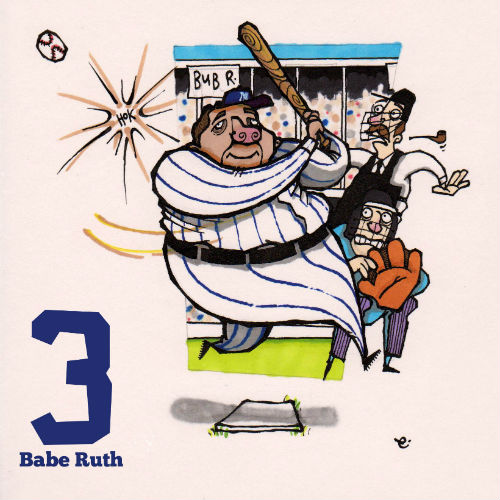
Sport by Numbers: Number 3

Today's sporting number comes from the hotly contested series from one to fifteen. These are the numbers that cover the action for all but the most lunatic of sporting occasions and, as a result, have come to be associated with all kinds of different personalities and disciplines. Number 3 is the number that AC Milan retired in honour of their stalwart defender Paolo Maldini; it is also the number carried by the legendary Dale Earnhardt throughout his career in stock car racing.

However, it would have been remiss of me to not award my number 3 to the Sultan of Swat. The 20th Century saw the invention of many things that we now accept as facts of life without really thinking about them and one of these was international sporting superstars. George Herman "Babe" Ruth was one of the first and, over a century on from his Major League Baseball debut, he remains one of the biggest. If he hadn't been born, someone would have had to invent him.

George Herman "Babe" Ruth 1895-1948

Friday, 22 April 2016

Sport by Numbers: Number 33

Today begins a new series of pictures combining sport and the iconic numbers associated with some of its greatest practitioners. I'll be trying to add a new one every Friday morning, but you know what I'm like. Flaky.

Keen-eyed viewers will also notice that I am not doing them in any kind of order, least of all numerical order. This is a deliberate strategem on my part to make the project seem like more fun and less like a self-imposed prison. Where, of course, the gaoler is me and the terms are fairly lenient. Flaky, you see.

Anyway, the first entrant is probably best known to British people as the co-pilot in the 1980 disaster comedy film Airplane! but the majority of Americans recognise him instead as perhaps the greatest basketball player of all time, Kareem Abdul-Jabbar. Virtually every other rival he has for that title is also on my list awaiting being drawn by the way, so don't panic too much.

He is also an excellent reminder that US sporting greats can appear in motion pictures and not subsequently murder their wife.

Number 33: Kareem Abdul-Jabbar

Tuesday, 12 April 2016

Disaster Film Olympiad: Countdown To Looking Glass

Countdown To Looking Glass is an unlikely name for a film but it has a similarly unlikely premise: financial instability caused by a banking collapse suddenly intensifies the significance of a regional dispute in the Middle East, one that quickly descends into a proxy war between the Soviet Union and NATO forces which threatens to spill over into a global conflagration. None of this could ever happen.

As the new Soviet-backed, some say puppet, regime get down to business in Oman, the Western news media swing into action to help placate and inform the viewing trillions. The responsible souls of the major news outlets understand the significance of their role and would never dream of trying to spread panic or propaganda. They are our true heroes.

The disaster movie-as-faux-real-time-news-coverage is not an unusual concept, nor did it begin with Countdown To Looking Glass - 1983's Special Bulletin is a notable earlier example. However, Countdown has a few interesting twists and tweaks to the format designed to keep things fresh and interesting. Firstly, they engage the services of real life contributors: veteran American TV news stalwarts Eric Sevareid and Nancy Dickerson both appear as themselves as a senior analyst and senior reporter respectively. Additional opinion is provided by US Senator (and five-time former Presidential candidate) Eugene McCarthy, defence analyst Lincoln Bloomfield and Congressman (and all-round right wing diarrhoea cannon) Newt Gingrich. Although it is perhaps debatable as to the exact degree which each of the above understood what was actually going on, it nevertheless adds an interesting vérité to proceedings.

Patrick Watson and Newt Gingrich in Countdown To Looking Glass (1984)
Don Tobin reports in Countdown To Looking Glass, shortly before kissing his ass goodbye

The second change to the format is that the real time news coverage is broken up by portions of melodrama, dealing with the real lives of both the lead anchor Don Tobin (played by Canadian news veteran Patrick Watson) and Washington reporter Dorian Waldorf (Helen Shaver). We watch on day by day as an increasingly anxious Tobin yaks on to his wife about the likely outcome of the unfolding crisis and, more significantly for the story, we see Waldorf's romantic relationship with a White House staffer lead to exclusives, high anxiety and heartbreak. Having gone to the trouble of getting real world contributors to weigh in on an entirely fictional story, these soap opera-style interludes could have been an eccentric move on the part of the producers. But oddly, it works: Shaver's story in particular has some very interesting and incisive points to make about the way that news events and the news media have become so interdependent as to have become self-sustaining; the exclusive story she uncovers from inside the Oval Office seems to have the potential to help defuse the spiralling situation only to be held back by the station's editorial policy.

It's all so grindingly predictable. This would ordinarily make for a damning condemnation of any film, but in this case it is not: the unfolding news coverage portions of the piece are done well enough that any despondency you feel tends to be despondency at the worst excesses of global politics and its vainglorious pride, its high ideals at the expense of the lives of its people. Sobering stuff, not least when - on the cusp of a nuclear exchange in the Strait of Hormuz - Newt Gingrich justifies the action as being crucial to the United States' vital stewardship of freedom and democracy around the world. Gallingly, this is something which required no acting talent at all on the Congressman's part because it also happens to be what Gingrich (in company with all of his contemporaries on the right of American politics) really thinks. Thanks, America.

Countdown To Looking Glass gets a spine tingling EIGHT out of ten Disaster Points.

Wednesday, 30 March 2016

The Five Greatest Sports Stars of the 20th Century

Last year I made five drawings of the five people who I consider to be the greatest sports stars of the 20th Century and with typical efficiency I am only now doing anything with them. I love sport more than anything else, I think. Like great music or art, it transcends human experience with a potency far outreaching its remit. But, unlike music or art, it retains a crucial element of total objectivity. There are winners and losers in sport; for all the discussion and for all the postulation there will always come a time when all the bullshit must, through absolute necessity, stop. It is this which appeals to me on such a fundamental level. Elemental, even. I need it.

Choosing five outstanding people from the sporting field is foolhardy in the extreme and invariably shot through with bias, blind spots and flaws. Complaints to the usual place, perhaps. Or, even better, how about making your own list? Creative solutions to internet-based disagreement is surely the way forward. For my choices, I tried to pick five people whose greatness went beyond their particular field of endeavour. They are people who made a wider social impact, through their values, their example or their personality.

I consider them to be five of the most inspirational people the Twentieth Century produced.

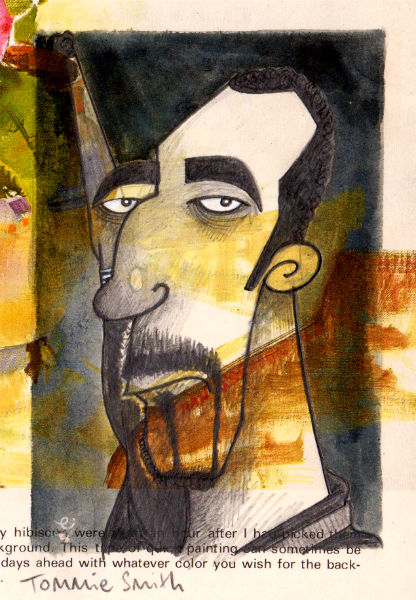
5. Tommie Smith (1944-) - Athletics

Tommie Smith

Tommie Smith crystallised an entire movement in one single perfect moment. On 16th October 1968 at the Mexico City Olympics, he won the 200 metres sprint in 19.83 seconds. It was an heroic enough performance as it stood: he had been nursing a hamstring injury through the heats and his display in the final was astonishing, the first time that 200 metres had been officially run in under twenty seconds in human history.

Quite rightly, however, Smith is better remembered for what he did on the podium. 1968 had been a year of tumult. In his homeland, it had seen the assassination of Martin Luther King and Robert Kennedy and the worsening of the conflict in Vietnam. The Civil Rights struggle was far too deeply ingrained to be solved simply by recourse to legislature and racial tension remained a tinderbox across the United States. As for the rest of the world, similar life-and-death struggles for recognition, for freedom and for human rights also raged: Northern Ireland, Warsaw, The Prague Spring, student uprisings in France and West Germany; the continuing stain of Apartheid in South Africa, as well as continuing tension in Israel and Palestine.

Tommie Smith's black gloved raised fist salute was seen as being a symbol of black power and association with the nascent Black Panther movement. In truth, it represented support for everything that is good and just in a year that had, at times, looked set to spiral out of control. Even if in the moment he, silver medallist Peter Norman of Australia and Smith's American teammate John Carlos may have not realised what an epochal gesture they had made, nearly 50 years on it remains the single most staggeringly eloquent reminder of sport's social potency.

Of course, Smith's reward was to be canned. Both he and Carlos were immediately sent home from the Olympics and made pariah by a significant proportion of American society. The following year, Smith moved into American Football, playing two games for the Cincinnati Bengals before becoming both a sociology teacher and an athletics coach at Oberlin College, Ohio.

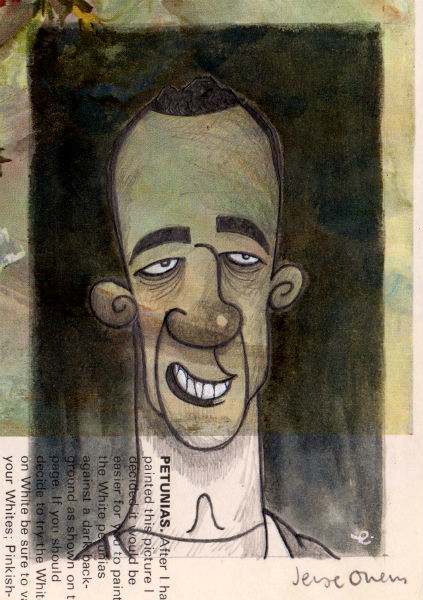
4. Jesse Owens (1913-1980) - Athletics

Jesse Owens

Jesse Owens was one of the greatest track athletes in history. During the 1935 Big Ten athletics meeting at Ann Arbor, Michigan, he broke three world records within 45 minutes. The following year, he won four gold medals in the 100 metre sprint, 200 metre sprint, 4x100 metre sprint relay and long jump at the Berlin Olympics.

Owens never set out to be a hero or a warrior for social justice. Both things just sort of caught up with him, even when nothing else could. He remains the ultimate fly in the ointment, the most celebrated up yours to the most insidious and evil political regime of modern human history. Adolf Hitler had, of course, designed the Berlin Olympics to be as carefully choreographed a love letter to the innate superiority of his Aryan supermen as any sporting event could be. But he had not reckoned on the basic truth of the forces at work in the sporting arena. 1936 was Owens' time and he would not be - could not have been - denied.

Much has been made of the Fuhrer's avoidance of Owens following his Olympic success. Debate still continues as to whether or not this was the result of prior engagements, a desire to not be caught out in an impending rainstorm or his virulent racism. The possibility even remains that the Nazi leader did seek out and congratulate Owens but that it was subsequently hushed up. The fact remains that Owens' feats were all featured in Leni Reifenstahl's state-funded 1938 film of the event, Olympia, whilst at home he remained a second-class citizen. It is this frequently ignored story which speaks with the greatest volume about the legacy of Jesse Owens, a campaigner for civil rights and social justice. He always maintained that it was not Hitler who snubbed him but his own President. "[He] didn't even send a telegram".

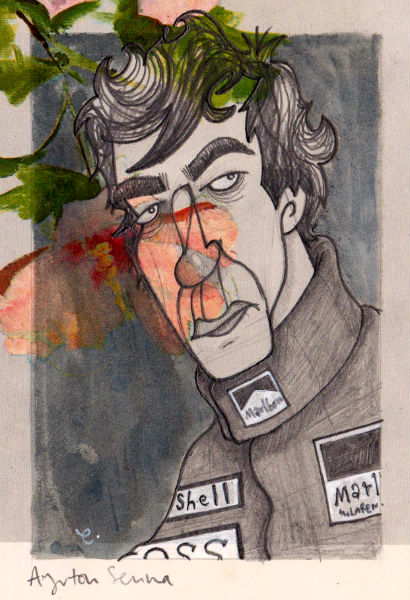
3. Ayrton Senna (1960-1994) - Motor racing

Ayrton Senna

Ayrton Senna was the fastest racing driver who has ever lived. He drove like the devil was after him and he was trying to get away. And as fanciful a narrative as that sounds, the man himself would leave you in some doubt as to whether or not it was what was at stake. There are few people possessed of the kind of single-minded dedication, control and ability to achieve all that Senna did in his brief life, fewer still able to articulate it in quite the same mesmerising way that he did: all the more remarkable if you consider that he was often doing so in a second language.

The winner of 41 Grands Prix, three Formula 1 World Championships and 65 pole positions - the latter a record that it took even Michael Schumacher nearly a hundred additional career races to overhaul - Senna's numbers remain impressive but, as is the nature of many statistics, are slowly being subsumed by history. What will not go away is the story. Senna's electrifying presence transfixed the motor racing world; Formula 1 was Ayrton Senna and to set out to conquer it meant beating him. What will never go away is the footage. Some of it shows him doing things which are devious, questionable or downright reprehensible, all reminders of the fundamental flaws that reside within human beings. These were foes to overcome all as real as Alain Prost, Nelson Piquet, Nigel Mansell or Michael Schumacher. What will never go away is the sight of a man propelling a racing car along at a speed at which his rivals were either unable or unwilling to match.

Senna was a remarkable man. Born of considerable privilege and wealth, he nevertheless remains nothing less than a hero to millions of his disenfranchised and poverty stricken Brazilian countrymen. Clearly flawed and prone to behaviour on track so nefarious it could probably have been tried in a court of law, he remains a hero to every journalist and motorsport fan, one whose legacy grows with each passing year. Had he survived the crash in the 1994 San Marino Grand Prix which claimed him, he could well have been the President of Brazil by now. Or of the United Nations. He may even have been able to swing Pope. To assume anything less of Ayrton Senna always was to be confounded by him.

2. Billie Jean King (1943-) - Tennis

Billie Jean King

So much of the story of Twentieth Century sport, as with its history, is entangled with the story of race that it is easy to forget that the battle for equality was never just confined to the colour of a person's skin. Women's rights and LGBT rights were - are - just as defining and active a social battleground. Billie Jean King was a pioneer, a leader and a spokeswoman; a brilliant competitor who could have made all her most telling points on the court but chose to speak out off it as well. Moreover, she still is and still does all of these things.

Much is made of her participation in the famous Battle Of The Sexes tennis match, an event between the top female player of the day and Bobby Riggs, the 1939 Wimbledon singles champion who, at 55-years old believed he was still the match of any modern female player. King disabused him of this notion, defeating him comfortably 6-4, 6-3, 6-3. But in reality this was just a spectacle for the television and a silly old fool getting his comeuppance. Billie Jean King is better remembered for the way she lived her life day to day, a fact summed up by her belief that her most famous match's key virtue was getting people interested and enthused about the sport of tennis.

As a player she was an indefatigable competitor. Combined with a longevity rare in such a high impact sport - her career spanned four decades and lasted 24 years - it makes the case for her inclusion on any list of sporting greats on a statistical basis alone. What truly sets King apart for me is her bravery. It takes considerable courage to choose to continually put your head above the parapet because it is the right thing to do, especially when you are successfully operating in an arena which would make anyone quite able to happily and quietly feather their nest ready for a peaceful retirement. King refused to stand down; on the issue of professionalism in tennis, on the issue of equality for women, or on the issue of the acceptance of homosexuals into society. To this day, if Billie Jean speaks openly on any subject, we had better all be listening.

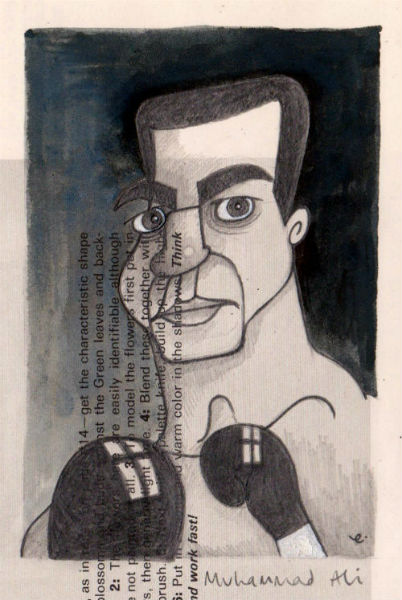
1. Muhammad Ali (1942-) - Boxing

Muhammad Ali

Muhammad Ali is the greatest. We have no excuse for this coming as a surprise as he has been telling us all for decades. It is perhaps to his greatest credit that the scale of his achievement - as a sportsman and as a human being - was such that it was nevertheless still surprising.

No other sporting figure has ever blurred so many social boundaries. He was both of our time and for all time; initially just a boxer, his extraordinary personality made him a star at a time in America where black people were supposed to know their place. Ali stood up and was counted. When this, as it inevitably would, made him enemies he stood louder and prouder. When they took away what was rightfully his he won it back in such impossibly heroic circumstances that it would be dismissed out of hand as a film treatment as simply too unbelievable.

Ali is a continual reminder to me that the search for a higher power is best attempted by looking around you. A glimpse into the eyes of Ali, even now as a frail man broken by disease and dulled by age, leaves me in no doubt as to his other-worldly power to inspire greatness in those around him. There will never be another sportsman who so unifies as many disparate sections of human society as Muhammad Ali. The greatest tribute of all is that, principle among the reasons for this is that Ali existed in the first place.

The five pictures that illustrate this piece are available to buy for £25 each, or £125 for the full set (including Pelé, who didn't make the cut). If you are interested, drop me a message on Facebook or send me an email.

Tuesday, 29 March 2016

Disaster Film Olympiad - Volcano

Los Angeles is a fascinating place. Most of the turbulence that afflicts the city is social - gang violence, racial tension, pro-footballers murdering their wives and getting away with it, etc. - but the potential for far a more elemental catastrophe lurks under every crib, pimp wagon or Ben Affleck's house. The San Andreas fault is responsible, the meeting of the Pacific and North American continental tectonic plates. It makes coastal California ripe earthquake territory and when they strike, they tend to be the sort of earthquakes that do more than rearrange your gnomes.

Of course, Los Angeles is also the home to the American film industry and there is nothing Hollywood enjoys more than occasionally reminding itself that it could at any moment be naught but a smoking crater in the ground, just like Kevin Smith's house. It's all part of that particular deal with the devil that movie stars make with their conscience as the man arrives with the next lorry load of money.

Volcano was released in 1997, part of the brief pre-millennium disaster film renaissance which also saw us clenching our buttocks through Dante's Peak, Twister, Armageddon and Deep Impact. Also notable to anyone who might perhaps be endlessly watching disaster films for no real reason is that the director was Mick Jackson, the Briton who made Threads. Fortunately, Volcano is nowhere near as brutal. Although I don't live in Los Angeles, so maybe it is. The fact that John Travolta potentially considers Volcano to be more frightening than Threads is the take home portion from this paragraph.

Anyway, the earthquake that I had been warning everybody could happen in Los Angeles happens. Our hero, Mike Roark of the city's Emergency Management Committee, puts aside his much-needed family holiday to make sure nothing dreadful has happened: one of the Os in the Hollywood sign may have fallen over, for instance, or Warren Beatty's toilet might be leaking. His decision has long-reaching consequences for some of the city engineering workers, who are cooked to death while inspecting a storm drain. This is an unlikely thing to happen, but Roark takes it in his stride. Roark is an easy man to have sympathy towards. He's middle-aged and craggly, gruff and curt yet possessed of an undeniable twinkly oaky Southern charm. He is a bit like Tommy Lee Jones, so the film's casting director secured something of a coup when they acquired the services of Tommy Lee Jones to essay the role.

Tommy Lee Jones in Volcano (1997)

The itch in Roark's knickers is Dr. Amy Barnes, a geologist. Being a geologist is comfortably one of the most genuinely perilous jobs that one can have while still being excruciatingly boring conversation at a dinner party, a dichotomy which tends to make them peculiarly strident people. Barnes is convinced that the earthquake has caused the formation of a volcano right under the centre of the city. Roark is sympathetic to these concerns, but he can't just start throwing tax payers' money around without evidence. Evidence that Barnes, to her own frustration and no doubt that of the people who have to talk to her at her friends' dinner parties, is unable to gather.

Fortunately, Barnes has a key ally in her quest: Mother Nature. The volcano that she had been predicting to everyone could volcano erupts right under the La Brea tar pits, causing hundreds of dollars worth of damage to the fibreglass mammoths and also pumping boiling lava all over the place. Wilshire Boulevard, traditionally given over to being the main arterial road for the largest city in California, becomes a regular shit show of burning vehicles, stuck underground trains and fifth degree burns. It's a lawsuit waiting to happen. To her credit, Dr. Barnes continues to work for the good of the Angelenos, where most of us would take to the highest vantage point immediately available and look smug.

There are two ways that this sort of film can go: they either deal with a pre-existing adversarial relationship being reconciled in the crucible of extreme circumstance, or the nascent union between two people being thrown together by events. Volcano is the latter and if the sex is as impressive as Roark and Barnes' teamwork, there may yet be further earth tremors in southern California. Using carefully placed detonations of explosive devices, they manage to channel the lava flow through the city's network of subterranean tunnels and into the Pacific Ocean where it would presumably solidify and form a place even drier, hotter and more exclusive than Los Angeles itself, much to the chagrin of the Hollywood elite.

I don't know enough about volcanology to know whether any of this exotic bill of fayre is likely or even possible, but I know enough about disaster films to say that this is a perfectly serviceable one. It ticks all of the traditional generic boxes - relationships are explored and developed, people are roasted to a crisp and the special effects department get to just go nuts - as well as retaining its own personal charm. Volcano gets SIX out of ten Disaster Points.

Thursday, 10 March 2016

Disaster Film Olympiad: The Day The Earth Caught Fire

There are two things of which simply no good can ever possibly come: nuclear weapons and the international dateline. When they combine, the overall effect is inevitably catastrophic for all in its path. Unfortunately, these were the precise confluence of circumstances that were to assail the hard-working staff at the offices of The Daily Express in 1961, on a day... THE EARTH CAUGHT FIRE!

For years, man has yearned to destroy the Sun...

Typical tabloid hyperbole, that. The Earth did not literally catch fire, but it was nevertheless sickening for something pretty serious. The Day The Earth Caught Fire is an entertaining and considered Cold War fable that warns that the dangers of nuclear weapons - or not checking your calendar - stretch far beyond the obvious. The United States and the Soviet Union, now both building the spiffiest, most powerful hydrogen bombs that modern technology can muster, somehow contrive to each test them simultaneously on opposite ends of the globe without having first checked to see how time zones work. The overall effect throws the Earth off of its normal orbit and into an inevitable collision course with the Sun.

This annoys everybody. The new jaunty tilt of our celestial home causes havoc with the seasons, as drought, heatwaves, storms and floods beset countries quite unprepared to deal with the consequences. The action centres on the newspaper offices of central London, where to call the weather all to cock would barely do the situation justice. The temperature soars, causing a catastrophic drought, ruinously damaging thunderstorms and freak fogs. To be honest, it's pretty similar to what the weather is like in the 21st Century, although it is best to put that thought to the back of your mind since the upshot of all this is: we're doomed. The hardworking Daily Express staffers - motivated by the possibility of a worldwide scoop and powered only by cynicism, lukewarm Coca Cola and a bar tab that looks like Jeremy Hunt's parliamentary expenses claim - do their best to get to the bottom of the story, even though it turns their newspaper into a shrill, weather-obsessed, catastrophe rag. Which obviously could never happen.

It is an unusual disaster film, but it doesn't suffer at all for it: the main characters are reactive, rather than active; resigned rather than rallying. The film neatly captures the constrictive inevitability of a society that has contrived to destroy itself as we all feared it would. There are no heroes, just people being people. Some bad, some mad, but mostly good-hearted. Of course, a film is still always only a film, so a few compromises have to be made: of course our leading man Peter Stenning would take this opportunity to begin a torrid romantic entanglement with Jeannie Craig, a secretary from the Met Office. And naturally he will end up defending her honour from a bunch of feral beatnik water terrorists by engaging in fisticuffs in her apartment. These are things that happen in every film, no matter what the genre or the stakes.

On the whole, however, it is an absorbing and entertaining way to spend 90 minutes. Well, entertaining when one considers the oddly prescient nature of the subject matter: as I watched the film the sky outside was purple and the hail was falling upwards. Particularly pleasing is its ambiguous ending, as the dual forces of science and irony combine to decide the only way to save Earth from a certain fiery demise is to right its place in the heavens with... more atomic blasts. What will happen? The church bell ringers will be putting in for double overtime, if nothing else. It's hard enough ringing bells in normal temperatures and when adequately hydrated. More important still is that I have successfully managed to write the first ever retrospective review of The Day The Earth Caught Fire that doesn't mention it features a pre-super duper super stardom Michael Caine, playing a copper.

Daily Express journalist Peter Stenning (Edward Judd) in The Day The Earth Caught Fire: what would Princess Diana do?

More worthy of note even than the revelation that Michael Caine has to eat food and pay his gas bill are the special effects. Considering the technological limitations of the time they stand up very well indeed. Particularly stunning are the vistas of London as a sun-bleached, dried out and abandoned husk - all made by the matte painting mastery of Les Bowie. Film making has become less of an art since computers came along, in many ways. Sigh.

The Day The Earth Caught Fire gets a smouldering EIGHT out of 10 Disaster Points.

Tuesday, 1 March 2016

Disaster Film Olympiad: Flight 90: Disaster on the Potomac

Strange though it may seem, real-life disaster tends not to be a particularly fertile ground for the creation of disaster movies. Reality tends to either be too tame for entertainment or too horrific for imagining, plus it has the unfortunate habit of continually confounding any conventional narrative structure, through its dedication to happenstance and dumb luck. It's more of a challenge to build a decent story arc when historical accuracy dictates that the character you have spent time establishing has a date with destiny at prescribed stage in events. Yet take too many liberties and your film isn't worth a brass farthing: a disaster film can either trade on its creativity or its adherence to reality, there's really no in-between.


Flight 90: Disaster On The Potomac's hands were tied from the beginning. The decision of whose stories to feature has already been taken by history, the ascription of the values that arose from them a done deal. The result is an odd mixture: the preamble is a bit boring, but only in the way that everyday life can be a bit boring. The drama is fraught and tense, but no more so than the historical event on which it is based. Essentially you are left with a compromise: either a news report with additional characterisation or a soap opera with limited dramatic license.

The event on which the film was based took place in Washington DC in January 1982. Air Florida's Flight 90 was scheduled to fly from the capital to Tampa, Florida. The weather was as wintry as a January day in Washington is wont to be, and take off was delayed by an hour and three-quarters due to snow and ice. This was not good news for the real people involved in this incident but its value to the screenwriter cannot be understated: a delay is prime territory for expositional dialogue. Lives are fleshed out and the stakes made abundantly clear. Were I a normal person, I would surely have started to relate to these people, their hopes and dreams.

Unfortunately for everyone involved, the pilots of Flight 90 were inexperienced at dealing with such arctic conditions and their failure to properly de-ice the wings prior to take-off led to the deaths of 74 of the 79 people on board. Their hobbled aeroplane failed to reach adequate speed on the runway, stalled and swiped into the 14th Street Bridge, killing an additional four people stuck on the ground in a snowbound Washington DC traffic jam. The Boeing 737 ended up in the frozen Potomac River below, as though it were nought but a common salmon. The stragglers bob to the surface and their battle for survival begins.

The film is fairly formulaic, cheap and cheesy stuff but it makes a number of key decisions which perhaps raise it above other examples of its type. Most notable amongst these is the fact that the crash itself is not graphically reconstructed: a neat reminder that this is a character piece rather than a Hollywood blockbuster, that each of the characters you are watching was a person you might have bumped into on the street not two years before had life taken a few different turns. The fact that five of the people involved in the accident still were people you could bump into on the street is the film's real point for celebration, rather than any florid displays of special effects mayhem. It's an admirable decision, one which arguably costs the film in terms of its overall effectiveness but saves its soul.

Alternatively you could forget everything I just said and look at the official movie poster. Cor lummy.

It is not, by any means, a great film. It is not really a good film or a bad film, either. As a faithful account of a traumatic day and as a memorial to the good in humanity that such days tend to reveal, it does pretty much everything that you would assume it should. Flight 90: Disaster On The Potomac gets FIVE out of ten disaster points.

Friday, 26 February 2016

Disaster Film Olympiad: Outbreak

If there's been an outbreak, it is probably monkeys. It usually is. They're dirty. They wee all over their hands and then touch all the bananas in the bowl, not just the ones they were going to eat, and then you've got AIDS and Ebola all in your mouth in one go.

Zaire, 1967: a devastating virus with Ebola-like symptoms called Motaba has ravaged the camp in the jungle where the US army - who were propping up the CIA-sponsored coup d'etat of General Mobutu - are based. It's bad stuff, this Motaba virus, one of those nearly always lethal viral haemmorhagic fever things that makes you unwelcome company at all but the most unruly church fetes. In fact, the mortality rate and its infectiousness are so high that the American government enact Operation Clean Sweep, which sees the afflicted area cleansed by the dropping of a massive incendiary device. Which is what happens when you don't have socialised healthcare.

In spite of the rigour and unimpeachable moral standards of their decision, by 1995 Motaba is rearing its ugly head again, making every fart a mortal risk. Unfortunately, greed and military cover-ups abound, resulting in a monkey who is a carrier of the virus being shipped to the United States for use in animal testing, which is wrong on any number of levels.

In fact, it turns out that karma is a stone cold bitch. The monkey busily infects everyone who crosses her path, probably via the old wee banana shim-sham. By the time she is smuggled out of the Biotech lab by Patrick Dempsey, to be sold as a pet on the black market in Cedar Creek, California, there's a whole world of hurt brewing across the continental United States. Not least for the kind of selfless, hazmat-suited, wrecklessly brave infectious disease specialists whose job it is to sort out this kind of mess. People like Dustin Hoffman and Rene Russo, a recently divorced couple who until this point thought that their biggest problem was who got custody of their dogs. With the military high-ups planning a dastardly repeat of Operation Clean Sweep on home ground, our heroes (by this stage in various stages of infectiousness, naturally) face a race against time to identify, find and capture Patient Zero, get hold of their juices and fashion an antidote. Preferably one that can be administered with a hosepipe. Plot twist: Patient Zero is, as you may already know, a monkey. Who lives in a tree.


Outbreak is the kind of film that you can put together like a jigsaw. Everything you are expecting to happen happens and roughly in that order. There are moustache-twirlingly evil career military men who view humanity as nothing but a series of statistics and calculations of collateral damage. There are good hearted scientists doing battle with a lethal yet invisible foe. There's panic, there is death, pestilence and gruesome chapped lip make-up. Kevin Spacey - then at the height of the part of his movie career where he'd die in every film in which he appeared - also duly obliges, falling victim to the kind of torn hazmat suit japes in the laboratory which would probably have been reasonably funny had the stakes not been quite so high.

Oddly, it is no less of a film for it. The thrills and spills (mostly bodily fluids in the latter case) are ramped up at a pleasing pace, while the fundamental truth that the ins and outs of immunology is probably a little complicated and dry a subject for a Hollywood blockbuster are adroitly sidestepped with a neat blend of expositional graphics and SHOUTING. It's a familiar old warm jumper of a film, one which rewards repeat viewings.

All of this and the monkey survives. Kevin Spacey should perhaps have had a word with their agent. Outbreak gets an all-your-organs-are-liquifying-and-pouring-out-of-every-hole SEVEN out of 10 disaster points.

Thursday, 25 February 2016

Disaster Film Olympiad: The Day After

I'm going to Kansas City, as Little Richard put it. Kansas City here I come. It's not just pioneering rock and roll heroes, either. All sorts of things are on their way there, including - in November 1983 - intercontinental ballistic missiles.

It was the early 1980s. The Cold War was at its height and the situation between the great powers of East and West was at its most precarious since the Cuban Missile Crisis of 1962. In an unlikely turn of events, Ronald Reagan was in the White House. In an unlikelier one still, he was in there because he was the President. His Strategic Missile Defence initiative - known by the colloquial name of the Star Wars system - promised the possibility of a winnable nuclear war. It was an escalation in an arms race that had already gotten wildly out of control and tensions rose in tandem. After all, total and instantaneous global destruction was what was at stake.

Both of these ways of thinking were the inspiration for The Day After, the highest rated American made-for-television film of all time. Its name referred to the fact that, rather than the widely assumed cessation of all life on Earth, there would be a day after any nuclear conflict. The film set about essaying how the post-nuclear world may turn out to be with the action centring around a number of families in and around the area of Kansas City, Missouri and the campus of Kansas University at Lawrence, Kansas.

As a confrontation arose between the East and West at the East German border, the inhabitants of this hotbed of military hardware suddenly became aware that large pieces of it were starting to fly away. As one observer grimly notes, this means that the corresponding ones in the Soviet Union would, too, be on their way. As good a time as any to make sure your will is fully up to date. Upon their arrival, many people and places in the major urban areas are instantaneously anhailated, leaving a decimated band of stragglers battling for their own and each other's survival.

Steve Guttenberg as Steve Klein in The Day After (1983). You're not looking well, chief.

The Day After retains the majority of its ability to shock, appal and frighten, even from an historical distance of almost a third of a century. Many of its scenes are burnt into the minds of all who have seen it. For many, not even his sterling work in Police Academy or Three Men and a Baby will have superseded The Day After as Steve Guttenberg's standout role. A powerful legacy by anyone's standards.

That is far from The Day After's only social or cultural impact. Although its great contemporary - the British-made 1984 film Threads - remains the more affecting and chilling film, The Day After is the more outstanding and lasting piece. President Reagan watched the finished product a few days before it was released to the public and noted in his diary that it left him "greatly depressed". He would later cable Nicholas Meyer, the film's director, after the signing of a nuclear arms reduction treaty with the Soviet Union telling him that his film's importance to its successful completion should not be overlooked. Threads, a film which has nevertheless chilled the marrow of all that have ever encountered it, cannot boast such wider historical significance.

The most striking thing about The Day After, though, is its bipartisanship. The film caused considerable controversy - both before and after its release - for its refusal to point the finger at the Soviet Union for being the people who fired first. During the production, the US Defense Department refused to provide any stock footage of nuclear explosions or other support after its makers refused to back down from its policy of non-specificity and after the film was seen by the public, The New York Post newspaper decried Meyer as a dastardly red, a fifth columnist who was successfully doing all of the USSR's propaganda work for them. Such ideological wrangles have lessened in the intervening years but, to prove Meyer and his production team's instincts correct, their decision still affords the film a great universality: a sense that nationality or politics cease to matter when it is humanity itself that is at stake.

The Day After is a film of many standout moments; its sense of sadness, frustration and futility remains quite undiminished even thirty years on. It is a film that perhaps doesn't chill or frighten in quite the same way as Threads does, but it comes as close as anyone need dare. The Day After gets a shattering 9 out of 10 Disaster Points.

Wednesday, 24 February 2016

Disaster Film Olympiad: Testament

If anyone has ever considered what life would be like after a nuclear war and somehow reached the conclusion that it wouldn't be shit, an hour and a half in the company of 1983's Testament should see you right. While the film foregoes many of our favourite nuclear disaster tropes: running around, screaming, urination, burns, viciously imploding buildings and enforcement of the harsh strictures of martial law; it remains peculiarly affecting, in spite of - or very probably because of - its gentle, quiet, meditative tone.

The Wetherly family are a fairly normal bunch, a married couple living with their three children in the (alas made-up) town of Hamelin, California. The father is the breadwinner, working a 90 minute drive away in San Francisco. If any of the Wetherlys have cause to be glad of what it about to happen it is surely Tom, who at least won't have to do that commute any more.

Sadly for Tom, the rest of the Wetherlys and everyone else, the commencement of hostilities does more than just interrupt the scheduled episode of Sesame Street. The actual strike is peculiarly restrained for a film of its type: no whizzbangs, no special effects and no hellzapoppin, just a sustained flash of light seen through the living room window.

Testament is a film about dealing with the consequences of that flash. The family and community dynamics to which we have been briefly introduced quickly begin to collapse and decay all around us. Central to the film is Carol Wetherly, Tom's wife and now presumably widow, trying to keep a brave face and keep her family, their standards of behaviour and senses of personal morality together.

Carol and Brad Wetherly post for the annual family portrait photograph, 1984.

Of course this is difficult enough, contending with disrupted utilities and the cessation of regular deliveries of everyday supplies, before one even factors in the unseen plague of radioactive fallout. Desperation quickly takes hold in Hamelin, but it is portrayed as doing so without frenzy; rather it comes about as a result of an insidious, steady suffocation. Of new realities and circumstances removing all of people's other options. It is a sobering look at the unavoidable patheticness of it all. Not even the local school's performance of their previously scheduled rendition of The Pied Piper of Hamelin can raise spirits, if only because the stage is quickly strewn with the teeth, toes and tears of its participants.

The Wetherly children all deal with this new way of life - something which can be shit enough without all this nonsense - in different ways. The eldest son, Brad, finds something of himself, a businesslike maturity that sees him involving himself in caring for the community as best he can. His nascent friendship with the town's elderly ham radio enthusiast is particularly pregnant with pathos.

It is sad that it took such an event for Brad to gain such wisdom and perspective, but his steely visage is neatly contrasted by his sister Mary Liz, who is paralysed with the hopelessness of the situation and regret at what she, on the cusp of womanhood, has surely lost. The scene in which she asks her poor mother what it is like to have it off with a dude is a stark reminder that such conversations are difficult enough, before the onset of widespread leukaemia, shifting norms or looting.

Mary Liz was right to be filled with existential dread: she later succumbs to radiation poisoning, the second of the Wetherly children to do so after the death of Scottie, the youngest. Both are buried in impromptu ceremonies in the front yard, with as much dignity as the exhausted, increasingly traumatised and desperate family can muster.

The whole town, in fact, is being relentlessly devastated by the constricting inevitability of it all. Survivors in varying states of mental distress begin to start thinking getting out to look for anything that has remained beyond their horizons is their only option. Even Kevin Costner, portraying a young father of a baby who dies not long after Scottie, decides that he can't hack it any more, even though he managed to get through Waterworld largely unscathed.

The Wetherlys, too, are beginning to wonder if a radical option might be their best bet. With their number swollen by Larry (a child orphaned by the initial blast) and Hiroshi, a disabled child who was a long-standing friend of the family and who they have now adopted after the demise of his father, the Wetherlys pile into the family station wagon with one eye on committing suicide by carbon monoxide poisoning. Bravely, Carol decides to persevere with living on, which is particularly good news for the children, who had perhaps not had the same idea. We leave them celebrating Brad's birthday in dismally reduced circumstances, quietly determined to face down an uncertain future.

Testament is an unusual example of its genre but it is none less powerful for it; a thoughtful look at the agonising but inescapable decline of human social norms and values in extreme circumstances. Jane Alexander, who played Carol, received a well-deserved Academy Award nomination for her performance, by turns strong, sad, desperate and resolved. Testament gets 8 out of 10 disaster points.

Tuesday, 23 February 2016

Pictures for sale

It's that time again, when Spring is starting to spring and I look around my cave of bewilderment and pencil shavings and see artistic output strewn everywhere. Maybe you or someone you know might be able to give any of these pictures a home?

ADELAIDE TERRACE, HOVE. 28 x 38cm, acrylic on 300gsm watercolour paper. WAS £120, now £80.

CHIN UP, LOVE - IT'S THE PRESIDENTIAL INAUGURATION. 9.5 x 28cm, acrylic on 300gsm watercolour paper.
WAS £50, now £30.

NIKI LAUDA. 21 x 27cm, acrylic on textured white card. WAS £70, now £40.

STREET FIGHTER 2: REUNION EDITION. 38 x 28cm; pen, ink and watercolour on 300gsm watercolour paper.
WAS £120, now £80.

SWAN RUGBY. 10 x 15cm; pen, ink and marker on 220gsm cartridge paper. WAS £25, now £10.

WESTERN. 21 x 30cm; pen, ink, watercolour and pencil on white card. WAS £35, now £20.

ZINEDINE ZIDANE. 21 x 29cm; acrylic on reclaimed book page. WAS £70, now £40.

If any of the above have caught your attention, you can email me or contact me via Twitter or Facebook. Alternatively, you can do the whole thing via Paypal, although do remember to leave a note stating which picture or pictures you would like.

Monday, 22 February 2016

Disaster Film Olympiad: Meteor

There is a solution to every problem. This fundamental truth should pacify us all, particularly when a five-mile wide lump of rock breaks free of the Asteroid Belt and heads our way.


Nuclear weapons get a bad rap, on the whole. Generally speaking, when the nukes get dusted off, there's a feeling of resignation and defeat in the air. How refreshing it is, then, when bulk-watching disaster films to get to one featuring a celestial body threatening all life on earth. All of a sudden the Manhattan Project looks like an insurance policy. Robert Oppenheimer lightens up and appears on The Graham Norton Show joshing with his other guests, Chris Martin and Jada Pinkett-Smith.

Problem: five-mile wide asteroid on a collision course with Earth. Solution: Hercules! Hercules is the United States' contribution to world peace, a satellite in geostationary orbit with 14 100-megaton nuclear warheads pointed at the Soviet Union. It's the kind of thing that makes everyone feel that bit safer. Fortunately, Hercules can be rotated so that its payload points outward and make that asteroid feel the cut of our collective jib.

Uh-oh. Supplementary problem. The USA's top space flotsam science man, who improbably looks and sounds just like noted Scotsman Sean Connery, says that Hercules' death load will be quite insufficient for the task at hand. Like taking Gwyneth Paltrow to an all-you-can-eat chicken buffet.

But remember, there's always a solution. In this particular case it is Peter The Great. Peter The Great is the name of the USSR's peace initiative, floating somewhere above the United States, biding its time and packing serious heat. Of course, these are Hollywood movie Soviets, so they are shifty no-good bastards who initially deny it. But once Sean explains the gravity of the situation, the Russians fess up and a multinational death force of unimaginable destructive magnitude is assembled to blast some serious rock ass.

Of course, the true joy in films like Meteor is that the writers get to have some fun poking holes in the preposterousness of Cold War politics when projected across a broader backdrop. Martin Landau, now seemingly high up in the US military is flabbergasted. You can't let the Soviets into our control centres. They'll steal all the upload codes, not flush the toilet and besides, this measly god damn rock will just break up in the atmosphere. Not even Sean's growling or the firm hand of President Henry Fonda on the tiller can convince him otherwise.

He is not alone. Even after the announcement is made to a largely indifferent world, people seem able to get on with their business with admirable coolness. This air of calm persists until the rock begins to splinter, sending smaller but still devastating meteors crashing to Earth. A Swiss skiing marathon is quite severely disrupted, causing Martin Landau to cast his doubts aside.

As impact day - December 7th, a date which really would live in infamy - arrives, there's much more palpable tension. Sean is swapping his wig for one which is slightly more progressively grey on an hourly basis. Just as the US launch their missiles, a further splinter decimates New York City. First to fall is the World Trade Center, something which could never happen in real life. Unfortunately, New York is also the location of the centre for Earth-saving operations and our heroes are quickly thrust into an unseemly bonus battle for survival with a spectacularly muddy Hudson River.

Meteor is actually a really good little film. I was surprised. Surprised because I've seen enough big budget disaster movies from their golden age of the 1970s to know what to expect. Crap, essentially. Big name stars phoning in a performance, shoddy dialogue and trite situations. Which is not to say I don't love them all; but finding one that is a little better than the norm was a treat nevertheless. My favourite thing was that for once, the all-star cast was, on the whole, very well used. I would certainly have voted for Henry Fonda to be President and the multiple requirements of the Soviet interpreter to be able to speak fluent Russian, be a woman, bewitch Sean Connery AND be a famous film star were admirably met by Natalie Wood. It was a toss up between her and Yul Brynner, presumably. But with Sean Connery already on the payroll, they probably couldn't stretch the wig budget. And of course Trevor Howard is a beknighted astrophysicist ensconced at Jodrell Bank. Of course Trevor Howard! Of course Jodrell Bank!

The only potentially shaky bit of casting is Sean Connery, who I think is supposed to be an American. But we've been here with Connery before. Sean Connery doesn't have a nationality or an accent, per se. He is just Connery. Got to love a bit of Connery. Meteor gets a bold SEVEN out of 10 disaster points.

Friday, 19 February 2016

Disaster Film Olympiad: This Is Not A Test

Where would you like to be when the Intercontinental Ballistic Missiles arrive? The wise among you will probably say 200 metres underground in a fully air-conditioned and ventilated concrete and lead-lined bunker complete with its own state-of-the-art filtration and waste disposal systems, plus fresh water, ample food, a reliable generator and varied types of communication technology. The more paranoid of you are already reading this from there. Hello, if you are. Playing the long game is admirable. You may yet have the last laugh, in addition to your agonising case of rickets.

No-one, surely, would choose to be stuck at a roadblock on an interstate highway in California. However, that is the exact scenario in which what one might loosely term the protagonists of This Is Not A Test find themselves; stuck at night in a sullenly over-zealous traffic policeman's dragnet. The object of this police attention is Clint Delany, a man on the run from the law for suspected murder. Aside from a brief skirmish with the wanted man, the group's attention soon turn to the police radio announcing the commencement of hostilities with the Soviet Union.


This comes as a real drag to our motley crew, most of whom had other plans that night. Among their number are a a dolly bird and her beatnik lover who seems to have secured their future financial stability by what were presumably dubious means; a hokey, oaky old grandpappy and his beloved (if shrill) granddaughter; a married couple on their way to holiday in Mexico; and the drivers of the Discount World lorry who had been unwittingly ferrying the hitchhiking outlaw to freedom.

Their truck has a large part to play in proceedings. It is somewhat misleadingly named: a British shop called Discount World would be filled with all manner of remaindered tat, California's Discount World is the kind of store where one might bump into Scrooge McDuck. Every single item of cartoonishly over-indulgent cuisine and couture imaginable is being ferried about in the trailer, seemingly without any irony. A shortage of alternatives leave our friendly patrolman to suggest that this trailer might be cleared out and used as an impromptu bomb and fallout shelter. As finessed plans go it is fairly weak, but it is the best one he has and besides, he's the one with the gun.

On many levels, in fact, this plod is quite the dick. His unrelenting blend of buttoned-down officiousness, intransigence and total lack of a sense of humour would be a major bummer in any situation, but in this particular one it quickly starts to seem like overkill. Literally, in the case of the small pet poodle of one of our protagonists: its respiratory needs deemed surplus to the requirements of a post-apocalyptic community of lorry-dwellers, it is duly dispatched at the bare hands of this lurching wall of malevolent gristle. It is comfortably the film's most affecting moment; the dog was the only character for whose ultimate survival I had any vested interest. I also suspect the police officer was probably also a racist, although the makers of This Is Not A Test did not diversify sufficiently during the writing or casting process for this hypothesis to be verified. But he didn't like animals. Always a red flag.

Still, there is an upside to the patrolman's truculence and intolerable heavy-handedness. Once the remainder of our heroes discover the contents of the lorry's trailer, all subsequent attempts at clearance are done with a belly full of caviar, pissed up on 100 proof bourbon and wearing a mink coat. Whether or not this clever subversion of the gravity of the situation was a carefully-planned psychological trick on the part of the policeman is unlikely to ever become clear. It is only partially effective, if so... the undeniable thrill of skulling a bottle of hooch with a crown on proves as fleeting only as each participant's individual ability to suppress the weight of their knowledge re. the impending commencement of global thermonuclear war.

By the film's denouement, our heroes have divided into several distinct groups. The huddled lorry-dwellers quickly turn on each other as the temperature rises and claustrophobia takes hold. Taking their chances in the outside world are the hokey old grandpa, his granddaughter and the first available man she was able to grab from the roadblock. Pops chooses this moment, a mere 10 minutes before curtains, to remember that just round the corner - presumably just 11 minutes round the corner - there is an underground cave with a fresh water spring. Thanks, gramps. Ten minutes is still enough time to put you in a home.

Our outlaw, too, sees a window of opportunity - albeit a rapidly diminishing one - to make good his escape. Unfortunately, his attempt to steal a car quickly ends in a contretemps with an pickup truck loaded with chickens. The sight of a frantic scofflaw retributively laying waste to the hens who have scuppered him would be a striking addition to any film; in one dealing with portending destruction it borders on the tragicomic. Look on the bright side, Clint - if this is the worst thing that happens to you today...

As nuclear disaster films go, This Is Not A Test is not particularly outstanding example. The budget was low, characters laden with stereotype and its cast of unknowns fairly wooden. Nevertheless it is, at times, an interesting study in the breakdown of human society in the face of the unimaginable. Within 73 minutes, we witness mob rule, faction forming, dog murder, extra-marital affairs, crown theft and a near-immediate descent into mass alcoholism. These scenes prove in stark contrast to the official Civil Defense films that the United States was making contemporaneously, where government was well-drilled and impervious, the populace calm and victims few and far between. In their defence, the majority of these films were only twenty minutes in duration: it is always the subsequent 53 which prove the real yardstick.

Ultimately, however, the characters on display in This Is Not A Test all display such genuinely unlikeablilty (in what were, admittedly, chastening circumstances) that when the bomb's arrival heralds the end of the film, it is a relief on a number of levels. This Is Not A Test gets 3 out of 10 disaster points.

Thursday, 18 February 2016

Disaster films, revisited

Long-suffering readers of my blog may well remember that in 2013 I attempted to watch the 100 top-rated disaster films on IMDb.com. The attempt, as predicted by all, was unsuccessful. Why should this have been?

Well, the reasons were varied. Firstly, I am flaky. Disgracefully so. The only defence I can present is that I am not being paid to write this any more than you are to read it. Maybe I should be. You definitely should be.

Secondly, watching disaster films is somewhat emotionally draining and dislocating. At best, that is. At worst it is fully traumatic, an invitation to an entirely self-inflicted pathology that could colour my remaining days. Fortunately, the intervening three years have rendered this less of an issue. I am now three years older and hopefully three years more emotionally mature. Additionally, society has since developed in such a way that chain-watching apocalyptic fiction is now no more chastening than watching the news.

Thirdly and most painfully for me to admit, my initial list and the model for its creation were shoddy. I am flabbergasted that past me would have allowed such a slipshod list into the public domain. There were countless exclusions and inclusions blatantly contrary to the qualifying criteria.


What has changed is that, over the past few weeks, I have found myself obsessively watching disaster movies once again, although this time through my own stupid free will rather than my own stupid self-discipline. I quickly realised that I had, quite unwittingly, managed to tick off a further seven of the films on my totally lousy and shameful original list.

The upshot of all this is that I am going to revive the project, but with some new rules which will hopefully see it able to thrive and - most important of all - a new list which may be amended and added to on the fly. What will any of us learn? Nothing. Which was my intention all along.

What qualifies a film for inclusion? Well, there are only reasonably mild changes from my original framework but I think they will be significant. My old first rule was "a disaster must happen in your disaster movie". A good start you'd think, but it in fact excluded a surprising number of titles. So my new rule number 1 is "A disaster must happen, be anticipated or narrowly be averted in your disaster movie".

Rule two remains unchanged. "A disaster must be the only reason for making your movie". Mundanity is the lifeblood of the disaster film. The everyday being disrupted is central. How else will your characters go about learning and growing, if not from beneath a fallen tree or stuck inside a volcano with an atomic bomb?

Rules 3 and 4 were more problematic. Inevitable and unavoidable disasters will now be included, so long as they fulfil the other existing criteria. Additionally, rule 4 will also now be disregarded. Some of the best films in the world require all of the characters being dead at the end of it. Many films that otherwise fall flat could be vastly improved by it. Food for thought for all you aspiring screenwriters out there.

Rule 5 (now Rule 3 thanks to my sharky streamlining) remains - "Your disaster must not be fanciful" - although in a reworded form and including this fancy diagram to give additional detail of exactly what I mean by it.

As promised, here is a helpful diagram

If you feel short-changed by this new truncated list, I may be able to placate you with an additional new Rule 4: "Your movie must be feature length, but films of any sub-genre are permissible as are made-for-TV movies". I love TV movies. Sequels and films dealing with the same historical disaster are now also allowed.

All of this meandering, tweaking and procrastination leads me to this: the reformed disaster film list. May god have mercy on all of our souls.

2012 (2009)
A Night To Remember (1958)
Airplane! (1980)
Airport (1970)
Airport 1975 (1974)
Airport '77 (1977)
Alive (1993)
Armageddon (1998)
Asteroid (1997)
Atomic Train (1998)
Atomic Twister (2002)
Avalanche (1978)
Blindness (2008)
By Dawn's Early Light (1990)
Contagion (2011)
Countdown To Looking Glass (1984)
Dante's Peak (1997)
Deep Impact (1998)
Dr. Strangelove (Or: How I Learned To Stop Worrying And Love The Bomb) (1963)
Earthquake (1974)
Ebola Syndrome (1996)
Epidemic (1987)
Fail Safe (1964)
Fire! (1977)
Flight 90: Disaster On The Potomac (1984)
Flood (1976)
Flood (2007)
Heatwave (1974)
Hurricane (1979)
Krakatoa, East of Java (1968)
Meteor (1979)
Miracle Mile (1988)
Night of the Comet (1984)
Night of the Twisters (1996)
On The Beach (1959)
Outbreak (1995)
Panic In Year Zero! (1962)
Right At Your Door (2006)
Rollercoaster (1977)
Special Bulletin (1983)
The Big Bus (1976)
The Cassandra Crossing (1976)
The Concorde... Airport '79 (1979)
The Day After (1983)
The Day After Tomorrow (2004)
The Day The Earth Caught Fire (1961)
The Day The Sky Exploded (1958)
The Great Los Angeles Eathquake (1990)
The Hindenburg (1975)
The Last Voyage (1960)
The Night The World Exploded (1957)
The Perfect Storm (2000)
The Poseidon Adventure (1972)
The Swarm (1978)
The Towering Inferno (1974)
This Is Not A Test (1962)
Threads (1984)
Testament (1983)
Titanic (1998)
Tornado (1996)
Twister (1996)
United 93 (2006)
Variola Vera (1982)
Virus (1980)
Volcano (1997)
When The Wind Blows (1986)
When Time Ran Out (1980)
Where Have All The People Gone? (1974)
World Trade Center (2006)
Zero Hour! (1957)

Thursday, 26 November 2015

Twenty five dogs

My history of doing prints has been a slew of disappointment and frustration, I'll be honest with you. There is little more dispiriting than watching a pile of identical artworks gathering dust sadly in the corner of your room.

So I have come up with a brilliant solution. What if everybody who wanted to buy a print told me ahead of time, so that I know how many to get? I know. Pretty smart. I suppose if I was really on top of things, I'd start getting deposits in as well. But if there is one thing about me, it is that I am a hugely credulous optimist at heart, so hopefully (hopefully) I won't have to do this.

I understand that this is perhaps not the kind of positivity and salesmanship that one would normally associate with this kind of pitch. However, as well as being a hugely credulous optimist, I am also a honest to the point of harmfulness. I anticipate that I will soon win numerous awards for my business acumen.

Click here for bigger

But anyway, yes... I've made a print! Twenty five dog breeds! How about that? It will be A3 size (29.7 x 42cm) and printed on 170gsm paper.  The price is £20, plus £5 for postage and packing (or £10 for postage and packing if you are outside of the UK). If you would like to pre-order one, you can either email me or contact me via Facebook. I can't absolutely guarantee that they will be ready in time for Christmas, but if you particularly want it for then do let me know and I will try and accommodate.

PLUS! A bonus for all my long-suffering fans: I have made all the line art (plus some extra stuff that didn't make the cut) available as six A4-sized pages that you can download, print out and colour in yourself. They are available HERE. For free! FREE!

Wednesday, 11 November 2015

Other prints are available

My endlessly long-suffering faithful readers will know that you can now buy a print of my picture of 60 great European football players. However, this is not the only thing that I have for sale. Dare I even utter the word, but they may be good Christmas presents. Yes, I went there. I heard those sleigh bells ringing. Ding ding dong dingie dong doo.

I can now offer a range of other A3-size prints too! These are exciting times. Each one is on 160 gsm photographic paper and will cost you £20 (or £30 if you are lucky enough to not live in the United Kingdom).

60 Grand Prix winners, 1906-present. (click here for larger)

The first print is in a format that fans of my football picture will probably remember. The subject this time is people who have won a Grand Prix motor race, from the inception of the term in 1906 up to the present day. All 32 Formula 1 World Champions are included, plus significant competitors from pre-war, pre-Championship motor racing. Completing the list are notable drivers from the World Championship era who never won the title but nevertheless made their presence felt or left us before they were able to achieve their full potential. Fans of Heinz-Harald Frentzen will no doubt be suffering pangs of disappointment, but for Giancarlo Baghetti boosters there is good news: the only man ever to win his debut World Championship Grand Prix makes the list.

The relative sizes of cats (click for larger)

Some people do not like sport, either as much as I do or at all. It's crazy but it does happen. I've seen it with my own eyes, when I wasn't otherwise occupied watching sport. For these people, it should be noticed that I also like animals. Here are some now! This is a helpful visual guide to remind you about all the varieties of cats available for consumers these days. Plus, at just £20 per print, that is a mere £4 per cat. £4 for a tiger? Yes please!

Giraffe (click for larger)

For people who are not all that in to cats, there is a giraffe. But what is a giraffe if not a long-necked vegetarian cat? Actually, a giraffe is more like a horse, a fact your local farrier is likely to want to repudiate in the most stringent terms. But persist and you too could be riding your very own giraffe down to your letter box to pick up an additional, flatter, giraffe.

As I said at the beginning of this post, all of these prints are A3 size and cost just £20 (£30 if you live outside of the UK). If you would like to buy one, just send the appropriate monies to this here Paypal account. Please remember to include a suitable delivery address and, most importantly, remember to state whether you want "GP", "Cats" or "Giraffe".

(If you would like to buy a print but don't do Paypal, do not panic: you can contact me via email, Twitter or Facebook instead and we can sort out an alternate means of payment and address exchange).

If you prefer buying originals to prints, don't forget that there's a gallery of items that are currently for sale at the top of this page. To help you further, there's also a link to it here: HERE.

Attention

You have reached the bottom of the internet